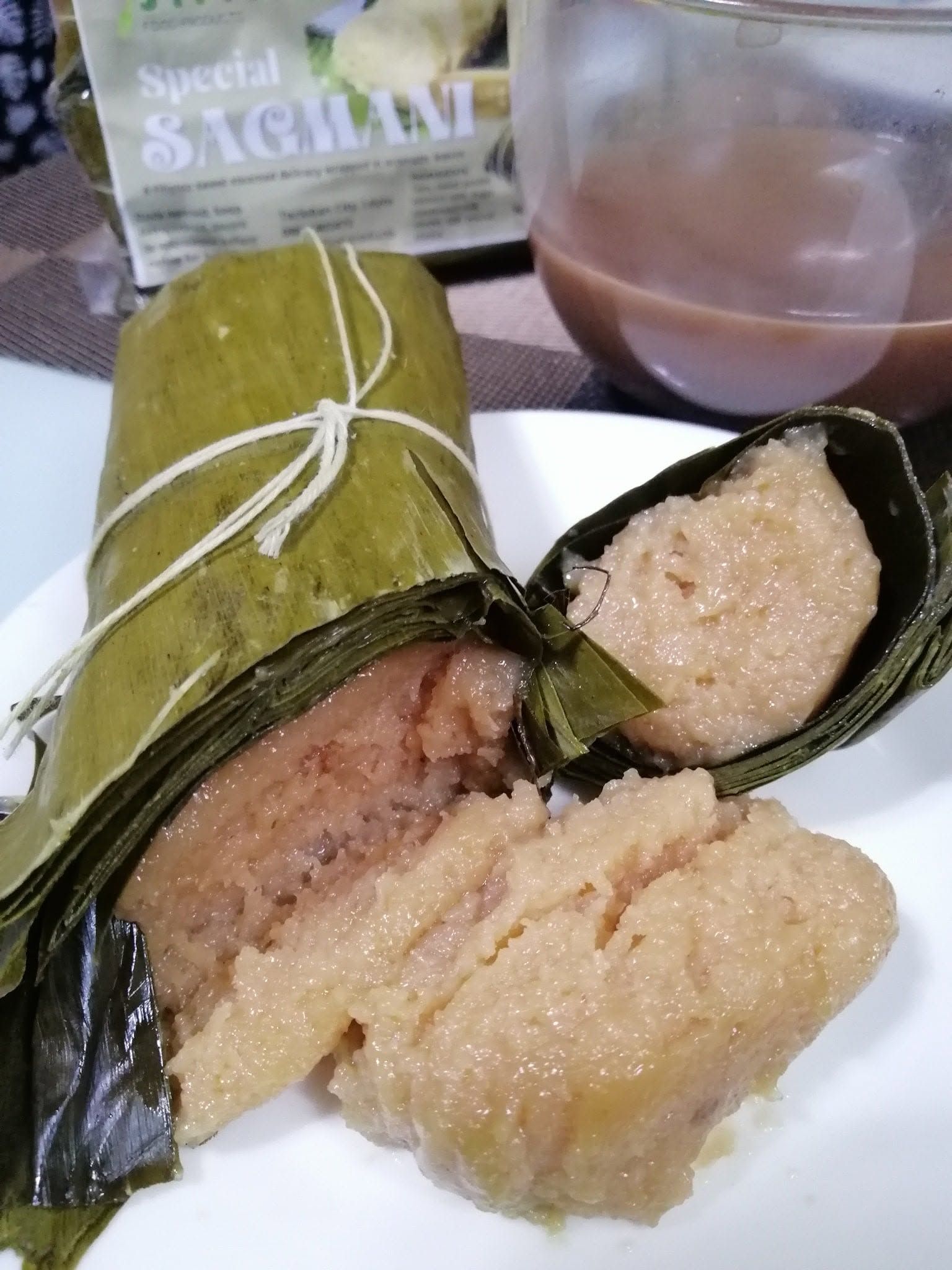

Made from grated taro, coconut milk and sugar, this traditional Waray treat brings together local ingredients and a painstaking preparation process that has endured through generations.
Beneath its simple wrapping of banana leaves lies a dense, sticky and sweet delicacy that carries the distinct flavors of Leyte.
Known as sagmani, this traditional Waray kakanin is made primarily from grated gabi, or taro, cooked with coconut milk, sugar and, in some preparations, peanuts before being wrapped in banana leaves and steamed.
Unlike ordinary rice-based suman, sagmani gets its characteristic texture from grated root crops.
Its consistency is thick and glutinous, almost like a soft, chewy pudding.
The sweetness of sugar blends with the rich, slightly nutty taste of taro, while coconut milk gives the mixture its creamy character.
The banana-leaf wrapping completes the experience. Once opened, it reveals a compact, moist mass of cooked root crop, its surface slightly glossy from the coconut-rich mixture.
The leaves also lend a subtle earthy fragrance, making the delicacy recognizable even before the first bite.
Sagmani is among the native delicacies associated with Leyte, sharing space with more widely recognized local treats such as binagol and chocolate moron.
While these delicacies differ in ingredients and preparation, they share an important feature: the use of locally available agricultural products transformed into familiar Filipino sweets.
According to a 2014 account published on the food blog Maybe I Should Learn Cooking, sagmani is traditionally prepared using grated gabi, sugar, coconut milk and boiled peanuts.
The writer, who identifies the delicacy as a distinctly Waray creation, also notes that some makers substitute sweet potato or cassava for taro, although the writer considers the latter versions closer to suman.
Preparing sagmani requires considerable time and physical effort.
The gabi is first peeled and grated before being combined with coconut milk, sugar and other ingredients in a cooking pan. The mixture is brought to a boil and stirred continuously to prevent it from sticking or burning.
As the ingredients cook, the mixture gradually thickens, changing from a loose combination into a heavy, sticky mass.
Reaching the right consistency is crucial. It must be thick enough to hold its shape when wrapped but soft enough to retain its characteristic chewiness.
Once cooked, portions are placed on heated banana leaves, rolled and secured at both ends. The wrapped mixture is then steamed, allowing the ingredients to settle into a cohesive, tender delicacy.
The process reflects the practical ingenuity of traditional Waray cooking, where root crops and coconuts are turned into affordable yet satisfying food. In communities where these ingredients are readily available, sagmani offers another way of making use of the harvest.
Its relationship with other Leyte delicacies has also helped establish its place in the local food trade. In a 2007 travel feature, Leyte: Binagol, Moron and Other Leyte Treats, travel writer Ivan Henares recalled seeing sagmani sold alongside binagol and moron by vendors along Zamora Street in Tacloban City.
He described it as a suman-like delicacy made from cassava, gabi or sweet potato, cooked in coconut cream and sugar, sometimes with grated coconut.
The delicacy continues to receive recognition as part of the region's culinary heritage. In April 2024, the Department of Agriculture and the Department of Tourism in Eastern Visayas featured sagmani among the traditional products displayed during a Filipino Food Month exhibit in Tacloban City.
The event brought together 15 exhibitors representing the provinces of Eastern Visayas, showcasing the region's diverse food products and local specialties.
For small-scale producers, these delicacies are more than food souvenirs. They are products that connect local agriculture with livelihood opportunities, allowing families and entrepreneurs to earn from recipes and cooking skills passed down through generations.
Sagmani may not have the elaborate packaging of commercially produced sweets, but its appeal lies in its honest ingredients and distinctive texture.
It is filling without being complicated, sweet without relying on elaborate flavorings, and memorable because of the combination of taro and coconut.
In every carefully wrapped portion is a familiar expression of Leyte's food culture: locally grown ingredients, patient preparation and recipes that have survived because people continue to make and enjoy them.
As traditional delicacies compete with commercially produced snacks and changing food preferences, preserving sagmani means keeping its preparation alive and giving younger generations a reason to appreciate it.
For Leyte, sagmani deserves recognition not simply as another item to bring home as pasalubong, but as a distinct culinary specialty whose flavor, texture and preparation tell a story of the province's enduring food traditions.
#OpinYon8news #Food