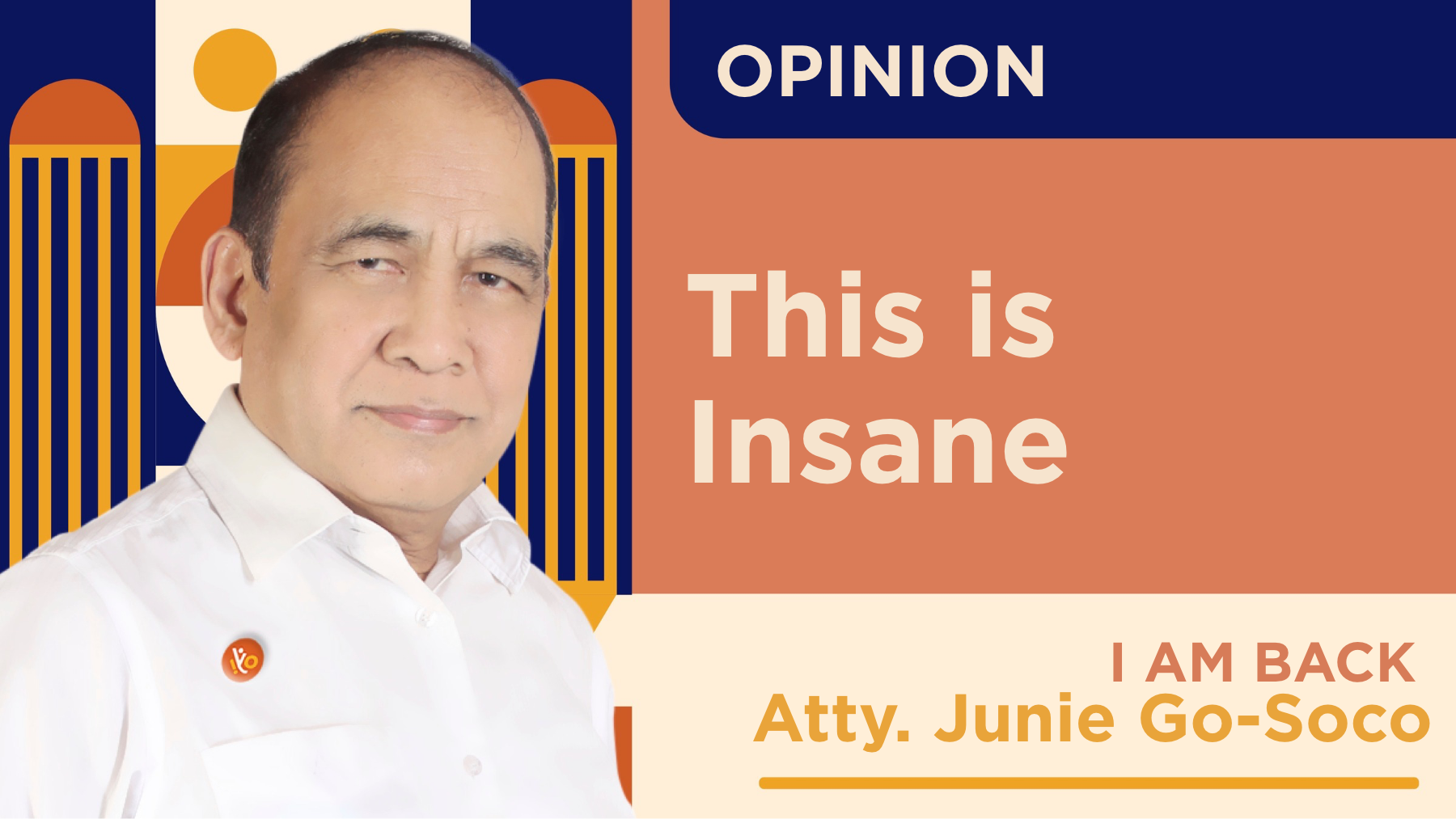

Where in the world can you find a legislature that violates the country's Constitution for a whopping 450 billion pesos in a single year (2024)? Answer: in the Philipp
This is a major implication of the country’s Supreme Court's recent decision.
Consider this: lawmakers violated the most fundamental law of the land, the Constitution.
Second, the amount involved is huge: almost half a trillion pesos in 2024, right before the 2025 local and mid-term elections.
The decision's main features clearly show that Congress padded unprogrammed appropriations when the budget bill reached It.
It was as if Congress could include any amount, as high as the sky. Sky is the limit, so to speak. And so Congress did.
The decision states that, as a general rule, the legislature cannot increase the budget bill the President submits for discussion and approval.
The Court recognizes that, in some instances, Congress may make unprogrammed appropriations subject to safeguards against abuse and to prevent empowering the President to decide on funding items not identified in the General Appropriations Act.
On top of this disregard for the above principle, the in-program appropriations are released when, in effect, there is no factual accounting that estimated collections have already been exceeded by actual collections, thus triggering the release of funds.
Also, the budget appropriation itself does not identify specific projects, allowing the President to decide on them. This practice bypasses the requirement that Congress identify and enact all projects.
This practice may benefit the President during implementation, but it circumvents the constitutional provision cited earlier.
All the above means that there should be no lump-sum funds that leave the identification of specific projects and allocations to the President after enactment.
The ruling also states that Congress must distinguish the circumstances for using new income and additional non-tax revenues for programmed versus unprgrammed expenditures.
This Supreme Court decision covered many practices of Congress from 2023 to 2026, all under the Speakership of Cong. Martin Romualdez.
So the question arises: what is the culpability of Cong, Romualdez? Can he face charges before the Ombudsman for his leadership role in the budget process that occurred when he was Speaker?
These are relevant questions in the current charge he faces before the Sandiganbayan, where he petitioned for bail in the ₱7.44 billion plunder case.
The recent decision extends his possible culpability to the time of budget process deliberations and approval. And not only to the execution of the budget through the implementation of projects funded out of the budget.
To borrow an expression used in the US: This is amazing, wild, and unbelievable.
This is what the decision states: Congress cannot use unprogrammed appropriations and the bicameral conference process to circumvent constitutional limits on the national budget or to delegate essential spending decisions without adequate standards and accountability.
#IamBack #Column #WeTakeAstand