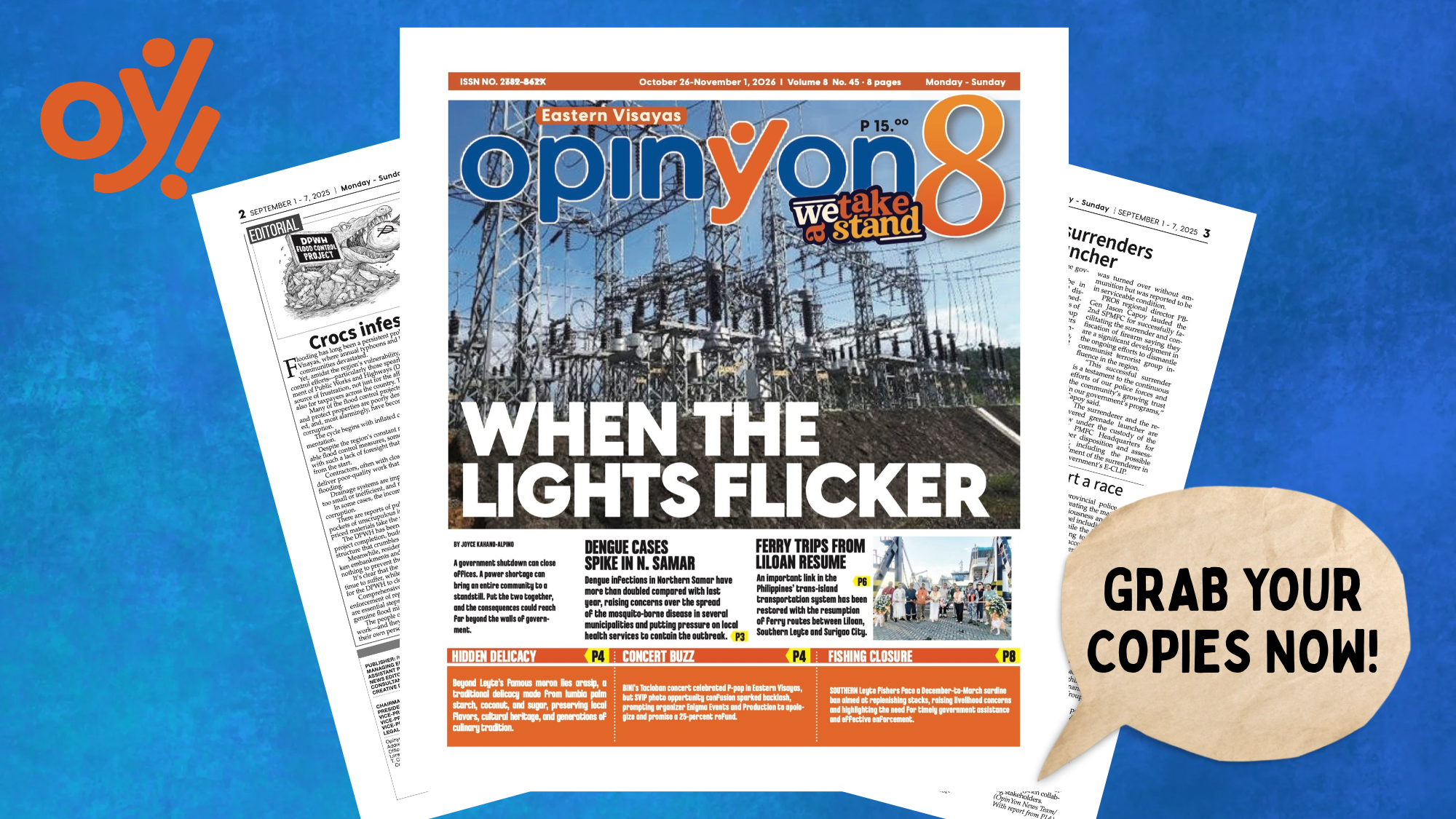

(Power, Water, Corruption: First of a series) A government shutdown can close offices. A power shortage can bring an entire community to a standstill. Put the two together, and the consequences could reach far beyond the walls of government. Eastern Visayas should pay attention.
On October 26, the National Grid Corporation of the Philippines (NGCP) announced a yellow alert for the Visayas grid from 5 p.m. to 6 p.m. Available capacity stood at 2,689 megawatts against projected peak demand of 2,473 MW.
On paper, supply exceeded demand. In practice, the grid lacked the operating reserves required to withstand another major disruption. Twelve power plants were on forced outage, while 16 were operating below capacity, leaving 650.3 MW unavailable.
That is the difference between having enough electricity for the moment and having a system resilient enough to survive the unexpected.
And the Visayas have already seen worse.
On October 20, NGCP reported only 2,468 MW in available capacity against peak demand of 2,545 MW. A 77-MW deficit.
The grid was placed under red and yellow alerts as plant outages and limited power imports from Mindanao tightened supply. A red alert means available supply cannot meet demand and required regulating reserves; interruptions may follow.
These are Visayas-wide figures, not measurements exclusive to Eastern Visayas. But the region is part of the interconnected system, and its households, businesses and public services are exposed to the consequences.
The problem is not simply a lack of megawatts. It is a lack of room for failure.
The Department of Energy has responded with efforts to restore generating units, address transmission constraints and accelerate battery storage deployment.
Its September 2026 announcement included plans for 253 MW of battery storage across Cebu, Panay, Leyte and Negros.
These are necessary interventions. They are not, by themselves, proof that the system's underlying vulnerabilities have been resolved.
Now consider the political dimension.
President Ferdinand Marcos Jr. has been reported as discussing a hypothetical government shutdown.
Any such remarks must be read in context: a political warning or hypothetical scenario is not evidence that government operations have actually been suspended. Nor would a shutdown automatically cause blackouts.
But what happens when an already strained electricity system faces a disruption in public administration?
Power generation and transmission require technical operators, regulatory oversight and coordinated emergency responses.
Electric cooperatives and distribution utilities must communicate with consumers.
Local governments and hospitals need contingency plans. Water utilities require electricity to pump and treat water. Telecommunications networks need power to keep people connected.
If a shutdown were to interrupt essential administrative functions, delay decisions or weaken coordination, the impact could compound an existing energy emergency.
The extent would depend on which agencies were affected, what continuity arrangements remained in force and how long the disruption lasted.
That is a risk scenario not a prediction. But responsible planning means examining it before a crisis arrives.
The burden falls hardest on ordinary people.
A small shop loses sales when its refrigerators fail.
A family pays for backup power or loses a day's income.
Students struggle to study.
Patients and frontline workers depend on facilities that cannot simply switch off when the grid falters.
For communities still rebuilding after disasters, unreliable electricity is more than an inconvenience. It is a brake on recovery and economic security.
The Energy Regulatory Commission's report on the October 1, 2025 earthquake in Cebu illustrates how quickly the system can unravel: the Leyte-Samar and Bohol sub-grids suffered a total power outage after the earthquake, prompting suspension of wholesale electricity spot-market operations in the affected sub-grids.
The episode was triggered by a natural disaster, not a government shutdown but it underscores the region's exposure to cascading disruptions.
The lesson is straightforward: resilience cannot be measured by whether the lights stay on during an ordinary evening. It must be measured by what happens when a major plant fails, a transmission link is constrained or a disaster strikes.
Government must publish clear contingency plans, utilities must explain recurring outages, and regulators must hold responsible parties accountable.
Battery storage can help. So can reliable generation, stronger transmission and transparent maintenance schedules. None is a substitute for the others.
Eastern Visayas cannot afford a system that works only when nothing goes wrong.
The lights may still be on. The real question is whether the system behind them is ready for the next shock.
#Coverstory #Opinyon8News