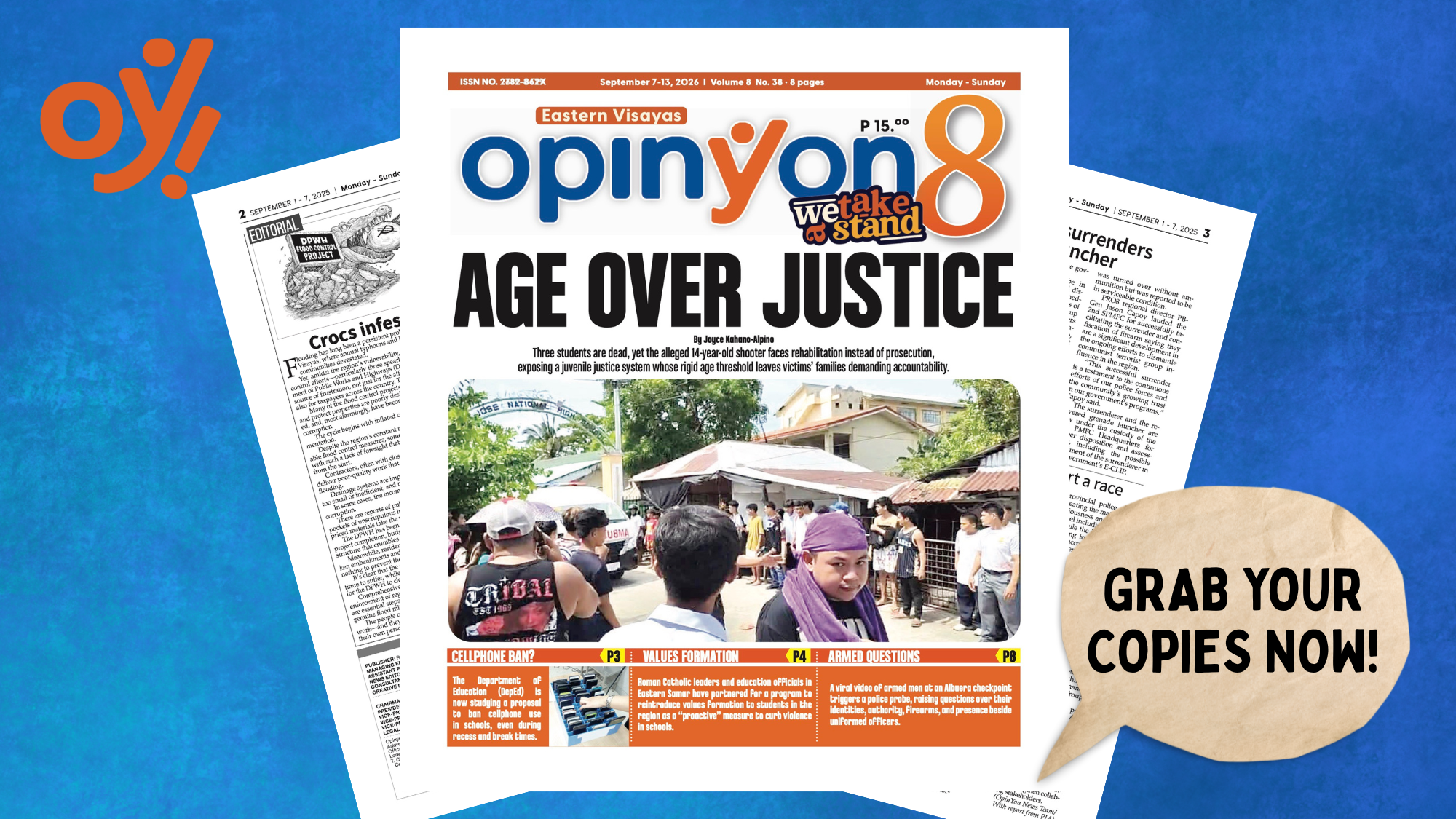

Three students are dead. Twenty others were wounded.
Yet the teenager accused of pulling the trigger walks a different path from the suspect who allegedly conspired with him, all because of a one-year age difference under Philippine law.
That contrast has become the most troubling question in the case.
On September 3, the Department of Justice ordered the filing of four counts of frustrated murder and six counts of attempted murder against the 15-year-old suspect.
Prosecutors said he acted with discernment and in conspiracy with the 14-year-old suspect. The cases will be filed before the Regional Trial Court in Tacloban City.
The 15-year-old already faces earlier complaints, including three counts of murder and two counts of attempted murder.
But the younger suspect who is the alleged shooter, is in a different legal category.
At 14, he is below the minimum age of criminal responsibility under the Juvenile Justice and Welfare Act.
He cannot be criminally prosecuted. Instead, he is subject to intervention and rehabilitation.
That may be what the law requires.
It is also where the law's limits become impossible to ignore.
The juvenile justice system was created on a sound principle: children are not miniature adults.
They are still developing, capable of change and deserving of rehabilitation rather than being swallowed by the criminal justice system.
But the Tacloban shooting forces a harder question:
What happens when the child needing protection is accused of causing catastrophic harm?
The answer under current law is stark. The younger suspect does not face a criminal trial or conviction. His case proceeds through rehabilitation and intervention.
Authorities stress that rehabilitation is not freedom. The boy remains under government custody and supervision.
But justice is not measured only by whether a suspect is confined.
For the families of those killed, there is a permanent consequence that no intervention program can undo.
That does not mean the country should abandon juvenile rehabilitation. It means the law must confront the rare cases that strain its assumptions.
The DOJ's finding that the 15-year-old acted with discernment is particularly significant.
It recognizes that a minor can possess an understanding of the consequences of extraordinarily grave violence.
Yet the law draws a hard line at 15: one year can determine whether criminal liability is possible at all.
That is the gap lawmakers should confront.
The case also reaches beyond the two minors.
Prosecutors recommended charges against Police Staff Sergeant Arla Ray Paciencia, the aunt of the 14-year-old, in connection with the government-issued Glock 17 allegedly accessed and used in the shooting.
She faces reckless imprudence resulting in multiple homicide and physical injuries.
Accountability, therefore, must extend to every adult whose actions or negligence may have enabled the attack.
But the central issue remains the juvenile justice framework itself.
A law intended to give children a second chance must not become so rigid that the gravity of an exceptional crime disappears behind an age threshold.
Three young lives were lost. Others were left carrying physical and emotional scars.
The country can believe in rehabilitation and demand a justice system capable of confronting extraordinary violence.
Those principles should not be enemies.
If the present law cannot reconcile them, lawmakers and not grieving families, must answer for the gap.
Because justice should protect children without making victims an afterthought.
#OpinYon8News #WeTakeAStand