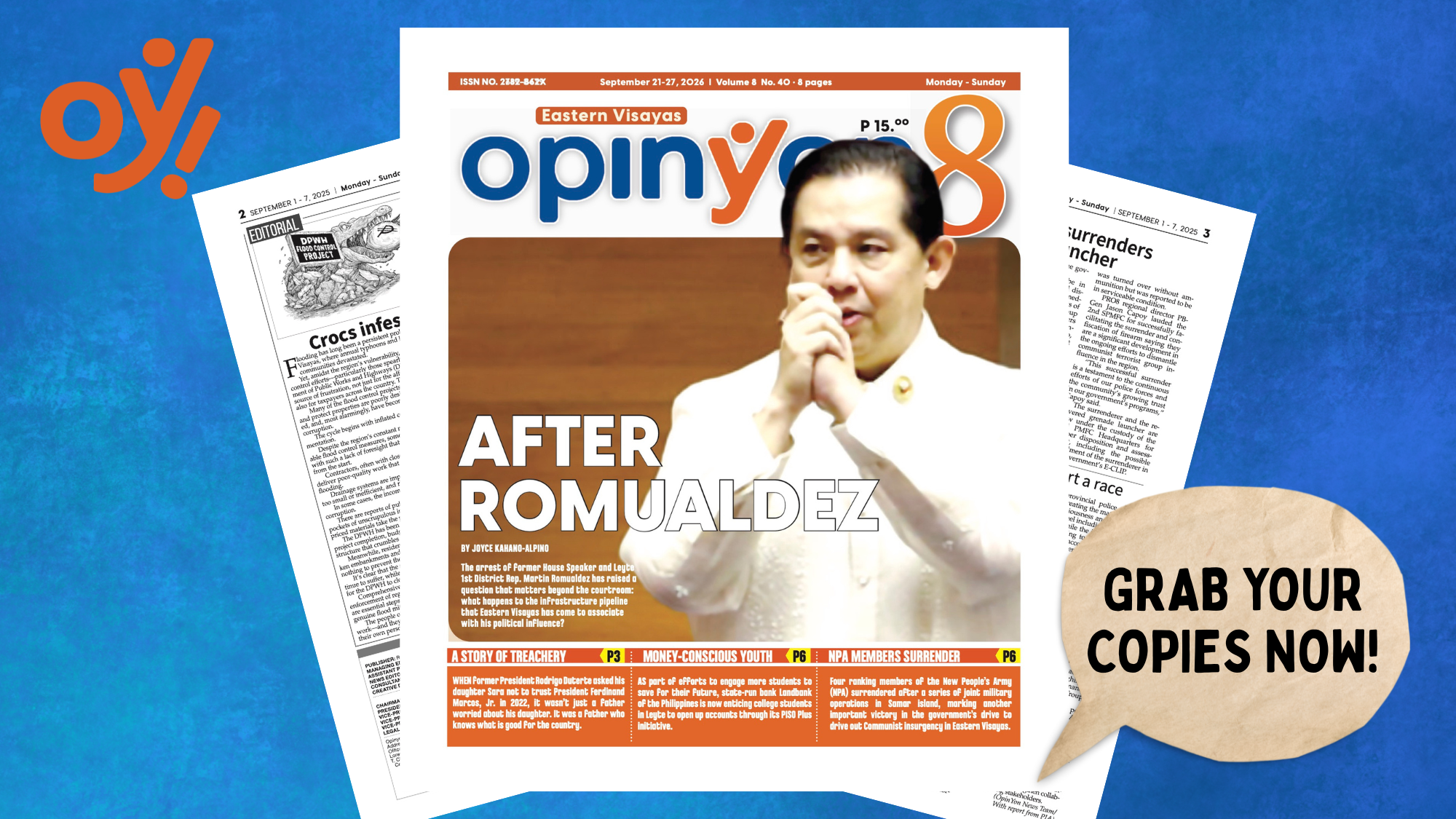

The arrest of former House Speaker and Leyte 1st District Rep. Martin Romualdez has raised a question that matters beyond the courtroom: what happens to the infrastructure pipeline that Eastern Visayas has come to associate with his political influence?
The short answer, based on the numbers currently available, is that Romualdez’s arrest does not automatically mean fewer infrastructure projects for Eastern Visayas.
But it does mark a potentially significant change in how projects, particularly those identified with political sponsorship, may be generated, prioritized and funded.
Romualdez was arrested on Sept. 7 after the Ombudsman filed a P7.4-billion plunder case alleging that he and three others benefited from commissions, kickbacks and other payments connected to government projects from 2022 to 2025.
Romualdez has pleaded not guilty, and the allegations remain subject to judicial proceedings.
The infrastructure question is particularly important in Eastern Visayas because Romualdez's political position coincided with an extraordinary increase in public works allocations to his home district.
According to analysts, DPWH budget records found that Leyte's 1st District received about P57 billion in DPWH funds from 2023 to 2025, making it the country's largest recipient during that three-year period.
The district was also allocated around P6 billion in the 2026 budget, still the largest allocation among congressional districts, according to DPWH documents.
But there is an important distinction: a project being associated with Romualdez is not the same as a project being legally dependent on Romualdez.
National infrastructure appropriations are enacted through the General Appropriations Act.
Projects already appropriated and under implementation do not disappear simply because the lawmaker associated with them has been arrested.
There is already evidence of this.
The P4.445-billion Tacloban-Palo Diversion Road, for example, remains under construction.
As of July 2026, DPWH-8 reported 42.30 percent overall physical and financial progress, with P2.332 billion already released under several General Appropriations Acts.
The project has a P2.1-billion funding gap, but its continuation is a matter of government programming and implementation and not Romualdez's personal status.
Likewise, the 2.55-kilometer Tacloban City Causeway remains slated for continuation.
DPWH-8 said six of its eight contracts have been terminated, one has been completed and another remains suspended because of obstructions involving electric posts and perimeter fences.
The agency said terminated portions could be rebid or proposed for future funding after inventory and validation by COA.
In other words, the immediate danger is not necessarily "no Romualdez, no projects."
The more consequential issue is whether projects previously advanced through political influence will continue to receive the same priority.
That question is difficult to dismiss given the scale of the previous allocations.
Reports show that the resubmitted 2026 National Expenditure Program initially contained nearly P10 billion for Leyte's 1st District before Congress reduced the amount by more than P4 billion in the final GAA.
Previous reports also indicated that Romualdez had been known to submit project requests to DPWH officials, with some subsequently appearing in the national budget proposal.
Yet Eastern Visayas is not entering 2027 with an empty infrastructure pipeline.
The Regional Development Council has endorsed P88.20 billion in infrastructure proposals among a broader P175.44-billion portfolio of proposed investments for FY 2027.
These proposals cover projects across the region, reflecting priorities identified by local governments, national agencies and other regional stakeholders.
The national infrastructure envelope is also expanding.
The Department of Budget and Management's proposed FY 2027 budget provides P643.95 billion for DPWH, P113.05 billion or 21.29 percent higher than its FY 2026 GAA allocation of P530.90 billion.
And Eastern Visayas' current priority list is not simply a collection of projects bearing the Romualdez name.
The region's Top 30 priority projects endorsed this month carry a combined investment requirement of P17.68 billion, covering flood mitigation, health facilities, airports, irrigation, ports, disaster resilience and other regional needs.
That could ultimately change the political equation.
For years, the region's infrastructure story has been intertwined with the extraordinary budget reach of a congressman who became House Speaker and one of the most powerful figures in Congress.
His arrest now puts that model under a much brighter national spotlight.
The real test for Eastern Visayas will therefore not be whether projects associated with Romualdez continue.
It will be whether projects continue because they are necessary, funded, technically ready and regionally justified, not because a particular politician has the power to push them.
For communities waiting for roads, bridges, flood-control structures, airports and other public facilities, that distinction could determine what happens next.
If the pipeline survives without the political machinery that once helped accelerate it, Eastern Visayas may discover that its infrastructure agenda is stronger than any single political patron.
If projects begin disappearing simply because their most powerful champion is gone, however, it would raise a different and more uncomfortable question:
Were these really regional priorities or political priorities wearing a regional label?
#OpinYon8News #Coverstory #WeTakeaStand