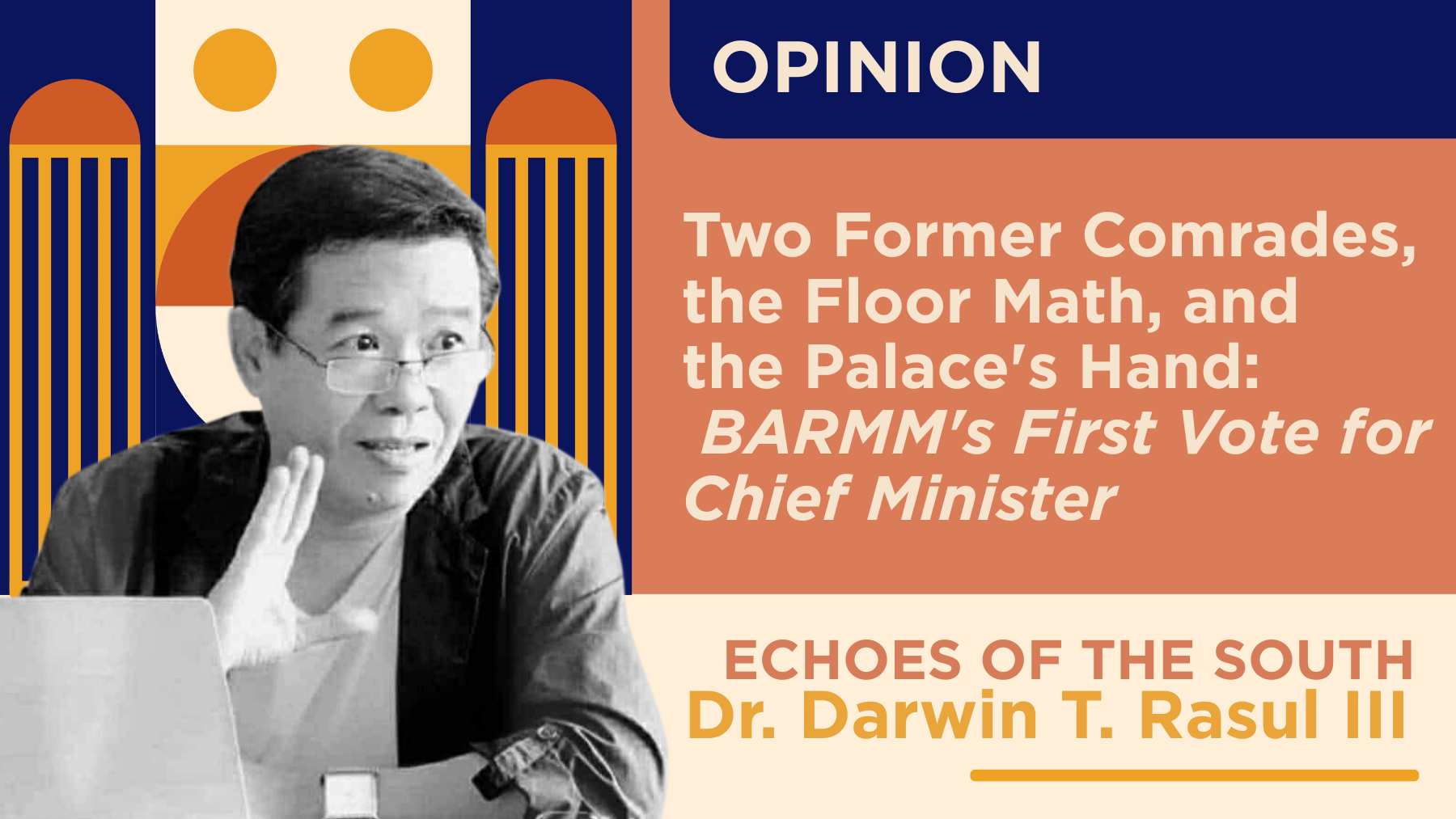

On September 14, the Bangsamoro people finally cast the ballot they had waited for seven years. More than 600 candidates contested seats in the 80-member Bangsamoro Parliament, with turnout reaching 82 percent of 2.39 million registered voters, about 1.97 million ballots cast — the highest in BARMM's history.
This is the third governing body built for Bangsamoro self-rule. The first two — the original ARMM in 1989 and its expanded 2001 version — let voters directly elect their governor and assembly, like any province. BARMM, the third and current structure, was different: created under the 2018 Bangsamoro Organic Law, it had never held an election. From 2019 to 2026, its Parliament and Chief Minister post were appointed by Manila, part of the peace roadmap giving the MILF time to normalize before facing voters. That day was the first time BARMM's leadership was chosen by ballot, not appointment.
Sulu was part of why the field narrowed early. Abdusakur Tan, then the governor, was the BARMM governors' pick to challenge Murad but did not push through after the Supreme Court, in September 2024, granted Sulu's petition for exclusion from BARMM territory, curiously after six long years after filing. That collapsed a potential three-way race into a straight contest.
But the September 14 ballot was only half the story. The more consequential vote comes once Parliament convenes to choose who will lead the region as Chief Minister — a race probably between only two men, Abdulraof "Sammy Gambar" Macacua and Ahod "Al-Haj Murad" Ebrahim, former comrades in arms for roughly five decades, first under the MNLF, later the MILF. That shared history makes their present rupture all the more striking.
Murad remains the movement's institutional face. He chairs the MILF central committee, presides over the UBJP, and served as interim Chief Minister from 2019 to March 2025. His party fielded the largest slate, 81 candidates. Macacua's road has been stranger, and rougher. He was installed as Malacañang-appointed transition authority head in March 2025, replacing Murad amid reported internal dissension, and later parted ways with his MILF posts.
Since then Macacua has served as interim Chief Minister and until recently as UBJP Secretary General, and MILF-BIAF Chief of Staff while running for Parliament as an independent, a choice he has defended as necessary to preserve his neutrality and ensure fairness among all sectors. He was also chosen to chair the rival BFP, appearing on the ballot unaffiliated, and thus deepening tensions with the UBJP.
That rift reportedly reached beyond caucus rooms. On August 15, Macacua's convoy was ambushed after his BFP swearing-in; three vehicles took gunfire, though no one was hurt. Investigators have named a person of interest, but no suspect or motive has been confirmed.
Climate Conflict Action Asia has tracked 611 violent incidents and 235 deaths region-wide this year — far above official tallies, since Comelec and the PNP validated only one incident as election-related, a gap officials read as peace and monitors as undercounting. The UP Sandatahang Dahas Monitor found BARMM had the country's highest number of state-related killings at 56 in 2025.
The votes are now counted, and the arithmetic looks closer than pre-election talk suggested. Of the Parliament's 80 seats — 40 party-list, 32 district, eight sectoral — the BFP won 31, ahead of Murad's UBJP at 30. The BARMM Grand Coalition took eight seats and the Serbisyong Inklusibo Alyansang Progresibo six, while the Raayat Democratic Party and Al Ittihad-UKB each secured one. Of the eight sectoral seats, two went to Non-Moro Indigenous Peoples, filled by independents chosen through customary law at an inter-tribal convention, two to settler communities, and one each to women, youth, traditional leaders, and the ulama. Members take their seats October 30, for a term through June 2031.
Who prevails once these 80 convene to choose the Chief Minister remains contested. Murad carries the weight of the MILF's central committee but no longer holds a clear seat edge; Macacua enters without the party machine that built his career, yet his BFP outpolled UBJP by one seat. The smaller blocs, and the two independent NMIP members, may hold the balance.
Malacañang's history argues against writing Macacua off: the national government has always intervened here before, since the inception of ARMM until most recently Marcos's installation of Macacua in March 2025 over the MILF Central Committee's reported objection. That instinct matters more now, since this election will have something to do with the 2028 national elections, and Marcos still lacks a clear standard-bearer against Vice President Sara Duterte, who leads early surveys.
My own reading: the floor math no longer clearly favors either man, so this contest may be less about seat totals than how far the Palace will go to assemble a coalition.
But the personalities and the arithmetic are the smaller story. What should have been remembered purely as a triumph in the Bangsamoro struggle for self-rule now carries a darker footnote, as reports of gunfire and coercion trailed a process meant to be defined by ballots alone. Any confirmed act of aggression deserves condemnation. A vote cast under a rifle's shadow is not free.
Three things are worth holding onto as Parliament prepares to convene: a debt to history, since the Bangsamoro Organic Law — signed under the Duterte administration as Republic Act 11054 — exists because generations paid in blood for the self-determination this election fulfills; a test of institutions, since Comelec carries the duty of protecting the returns and those who tallied them; and a test of restraint, since this election has been framed as a referendum on political maturity — whether old rivalries can be settled through votes, not gunfire.
What is beyond dispute is what this election represents for the Bangsamoro project — a milestone achieved after four postponements and now shadowed by violence that official security bulletins concede carries political overtones. In the coming days before Parliament convenes, the discipline shown by its members, security forces, and citizens will matter as much as any tally.
In the end, the truer measure will not be who takes the Chief Minister's seat, but whether the Bangsamoro people were finally allowed to shape their future freely and peacefully.•
____________________×
Dr. Darwin T. Rasul III is a political analyst, writing as a regular columnist of OpinYon. He has served as Expert-Consultant of European Union Germany, ARMM Cabinet Assistant Secretary (Asec.), Editor-in-Chief of ARMM Official Publication, and was a legislative researcher and then as consultant in the Senate of the Philippines. He is a book author and has written scholarly papers on political and historical issues about the Muslims in the Philippines.
#OpinYon #WeTakeAStand