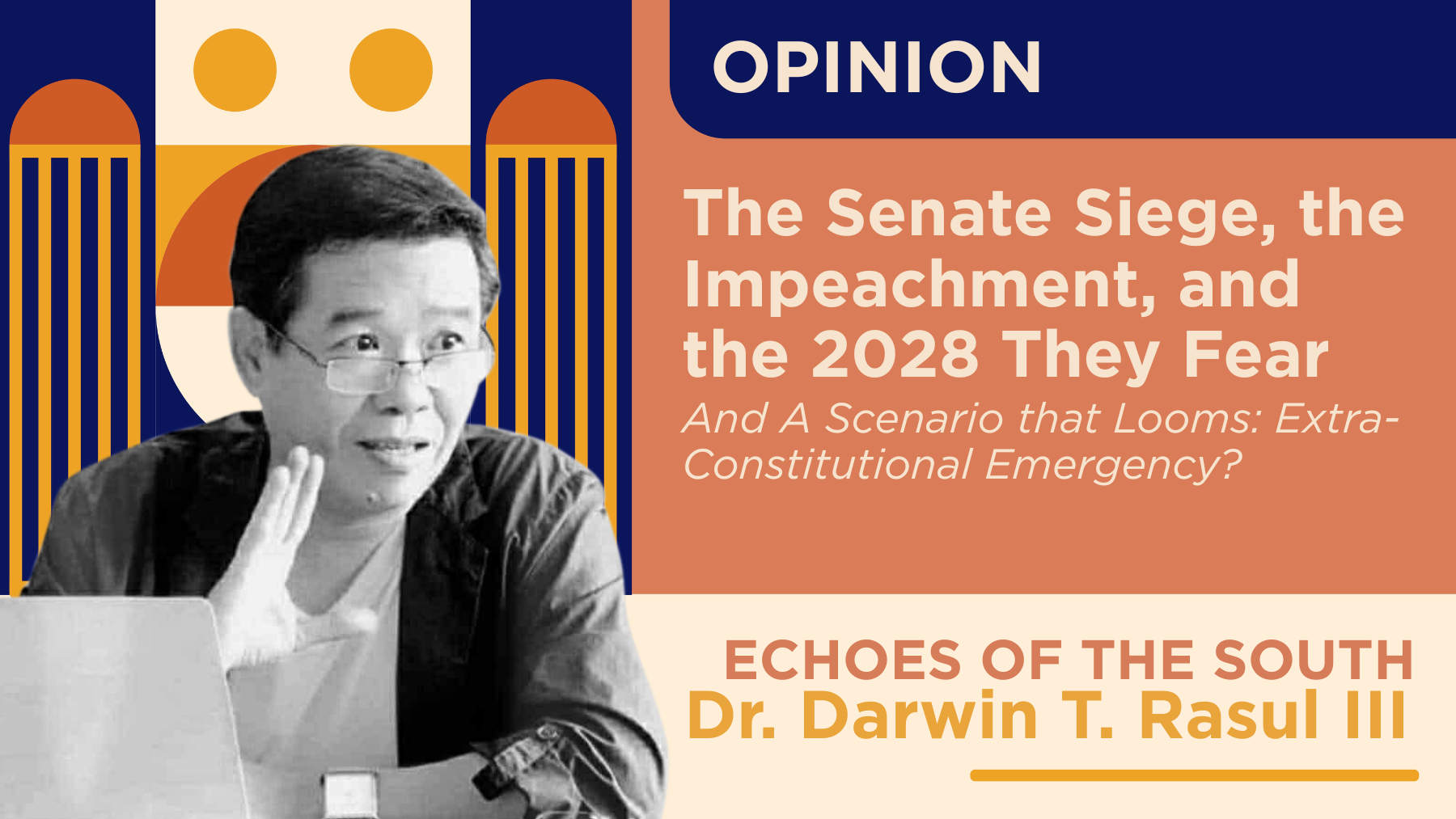

Strip everything down to its core, and one truth remains standing: this entire crisis — the warrant, the lockdown, the gunfire, the Senate in turmoil — exists because one overriding political objective is being pursued with every instrument available, and that objective is the impeachment of Vice President Sara Duterte. Everything else is a supporting move in that campaign.
The administration needs that impeachment to succeed. Sara Duterte is not merely a rival to be neutralized. She is the one figure with enough standing to win the presidency in 2028 — and whose victory would reopen old wounds powerful people have worked hard to keep closed. Removing her is not just politically convenient; for those with the most to lose, it is politically indispensable. Sara's allies are equally resolute, knowing what her survival means for the country's direction.
The first front was the Senate siege. This opening move failed.
The attempt to destabilize Senate leadership and prevent Senate President Alan Peter Cayetano from securing his position collapsed. The emergence of a new Senate President was not routine. It was a shift against the administration's impeachment design, placing the chamber under leadership far less accommodating to the outcome they required. That is why the response from the displaced bloc was immediate, aggressive, and without regard for institutional boundaries.
The second front was the threat to the Senate itself.
A lockdown was imposed. Personnel were reportedly manhandled. A gunshots were fired within the legislative compound. A senator was held under protective custody — valuable not only as an individual facing an international warrant, but as a vote upon which a fragile majority depended. The ICC warrant provided legal packaging; the timing revealed political content. A warrant pursued in good faith does not arrive at the intersection of a leadership transition and an impeachment transmittal. That convergence was not coincidence. It was political synchronization.
The third front was the convening of the impeachment court.
The battle has shifted from raw institutional pressure to the far more consequential question of where the twenty-four senatorial votes land. The siege was engineered to delay, intimidate, and fracture — to deny the Duterte bloc the footing it needed. It did not work. The administration must fight before a Senate whose leadership it did not install, and whose proceedings cannot be dissolved by chaos.
Beneath all of this runs a deeper current. The political configuration behind both the ICC warrant and the Senate leadership change is identical that is built on fear. Not ordinary anxiety, but the specific rational terror of those in the administration who know what a Sara Duterte presidency means for them. They pursued her father with identical relentlessness. That a Duterte return would compel a reckoning with long-deferred accountability does not merely concern the administration. It drives them.
And here is a scenario that political observers may raise in grave tones — not as prophecy, but as the logical destination of forces already in motion. Does this campaign escalate beyond the impeachment? The nation’s constitutional order may enter a vulnerable phase when democratic institutions become more exposed to political instability: a state of emergency declared, a pliant House repositioned as both legislative chamber and constitutional assembly, the Senate abolished, a new charter dismantling the presidential system in favor of parliamentary rule with the incumbent as prime minister. This is worse in every sense because it arrives wearing the face of constitutional legitimacy. This is not a forecast. This is the erosion of constitutional democracy drafted in anticipation.
The media treads cautiously. The military, under a chief of staff showing no signal of institutional independence, stands at ease. The political opposition fragmented by competing loyalties, unable to coalesce around anything beyond separate discontents. And both the Iglesia ni Cristo and the Catholic Church — formidable in numbers, yet immovable in action and in deafening silence, appear to have displaced conscience with self-preservation.
The present administration, believed by the fragmented opposition as trying to reshape this republic, is focused, resourced, and moving without hesitation to preserve themselves in power. The question now is whether democratic vigilance can still make a difference before the opportunity slips away.
That is the whole game. The Senate, as an Impeachment Court, is now the battlefield. The Constitution is the prize that ultimately hangs in the balance.▪︎
________________________________
Dr. Darwin T. Rasul III is a prolific feature writer, book author, and editorial opinion columnist. He was a political consultant in the Senate of the Philippines from 1988 to 1992. Dr. Rasul served as ARMM's Cabinet Assistant Secretary (Asec) from 2012 to 2019, and concurrently then the Editor-in-Chief of the regional autonomous government's official publication. He also served as a distinguished Expert-Consultant of the European Union (EU Germany) from 2021 to 2024. He is a regular columnist of OpinYon.
#WeTakeAStand #OpinYon #OpinYonNews #EchoesOfTheSouth