
We have lived through the usual consensus approach to national problems. It reflects the liberal idea of limiting state power through the social contract. Our Constitution is built on this idea: it protects citizens from excessive government control through checks and balances, individual rights, and democratic process.
Immanuel Kant, the 18th-century German philosopher who stressed the dignity and freedom of the individual under lawful government, in the Groundwork of the Metaphysics of Morals, stands behind this approach. But in the Philippine setting, it has shown its limits. Faced with corruption, insurgency, and crisis, a system built on slow consensus can be too divided to meet urgent needs. At such times, a Hobbesian corrective becomes necessary. Thomas Hobbes, the 17th-century English philosopher, argued in Leviathan that only a strong sovereign can guarantee peace and keep society from falling into disorder. National leadership must sometimes be firm and decisive to preserve unity and order. But strength alone does not make power legitimate.
Aristotle's classic study of governments, in the Politics, gives us the tool to judge that legitimacy: does the ruler serve the common good, or only private gain? A corrupted monarchy becomes tyranny; a corrupted aristocracy becomes oligarchy; rule by the many, corrupted, becomes mob rule. A government that uses the machinery of the state to enrich a favored circle, instead of serving the common good, has — by Aristotle's own definition — stopped ruling and started merely dominating, however constitutional its paperwork may look.
John Locke turns this into a sharper test of legitimacy. In the Second Treatise of Government, Locke held that political power is a trust: rulers are given authority only to protect the people's life, liberty, and property. The moment that trust is broken through selfish or arbitrary rule, its holders, in Locke's own words, "put themselves into a state of war with the people," and the trust is forfeited. Locke's test does not ask whether power was first gained lawfully. It asks whether it is still being used lawfully, day by day.
Étienne de La Boétie, the 16th-century French magistrate, answers a deeper question: why do the many obey the few? In his Discourse on Voluntary Servitude, he observed that no tyrant rules by force alone. Tyranny survives on the habit, indifference, or quiet cooperation of those it governs — from officials who sign what they are told to sign, to citizens who simply look away. Corruption on this scale is never the work of one man alone. It takes an entire chain of willing hands.
Nowhere is this pairing — Aristotle's corruption, Locke's forfeited trust — more visible than in the country's present economic wounds. Government hearings and official statements have pointed to the large-scale diversion of public infrastructure funds through padded, substandard, or fictitious projects, even as ordinary communities keep suffering the very floods those funds were meant to prevent.
This is the Hobbesian bargain broken in reverse. In Hobbes' own theory, the sovereign exists to turn a "war of all against all" into shared security. Here, by general account, the machinery of the state was turned instead toward private plunder rather than public protection. A sovereign that cannot protect its people from flood — because the very funds meant to build the flood walls were stolen — has failed the one bargain that gives its authority any meaning.
This capture of public money has come, observers note, alongside a tightening grip on the legislature itself: leadership built through patronage rather than principle, oversight of public funds that moves unevenly depending on political loyalty, and scrutiny of critics that moves quickly. No martial law has been declared. But a style of governing that squeezes dissent and consolidates control over both chambers of Congress does not need a formal decree to achieve the same result.
Here Kant's caution returns: if power is used to intimidate critics instead of prosecuting thieves, what is at work is not the legitimate Hobbesian corrective but its counterfeit — strength cut loose from law and order bought at the price of both liberty and the public treasury. And survival for whom, Aristotle would ask, if not for the common good the state exists to serve?
It is here that this essay's philosophical thread closes on an uncomfortable historical echo: the son now governs, in certain structural ways, much like the father he succeeded under a different name. Ferdinand Marcos Sr. ruled through a formally declared emergency and a compliant Batasang Pambansa built to approve, not restrain, presidential will. Ferdinand Marcos Jr. governs without any such declaration — through a legislative supermajority built by patronage, oversight in practice subordinated to executive priorities, and an alleged pattern of plunder whose main difference from 1972 is that it no longer needs a decree to operate.
The distortion of that history continues today: this year, the Supreme Court set aside Imelda Marcos's decades-old graft conviction, citing the prosecution's failure to properly authenticate key evidence and present a credible witness to it — a reminder that history can be unwritten by legal procedure just as easily as it was once written by force.
La Boétie's diagnosis fits both eras equally. The elder Marcos was sustained for two decades by the daily cooperation of technocrats and lawmakers who signed what they were told to sign. Today's diverted infrastructure funds are alleged to have moved through a similar chain of willing hands. Aristotle would call both regimes, whatever their formal titles, corruptions of legitimate rule — both accused of directing the machinery of the state toward private gain rather than the common good it was meant to serve.
History does not need a second declaration of martial law to repeat a father's essential offense. It needs only that the machinery of the state serve private hands rather than the public it was built to protect — and the philosophical record, from Aristotle to La Boétie, from Locke to Kant, has already given us the words to recognize this, whether or not a decree is ever signed.
In this balance of liberty and order — Kant's caution heeded, Locke's trust honored, Aristotle's common good restored — lies the possibility of a resilient Filipino nation: free yet secure, democratic yet strong, and one whose strength is measured not by how quietly dissent disappears or how much treasure vanishes, but by how faithfully the law is obeyed even by those who hold it.•
____________________×
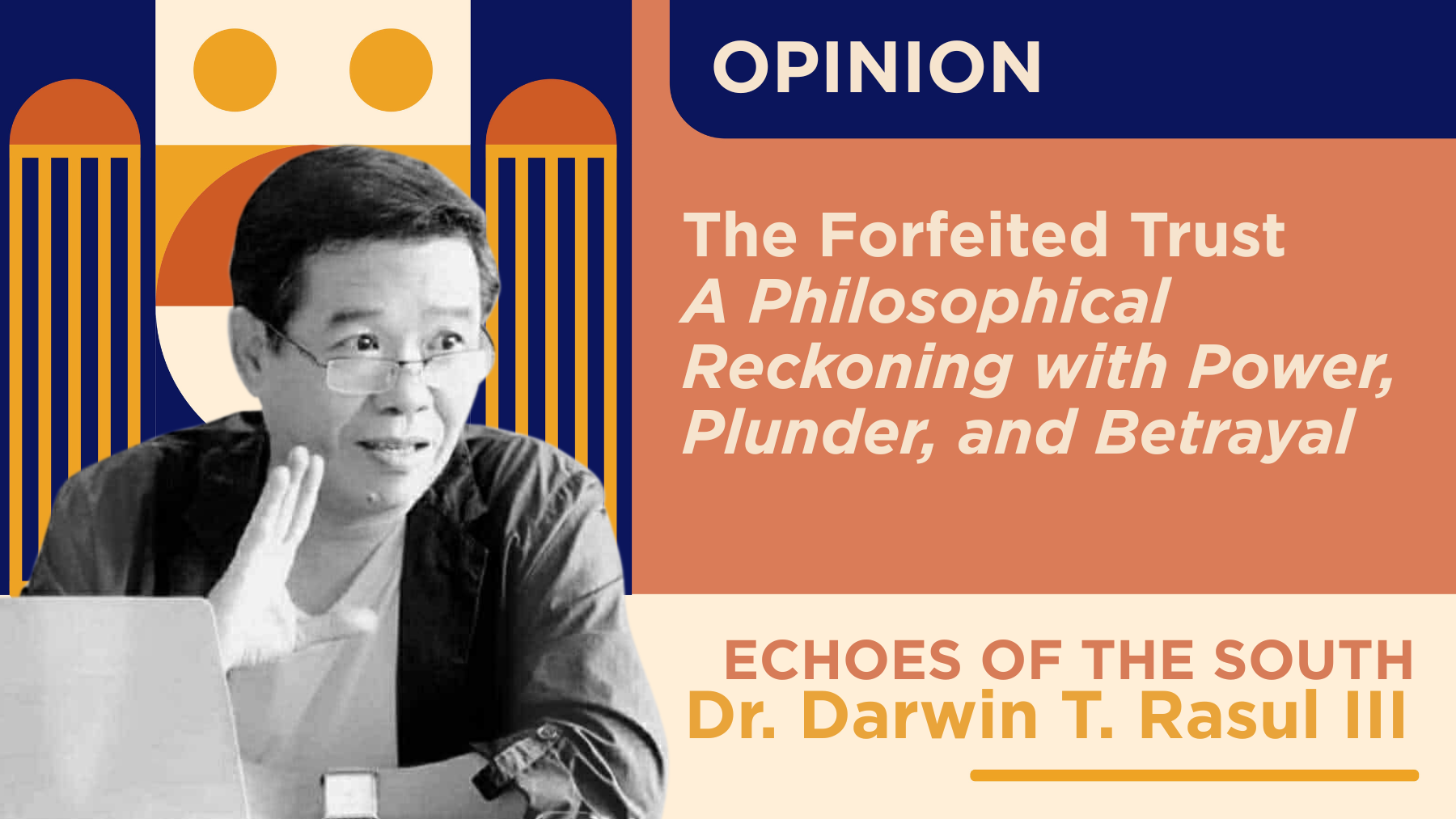
Dr. Darwin T. Rasul III is a political analyst, writing as a regular columnist of OpinYon. He has served as Expert-Consultant of European Union Germany, ARMM Cabinet Assistant Secretary (Asec.), Editor-in-Chief of ARMM Official Publication, and was a legislative researcher and then as consultant in the Senate of the Philippines. He is a book author and has written scholarly papers on political and historical issues about the Muslims in the Philippines.
#OpinYon #WeTakeaStand