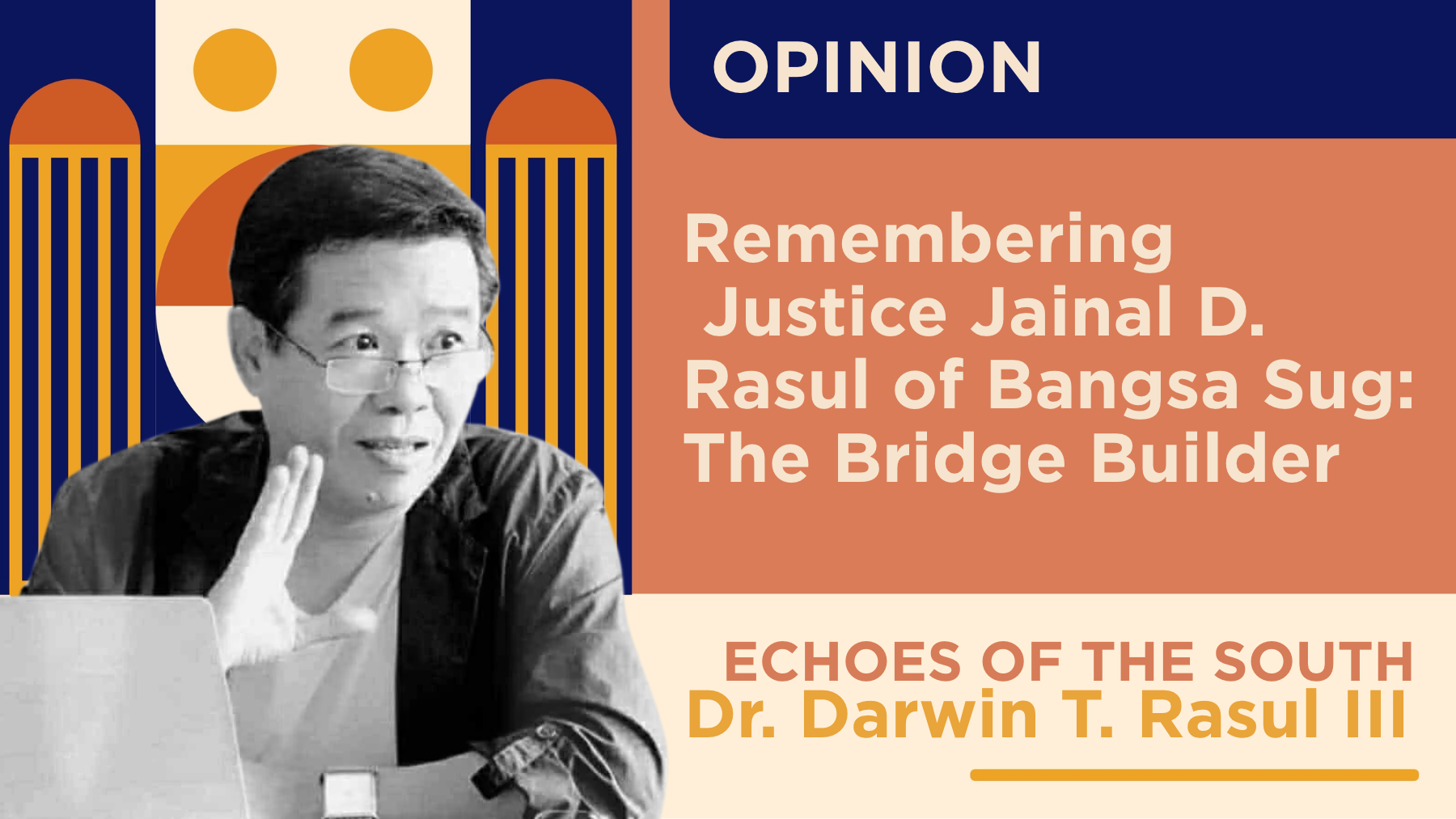

Some lives are best measured by the bridges they leave behind. By that measure, the late Justice Jainal D. Rasul was among Sulu's great builders. He linked Jolo to Manila, the Shari'a to the Civil Code, the mosque to the lodge, and the courtroom to the classroom, and he did so at a time when most Filipinos knew our province only through headlines of violence.
This column draws on the public record: court decisions, library catalogues, the Masonic press, and his own books. That record speaks for itself.
A Son of Jolo
Justice Rasul was born in Jolo on December 6, 1929, fourteen years after the Carpenter Agreement of 1915 stripped the Sultan of Sulu of his temporal authority. He was the grandnephew of Hadji Butu Rasul, chief minister of the Sulu Sultanate, whom Governor-General Francis Burton Harrison appointed under the Jones Law of 1916 as the first Filipino Muslim senator.
Justice Rasul's generation inherited two worlds: the Sultanate, with its adat and Islamic courts, and the Republic, with its constitution, civil code, and public schools. He chose to master the second without surrendering the first.
In 1954, President Ramon Magsaysay sent him to Karachi as the Philippine delegate to the First International Assembly of Muslim Youth. A year later, he earned his Bachelor of Laws from the University of the Philippines. He never stopped studying: constitutional law at an American Bar Association–sponsored conference for appellate judges in Lake Tahoe, Nevada; Islamic law and jurisprudence at Chulalongkorn University in Bangkok in 1984; and comparative family laws in Southeast Asia in Kuala Lumpur in 1997.
He married Lyding Rasul, and together they raised seven children, all of whom went on to build successful lives of their own.
Justice in Hard Times
Justice Rasul's legal career spanned more than four decades: three years in private practice with the Rasul, Tahil and Rasul Law Firm in Jolo, 13 years as a prosecutor, 18 as a trial judge, and a decade in the Court of Appeals.
He began as Assistant Provincial Fiscal of Sulu. It was modest work, but it kept him close to the daily lives of his people. He later became a Court of First Instance judge for Sulu, Tawi-Tawi, and Basilan during the region's darkest years. Jolo had been razed in 1974, and the autonomy promised at Tripoli in 1976 had stalled.
It was in that climate, under martial law, that he did what few judges then dared. In Dansalan, Basilan, he convicted soldiers for the massacre of civilian women and children. Bishop Jose Maria Querexeta, the Spanish-born first Prelate of Isabela, had asked former Senator Jose W. Diokno, founder of Free Legal Assistanve Group (FLAG), to act as private prosecutor, and the British Broadcasting Corporation (BBC) followed the trial closely. According to accounts of the case, President Ferdinand Marcos Sr., who had already muzzled the local press, asked British Prime Minister Margaret Thatcher to stop the BBC's coverage. She reportedly replied that she could not.
Later, as a Regional Trial Court judge in Pasig, he ruled in a case involving the UP Board of Regents that a public officer's tenure cannot be withdrawn at will; it may end only on the grounds and through the procedures the law provides. Public trust, in other words, is not a prize to be taken back on a whim. The Supreme Court upheld his ruling in 1991, and that safeguard still protects public servants today. For Justice Rasul, the law was a restraint on power: a shelter for the people, not a convenience for the powerful.
Law for a Plural Republic
On February 4, 1977, President Marcos signed Presidential Decree No. 1083, the Code of Muslim Personal Laws. Until then, the Civil Code had only temporarily allowed marriages under Muslim rites, a concession set to lapse in 1979. The Muslim Code made Muslim personal law part of the law of the land.
Justice Rasul helped the nation learn to apply it. In 1983, he sat on the Supreme Court committee that drafted the Special Rules of Procedure in Shari'a Courts. In 1984, he wrote Commentaries and Jurisprudence on the Muslim Code of the Philippines and a companion volume on Special Rules of Procedure in Shari'a Courts. After the Family Code took effect in 1988, he wrote Comparative Laws in 1994 which set the new code beside the Muslim Code, article by article, for a country now living under both. Lawyers and law schools still cite all three. His command of both codes was rare in his time, and it helped ensure that Shari'a was applied correctly across the country.
Justice Rasul also trained those who would apply it. He lectured for the Shari'a Bar at the Philippine Shari'a Institute from 1982 to 1995 and served as a Shari'a Bar examiner from 1984 to 1995. He was named an Asia Foundation Fellow in 1984, joined a 1985 Development Academy of the Philippines (DAP) roundtable on rewriting Philippine history, and lectured at the UP Institute of Islamic Studies.
Writing the Moro Story
Justice Rasul was a historian, too, writing for readers who had never been taught Moro history in school. In fact, the first of his 17 books, The Philippine Muslims: Struggle for Identity in 1970, drew sharply opposed reactions. Historian Gregorio Zaide reportedly called it "revolting," while Datu Bahjin, then foreign affairs chief of the MNLF, said it had inspired them to revolt. The next book he wrote was Muslim-Christian Land: Ours to Share in 1979. Then came Still Chasing the Rainbow in 1999, a compilation of Justice Rasul's essays and lectures of many years; in it, nearly two decades before federalism entered mainstream debate, he was already writing about many nationalities sharing one state. Then came Agonies and Dreams in 2003 and Islam and the Filipino Muslims in 2009.
Together, his books make a single case: that the land belongs to all who live on it, peace depends on sharing it justly, and no military solution will end a centuries-old conflict. Filipino Muslims are not a security problem with a religion attached. They are a people with a long history, a living law, and a rightful claim to dignity within the Republic.
The Appellate Years
On October 30, 1989, President Corazon Aquino appointed him Associate Justice of the Court of Appeals. He chaired its 14th Division from at least 1996 to 1999, and he became Presiding Justice, the first Muslim to hold the post. He might well have reached the Supreme Court, but the Judicial and Bar Council then limited nominees to those 68 or younger, a rule that closed what could have been his final chapter.
In his last years on the bench, the Supreme Court made him the first chairman of the Department of Shari'a and Islamic Jurisprudence of the Philippine Judicial Academy (PHILJA), and chairman of the 1997 and 1999 Shari'a Bar Examinations.
Beyond the Bench
Justice Rasul's bridge-building did not stop at the courthouse door. For almost a decade, he led the Sulu Cultural and Historical Society, Inc., guarding the very history he had worked so hard to put on paper.
The same spirit led him into Freemasonry. Raised a Master Mason in Bud Daho Lodge, he joined the Scottish Rite and rose through its ranks as Venerable Grand Prior, Venerable Lieutenant Grand Commander, and Sovereign Grand Inspector General at Large, until he reached its highest office: Sovereign Grand Commander of the 33rd and Last Degree of the Ancient and Accepted Scottish Rite Freemasonry of the Philippines. That, too, was a bridge: a Muslim son of Jolo leading a brotherhood of many faiths.
The Work Ahead
Justice Rasul's cause lives on in the struggle of Filipino Muslims to be recognized in the fullness of their history, their laws, and their identity, and to take their rightful place in the Republic. That struggle can be settled only through justice, understanding, and institutions that honor both diversity and unity.
Many of the problems he wrote about remain, and the work is not finished. But the bridge he built still stands, not as a monument but as an invitation: to choose dialogue over division, justice over force, and understanding over fear. The wounds of history need not be the next generation's inheritance. They can be its inspiration.
Justice Jainal D. Rasul spent his life insisting that two laws, many faiths, and one Republic could stand together on a single bridge. Keeping that bridge standing is now our task.•
_____________________________x
Dr. Darwin T. Rasul III is a political analyst, writing as a regular columnist of OpinYon. He has served as Expert-Consultant of European Union Germany, ARMM Cabinet Assistant Secretary (Asec.), Editor-in-Chief of ARMM Official Publication, and was a legislative researcher and then as consultant in the Senate of the Philippines. He is a book author and has written many scholarly papers on political and historical issues about the Muslims in the Philippines.
#Opinyon #WeTakeAStand