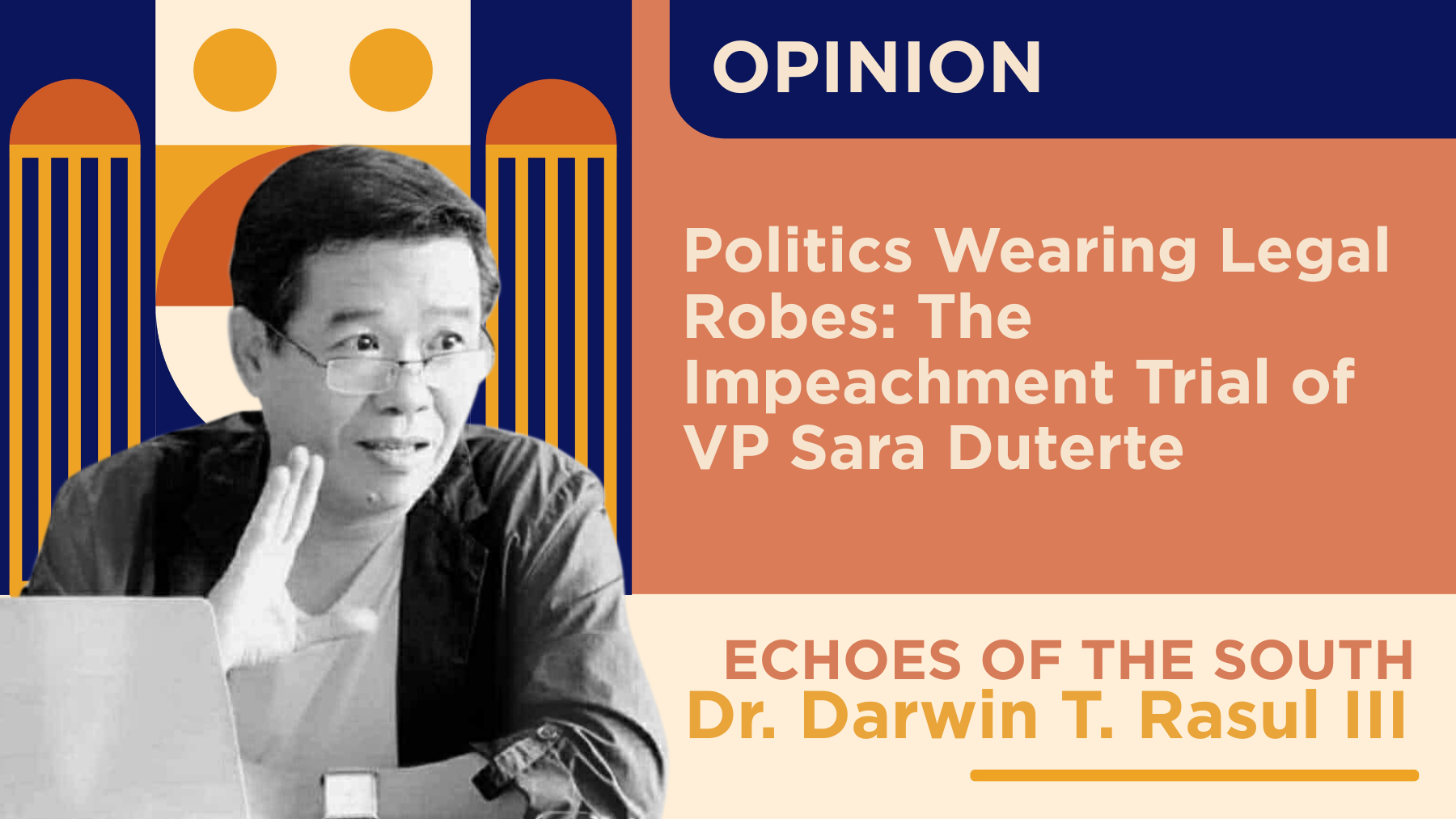

"The impeachment trial of Vice President Sara Duterte increasingly appears, to her supporters and many observers, less like a constitutional exercise and more like a campaign aimed at weakening her political standing ahead of 2028. The charges — betrayal of public trust, culpable violation of the Constitution, graft, and bribery — are undeniably serious. Yet the prosecution's presentation has invited criticism that it has been more theatrical than evidence-based. Recent surveys suggest that a large part of the public shares that view."
A TRIAL WITHOUT TRUST
Consider NBI Director Melvin Matibag. His appearance before the impeachment court drew significant attention, though critics argue his testimony added more political controversy than evidence. His credibility came under scrutiny after it became widely known that his wife, Laguna 1st District Representative Ann Matibag, had supported the House resolution that led to the impeachment articles.
The defense, for its part, said his testimony rested largely on secondhand information from a witness with an undisclosed household stake in the outcome, and argued that his family's involvement in the impeachment process should have been fully disclosed. Matibag has maintained that his role is separate from his wife's legislative work, but the arrangement still raises questions about how impartial he can be seen to be.
This is not to prejudge Matibag's motives or Duterte's guilt — that remains for the impeachment court to decide, and the presumption of innocence must hold. But the pattern is telling.
Critics likewise point to Matibag's own political history, as he was no stranger to Duterte-aligned politics. Matibag was PDP-Laban's secretary-general under Energy Secretary Alfonso Cusi's faction and actively campaigned for the Marcos-Duterte UniTeam ticket in 2022.
He broke from the party in October 2023 over disagreements surrounding congressional actions affecting the Vice President's confidential funds. In 2024 Daily Tribune columns, he referred to Sara Duterte as "Bratinella" — a term he said originated from her father, former President Rodrigo Duterte — and wrote critically about her survey standing. He was appointed NBI Director in February 2026, months before leading the probe that fed her impeachment.
The senator-judges have not inspired full confidence in the trial's fairness either. Questioning has split along the Cayetano-aligned minority and the Escudero-Gatchalian majority, at times reading more like cross-examination than judicial inquiry. Observers note that when senator-judges appear more engaged with one side than the other, public trust in the proceedings can suffer — creating the impression, fair or not, that political loyalties are competing with constitutional duty. This concern extends beyond Duterte's supporters. An OCTA Research survey, reportedly conducted July 4–11 among 1,200 respondents, found 71 percent of Filipinos want senator-judges guided by law and evidence, against 21 percent who favor political considerations.
Yet here lies the irony: the very public this impeachment was meant to persuade appears largely unmoved. Pulse Asia's latest survey, conducted June 28–July 3 among roughly 2,400 respondents, found 49 percent would vote for Duterte in a hypothetical 2028 presidential race, against 26 percent for former Vice President Leni Robredo, 14 percent for Senator Raffy Tulfo, and 1 percent each for Benjamin Dizon and Benjamin Magalong. General Nicolas Torre III registered 0.1 percent, with only 4 percent undecided.
Of the five matchups Pulse Asia tested, Duterte led every one — including a three-way race against Robredo and Raffy Tulfo, 51-27-16, and a contest against his brother, Senator Erwin Tulfo, and Senator Risa Hontiveros, where her lead widened to 56 percent. These figures do not point to a politician whose public support is collapsing under the weight of the allegations. Instead, they point to continued public doubt about the impeachment process and the narratives built around it.
Even the country's own pollster agrees. Pulse Asia President Ronald Holmes has observed that part of Duterte's continued strength may come from her supporters' belief that she is being politically persecuted — the impeachment simply the latest chapter in a longer fight that began with the confidential-funds probes and earlier impeachment attempts. If that reading is accurate, the people behind this impeachment may have unintentionally strengthened the very story they hoped to weaken.
Robredo, the opposition's strong alternative, has signaled she may skip a national bid, preferring a second term as Naga mayor. Yes she is being pushed into a contest she has not embraced, propped up by a bloc desperate for a face against Duterte's Mindanao base — a sign of how thin the anti-Duterte coalition remains.
WHERE THE TRIAL MAY LEAD
This trial will likely turn on political calculation as much as legal argument. Conviction requires sixteen of twenty-four senator-judges; based on current alignments, observers generally see that threshold as difficult, though not impossible, to reach.
The administration bloc commands roughly thirteen votes, three short. That math has grown more complicated as three senators identified with the Cayetano-led minority face separate legal troubles of their own, narrowing an already difficult path to conviction and complicating the final vote count. Jinggoy Estrada and Rodante Marcoleta face domestic plunder charges, while Ronald dela Rosa's situation is different: he remains in hiding, evading an arrest warrant from the International Criminal Court over the Duterte administration's anti-drug campaign.
The pressure has since widened. On July 31, the Ombudsman ordered a preliminary investigation into Senator Loren Legarda and her son Batangas Representative Leandro Leviste over alleged plunder, graft, and conflict of interest tied to a P10-billion solar energy franchise — a step the Ombudsman itself describes as one stage short of formal charges at the Sandiganbayan. Days earlier, Senator Panfilo Lacson turned over documents and testimony to the Ombudsman recommending plunder, malversation, and graft charges against Senate Minority Leader Alan Peter Cayetano over flood-control projects in his home district of Taguig. Cayetano has denied the allegations, calling them "malicious," while saying he welcomes the inquiry and will answer it in the proper venue.
Legarda, notably, moved into Cayetano's camp during the May Senate leadership shake-up and has since voted with the minority on several key impeachment motions. Observers say this string of legal actions against members and allies of the minority bloc has fed perceptions of mounting political pressure.
Either these developments are coincidental or politically driven — whether they are meant, as some suspect, to unsettle senators sympathetic to Duterte and push them back toward the majority — is a question drawing increasing public scrutiny. Either way, they have added another layer of uncertainty to an already heated trial and further complicated the Senate's political math.
Barring dramatic developments, however, the numbers still seem to tilt toward acquittal, leaving the prosecution to fight the political terrain as much as the legal case. Whether that reading ultimately holds remains to be seen. But not everyone shares this confidence. Former Defense Secretary Norberto Gonzales has warned Duterte's camp against complacency, noting the trial could follow the path of former Chief Justice Renato Corona, whose strong public support early in his trial did not ultimately save him from removal.
Favorable polling does not bind senator-judges, and momentum can shift once proceedings gather pace. Few politicians relish being on the losing side of a verdict the public seems to have already decided — even before a witness took the stand. Should acquittal begin to look inevitable, expect the familiar churn of Philippine politics: senators drifting toward Duterte for a comeback or in case she returns to power, while others stay close to the administration to keep gaining from it while it holds power.
None of this would be new — Philippine politics has long rewarded closeness to power over conviction of principle. The trial may ultimately produce not just a verdict, but the opening move of the next political realignment. Other political analysts offer a sharper, more provocative reading: those behind this impeachment, in this view, may be expecting a repeat of former Vice President Jejomar Binay's political downfall a decade ago.
Drifting toward Duterte for a comeback or in case she returns to power, while others stay close to the administration to keep gaining from it while it holds power.
None of this would be new — Philippine politics has long rewarded closeness to power over conviction of principle. The trial may ultimately produce not just a verdict, but the opening move of the next political realignment. Other political analysts offer a sharper, more provocative reading: those behind this impeachment, in this view, may be expecting a repeat of former Vice President Jejomar Binay's political downfall a decade ago.
Instead, the campaign against Duterte appears, in this reading, to be deepening loyalty to her, because the fight has grown bigger than her person — she is increasingly seen as the one figure willing to expose wrongdoing the administration would rather bury. Supporters of this view argue it reflects a broader rejection of the Marcos administration, with voters willing to accept real risk in trying to remove it. Ironically, some observers note, convicting Duterte would not close that door — it would open it for Senator Robin Padilla, who already leads potential senatorial preference surveys by a wide margin. This sentiment, in their view, reflects public dissatisfaction that goes beyond the impeachment proceedings themselves.
It is tempting to see the Constitution here not just as a check on power but as an arena where political power is fought over. Critics have drawn historical parallels between past efforts to sideline political rivals and today's conflict: the elder Marcos once moved to keep Ninoy Aquino from the presidency in 1974, while today, critics suggest, the son faces a similar need with Duterte and 2028. Such comparisons remain disputed and unproven, yet they help explain why many Filipinos increasingly see this impeachment as politics wearing the robes of law.
WHAT LIES AHEAD?
Readers should also watch what happens after the verdict, whichever way it falls. A Senate verdict may not necessarily end the legal fight.
The losing side could turn to the Supreme Court, not to re-argue guilt or innocence, but to challenge whether constitutional rules were properly followed. In that case, the High Court could be asked to step in if it finds a real constitutional question at stake — one the courts have the power to decide. Whether it would grant that request would depend heavily on the circumstances at hand.
Timing may matter more than most realize. A petition filed during or soon after the trial could still be unresolved when the 2028 campaign begins, and a court order pausing any penalty could leave the outcome hanging for months. Whether that changes Duterte's fortunes cannot be known in advance; it depends on how fast the High Court moves. The Senate may not have the last word — the Supreme Court could. And how quickly the High Court acts may carry real political consequences.
Another interesting issue has come up in legal commentary: former Supreme Court Associate Justice Adolfo Azcuna was said to have raised the possibility of separate Senate votes on Sara's removal as Vice President and on whether she stays eligible to run for President. In other words, Duterte could, in theory, lose the vice presidency through impeachment yet still remain eligible for the presidency in 2028.
Removal from office and a lifetime ban from public office, though usually bundled together in a Senate conviction, may in fact be treated as separate matters under the 1987 Constitution — an interpretation that has never been tested in Philippine impeachment history and remains a matter of legal debate. Still, it shows how questions of procedure may end up mattering as much as questions of evidence.
What lies ahead is not just a legal outcome but a political shift. Conviction could strengthen the belief among Duterte's supporters that she is a victim of political persecution. Acquittal, on the other hand, would likely raise questions about how strong the prosecution's case really was, and about the credibility of some of its key witnesses, whose impartiality the defense has already questioned. Either way, the more important verdict may already be written — not in the Senate, but in the surveys the trial was meant to overturn and may instead only confirm.
For many Filipinos, that judgment is already taking shape.
Political Analyst Dr. Darwin T. Rasul III is a regular columnist of OpinYon. He has served as Expert-Consultant of European Union Germany, ARMM Cabinet Assistant Secretary (Asec.), Editor-in-Chief of ARMM Official Publication, and was a legislative researcher and then as consultant in the Senate of the Philippines. He is a book author and a feature writer.
#OpinYon #Echoesofthesouth