
The impeachment trial of Vice President Sara Duterte is one of the most closely watched political events in recent Philippine history. Beyond the legal arguments lies a harder question: how much is this costing taxpayers, and what is it buying them?
Official figures put the trial's cost far below the billions once floated online. Early estimates ranged from under ₱1 million for basic essentials to roughly ₱126 million for the Senate's full impeachment-court operations, with about ₱26 million already earmarked and ₱500,000 spent before the trial opened. The confidential-funds allegation itself is also often overstated. The articles of impeachment cite not "100-plus million" but ₱612.5 million — ₱500 million tied to the Office of the Vice President, ₱112.5 million to the Department of Education.
Even that remains an allegation, not an adjudicated fact; the Vice President's camp maintains the funds were released through Malacañang's own budgetary process, with no proof of personal appropriation. Measured against this modest cost, the trial is not the runaway expense some have claimed online. The real question, then, is not whether it is a fair trade in pesos — it plainly is — but whether it is conducted fairly at all, a matter of motive more than money. And even so, how public money is spent remains a legitimate question.
Adding to public skepticism, are netizens urging Escudero, now the impeachment court's presiding officer, to close the proceedings and vote, arguing most Filipinos already sense the outcome will be political rather than judicial. Instead, they want attention redirected to the flood-control scandal, demanding who pocketed and where the huge money went. Accountability has a price, and that the Constitution provides impeachment precisely to scrutinize high officials if it protects democratic institutions.
Escudero has pushed back on the charge that the process is political theater, clarifying that the 16-vote threshold is grounded in the Constitution and jurisprudence — citing Bayan v. Zamora — not any pact among senators, each free to vote independently. Such strictness, he argues, reflects the mandate of millions of voters, comparable to the rigor of treaty ratification, and he hopes the Supreme Court will settle pending questions so the trial can finally close this chapter.
Yet a more corrosive cost may be at work — one measured in public confidence, not pesos. Many citizens believe several senator-judges will vote along pre-existing lines, splitting into familiar pro-Marcos and pro-Duterte blocs. This is not a judgment on any senator's motives; it is an honest reading of a Senate reorganized along factional lines this past year.
That reading gains weight from a pattern hard to ignore. Duterte ally Senator Jinggoy Estrada was arrested on a non-bailable plunder charge on June 1 over alleged flood-control kickbacks. Days before the trial opened, fellow Duterte-aligned Senator Rodante Marcoleta — then leading the Senate's flood-control probe and set to sit as an impeachment judge — was likewise charged with plunder and arrested. Senator Ronald "Bato" dela Rosa, also Duterte-aligned, remains in hiding after the ICC unsealed a warrant against him in May.
Days before NBI Director Melvin Matibag was himself due to testify against the Vice President, he abruptly revived a years-old probe into a 2019 SEA Games project then chaired by Minority Leader Alan Peter Cayetano, a Duterte ally and sitting senator-judge. Alan Peter and his sister, Senator Pia Cayetano, branded it intimidation timed to pressure a judge mid-trial. Given how closely such moves track the trial's calendar and its Duterte-aligned targets, critics see a broader design: sidelining enough minority senators as if the administration-aligned majority can still muster sixteen votes without them.
Of course Malacañang denies political motivation, and each respondent retains the presumption of innocence. Still, the clustering itself invites suspicion of interference in what should be an independent trial. Where one principle, regardless of political position, should unite all Filipinos, every peso spent by government must be justified and transparent, and every verdict must rest on evidence, not arithmetic.
Then there is also the electorate. The Vice President was elected in 2022 with more than thirty-two million votes, one of the largest mandates in Philippine history. That base is unlikely to be swayed by any verdict, and will read the outcome as political rather than judicial.
There is a bitter historical echo in this. Nearly four decades ago, EDSA I toppled a dictatorship on the promise that principle would finally outweigh power. Yet some of that revolution's own heroes — Juan Ponce Enrile chief among them — later stood beside the son of the man they had helped depose, lending him legitimacy on his path back to Malacañang. If EDSA's own defenders could trade conviction for alliance, the same trade may be unfolding now, as senator-judges weigh political survival against the evidence before them.
Democracy is not free — but neither should it be hollow. The Senate must show Filipinos that truth, accountability, and stewardship of public funds and public trust can go hand in hand.
The ultimate question is not simply how much this costs. It is whether the nation, at the end of this exercise, can honestly say it received what it paid for: not a foregone conclusion dressed in procedure, but truth that convinces the skeptical, accountability that outlasts headlines, and trust that numbers alone cannot buy.
______________________×
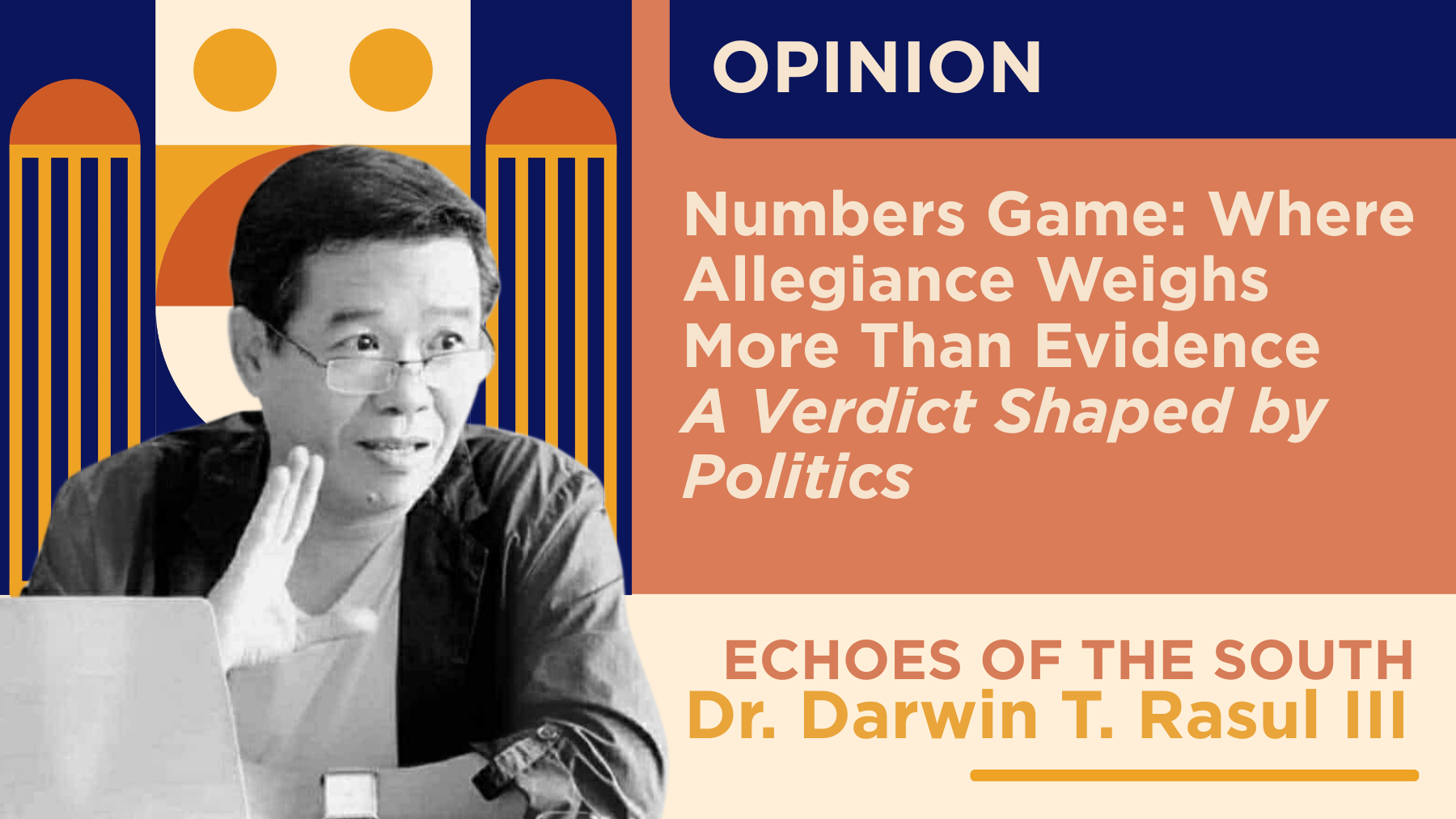
Political analyst Dr. Darwin T. Rasul III is a regular columnist of OpinYon. He has served as Expert-Consultant of European Union Germany, ARMM Cabinet Assistant Secretary (Asec.), Editor-in-Chief of ARMM Official Publication, and was a legislative researcher and then as consultant in the Senate of the Philippines. He is a book author and a feature writer.
#WeTakeAStand #OpinYon #OpinYonNews