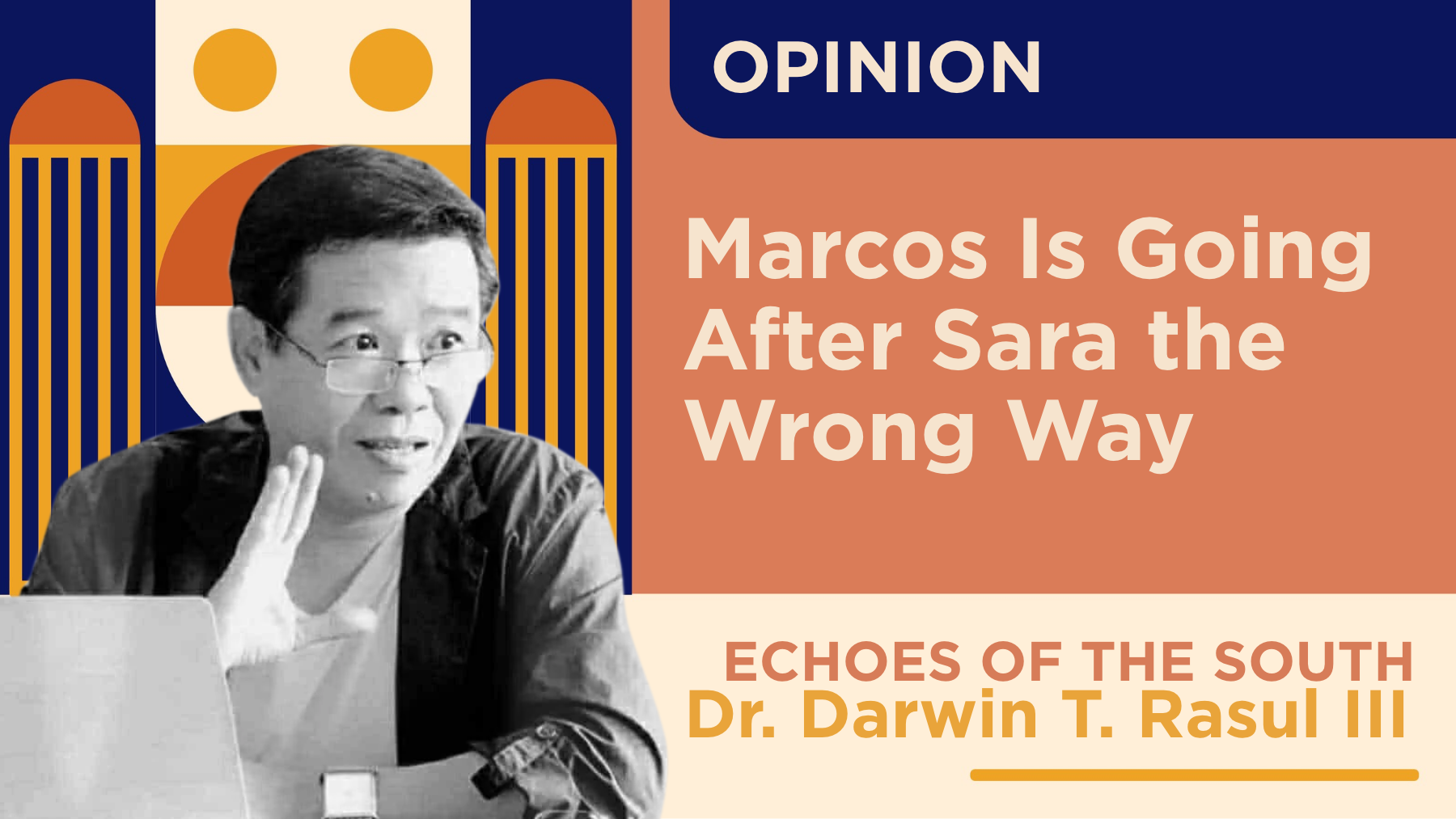

The administration is throwing its full weight into bringing down Vice President Sara Duterte, yet she remains far more popular than the President.
In June, Social Weather Stations (SWS) found 58 percent of Filipinos satisfied with Sara's performance, a "good" net rating of +31. Marcos Jr. stood at -7. By September, the Daily Tribune reported, he had slipped to a "poor" -11, with only 35 percent satisfied and 46 percent dissatisfied. That is the irony: the less popular leader is pursuing the more popular one.
Since May, Vice President Sara Duterte has been under siege. The House impeached her. The Justice Department charged her with three counts of grave threats. On September 4, a Quezon City court ordered her arrest, setting bail at ₱120,000 per count; she posted bail the next day. At her Senate impeachment trial, now past its 34th day, prosecutors allege ₱6.7 billion in unexplained wealth, and an Anti-Money Laundering Council official has presented bank records. Taken together, these look to me like calculated moves: one woman, many institutions, one direction.
Experts disagree on whether the impeachment trial and a criminal case may run at the same time. Article XI of the Constitution lists the grounds for removing the highest officials: culpable violation of the Constitution, treason, bribery, graft and corruption, other high crimes, and betrayal of public trust. Only Congress can remove Sara while she is in office: the House impeaches, and the Senate tries her. One school of thought holds that criminal prosecution should come only after the Senate convicts and removes her.
Senate President Sherwin Gatchalian says a verdict could come before the end of November. I expect a guilty verdict, not because the evidence must lead there, but because many perceive that the Senate majority has already made conviction a foregone conclusion. A conviction carrying disqualification would bar Sara from the 2028 presidential race.
This is my reading of the political dynamics, not a finding on the evidence. No vote on guilt has been taken, and Sara deserves a fair trial.
Consider the Senate's own move. The Constitution requires two-thirds of all senators, or 16 of 24, to convict. On September 23, the impeachment court voted 13–1, with six abstentions, to compute two-thirds based only on the senators able to take part. Four cannot: Jinggoy Estrada and Rodante Marcoleta, detained on plunder charges; Ronald "Bato" dela Rosa, at large under an International Criminal Court warrant; and Loren Legarda, on medical leave. With 20 senators left, 14 votes now suffice under the majority's ruling. Among those who voted for the new threshold were Raffy Tulfo, Erwin Tulfo, Francis "Kiko" Pangilinan, Panfilo Lacson, and Vicente Sotto III. I name them because, in my reading of their public statements and their gestures during questioning witnesses at the impeachment trial, they are likely to vote for conviction.
Note the timing: two colleagues jailed and a third being sought by authorities, and some senators may fear being next. In May, agents tried to arrest dela Rosa at the Senate; he slipped away. Estrada was arrested on June 1. Marcoleta, a Duterte ally, was arrested on July 6, only hours before the impeachment trial opened, after the Sandiganbayan issued a warrant. All three are presumed innocent. Yet under the majority's ruling, their votes no longer count, and each absence lowered the bar for conviction. In my view, that outcome obviously serves the administration's interests, to say the least. I claim no proof of orders, threats, or motive; the record is public, and the public can judge.
Then there is the Supreme Court. Three petitions sought to strike down the new threshold. The Court did not decide the constitutional question; it dismissed all three for lack of standing and because they were premature. Premature? The Senate court has already adopted the rule, and it already governs a live trial. When, then, is the right time — after the verdict, when the question is already moot?
Just recently, on October 6, the question returned to the High Court. Undeterred by the earlier dismissals, Senators Robin Padilla and Bong Go, joined by PDP-Laban, lawyers, and private citizens, asked the Supreme Court to restore the 16-vote threshold for an impeachment conviction. Will the High Court act on their petition? In my view, it would still be in favor of the administration.
And adding to my skepticism are on the cases involving Imelda Marcos, the President's mother. The Supreme Court acquitted her of seven graft counts over Swiss foundations allegedly holding at least $200 million, reversing her 2018 Sandiganbayan conviction. Prosecutors failed to prove guilt, the justices held, and key bank records were unverified. But acquittal is not innocence: the High Court did not declare the money clean.
Filed in 1991, the case was resolved under her son's presidency. Dated June 10, the ruling surfaced on September 9, days before the birthdays of Marcos Sr. and Marcos Jr. and just before the martial law anniversary. Coincidence, perhaps, but why did relief reach one family after many years, just as pressure tightened on Sara? Add to this the June's closing of a case over the Marcoses' alleged ill-gotten wealth, after the PCGG said it had recovered most of the assets and would present no more evidence.
Filed in 1991, the case was resolved under her son's presidency. Dated June 10, the ruling surfaced on September 9, days before the birthdays of Marcos Sr. and Marcos Jr. and just before the martial law anniversary. Coincidence, perhaps, but why did relief reach one family after many years, just as pressure tightened on Sara? Add to this the June's closing of a case over the Marcoses' alleged ill-gotten wealth, after the PCGG said it had recovered most of the assets and would present no more evidence.
Set these moves side by side: a House that impeached, prosecutors who filed charges, a court that issued a warrant, a Senate court thinned by arrests and eased toward conviction and, by all indications, a Supreme Court that seemed to wait until after the impeachment verdict. Each may have its own legal basis, and no single ruling proves a plan. But the contrast is plain: Sara's cases move fast; the Marcoses' fade. To me, that looks like design, though I offer no proof of coordination.
Here is the danger ahead: those pushing this strategy should remember that political power is temporary, and accountability can outlast any presidency. Removing Sara from the ballot does not remove the millions of supporters who have backed the Dutertes nationwide for a decade now. They will find another candidate.
When push comes to shove, that candidate may well be her brother, Davao City Mayor Sebastian "Baste" Duterte, as a potential 2028 presidential candidate. In Tangere's recent hypothetical 2028 presidential survey, Baste Duterte topped the field with 29%, while Senator Bong Go placed second with 26%; the remaining candidates registered lower percentages. Reports say their mother wants Sara to return to Davao so Baste can carry the banner. Mayor Baste has brushed off the idea before, but a blocked Sara may change the calculation.
Picture 2028, less than two years away, and think of the waste: political capital spent removing one Duterte, only to face another. The target changes; the threat does not. In my judgment, the next President is still likely to be a Duterte, and for Marcos Jr. and his circle, that could be a nightmare. People have called Rodrigo Duterte's arrest and transfer to The Hague a kidnapping. They will not forget who they believe took part in it, nor the senators who would judge his daughter.
Today, Marcos Jr. and his circle hold the levers of government. In less than two years, those levers could turn against them: plunder and other cases could be filed wherever evidence supports them, respondents could be barred from leaving the country, and, if convictions are secured, today's confident officials could be sent to prison. This is a political forecast, not a finding. Any case must stand on evidence, and every respondent deserves the same presumption owed to Sara.
The cases and Senate powers now aimed at Sara will not vanish; they will change hands. Those who use power against opponents may one day answer for it.
The Filipino people are watching and waiting.•
____________________×
Dr. Darwin T. Rasul III is a political analyst, writing as a regular columnist of OpinYon. He has served as Expert-Consultant of European Union Germany, ARMM Cabinet Assistant Secretary (Asec.), Editor-in-Chief of ARMM Official Publication, and was a legislative researcher and then as consultant in the Senate of the Philippines. He is a book author and has written published scholarly papers on political and historical issues about the Muslims in the Philippines.