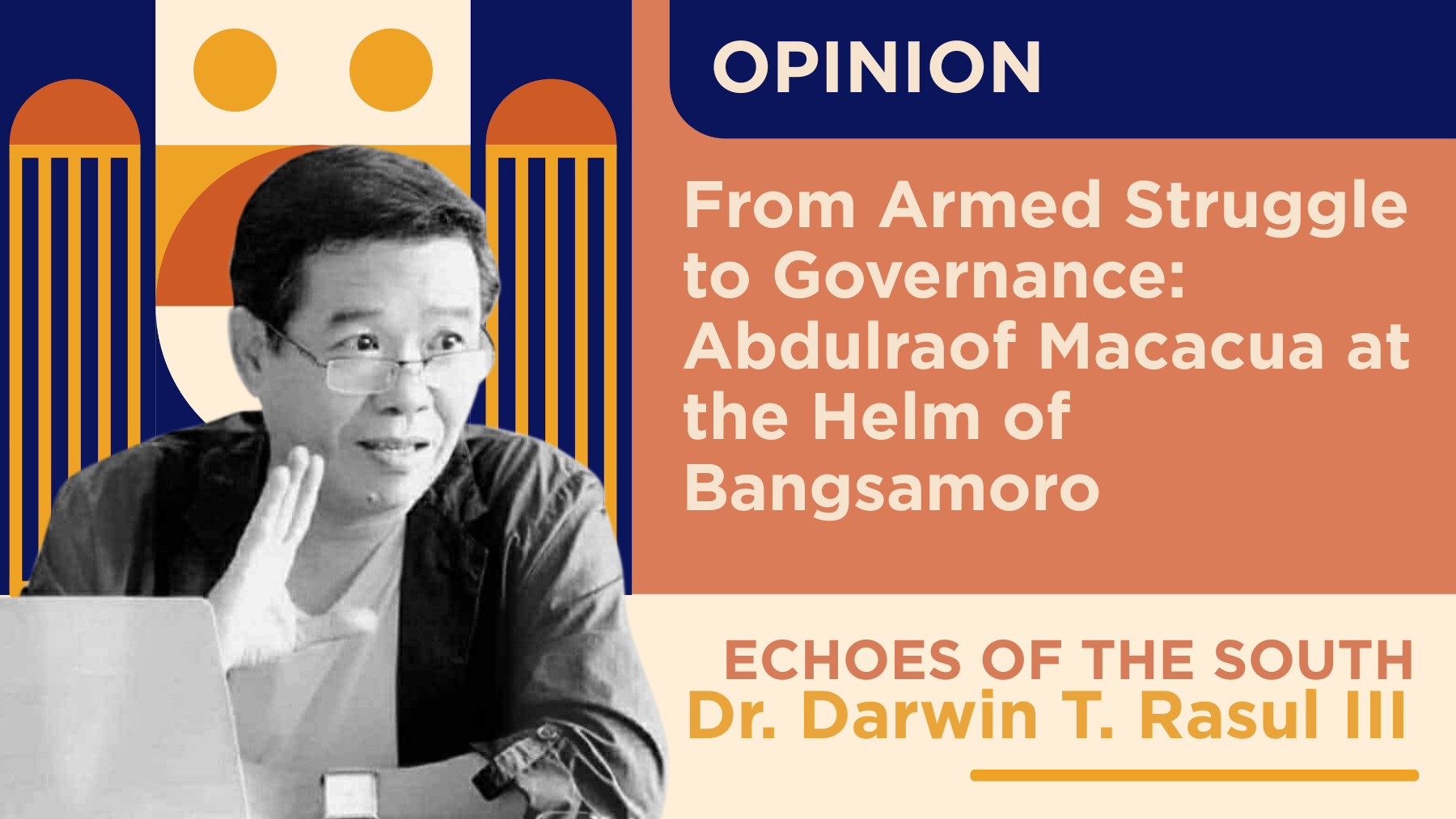

The Bangsamoro Autonomous Region in Muslim Mindanao (BARMM) reflects the transition of Moro political actors from armed formations into formal governance institutions. This trajectory is embodied in the career of Abdulraof Macacua, whose public life spans participation in Moro armed movements, engagement in peace negotiations, and executive service under the Bangsamoro Organic Law framework. His experience illustrates the passage from conflict-era organization to autonomous regional administration...
The Bangsamoro Autonomous Region in Muslim Mindanao (BARMM) reflects the transition of Moro political actors from armed formations into formal governance institutions. This trajectory is embodied in the career of Abdulraof Macacua, whose public life spans participation in Moro armed movements, engagement in peace negotiations, and executive service under the Bangsamoro Organic Law framework. His experience illustrates the passage from conflict-era organization to autonomous regional administration.
Born in 1957 in Maguindanao, Macacua grew up during sustained conflict in southern Philippines involving Moro groups and the state. In his early years, he was linked to the Moro National Liberation Front led by Nur Misuari, where he took part in field-level activities during its armed campaign. This period coincided with internal debates over ideology, leadership direction, and the future of negotiations with government.
These tensions deepened after the Tripoli Agreement of 1976, which created a framework for autonomy but also exposed divisions within the movement. A key figure in this divergence was Hashim Salamat, who emphasized a more explicitly Islamic orientation and a sustained revolutionary approach. His position eventually led to the formation of the Moro Islamic Liberation Front, which charted a separate course from the MNLF.
Macacua later aligned with the MILF and became part of its command structure. Within the organization, he was known by the field name “Sammy Gambar,” derived from Barangay Gambar in Maguindanao, where he had early community roots. Such identifiers were used for coordination and security during periods of armed activity. Within the MILF hierarchy, he served as chief of staff of its armed wing under Murad Ebrahim, operating within a structured chain of command focused on discipline and coordination during the conflict period.
As the movement transitioned toward negotiations, Macacua became part of the peace process that produced the Bangsamoro Organic Law in 2018, which established BARMM in 2019. The law replaced the previous autonomous arrangement and created a parliamentary regional government with expanded fiscal and administrative authority, reshaping governance in the region.
Following BARMM’s establishment, he served as Minister of Environment, Natural Resources and Energy, overseeing regulatory and resource management functions. He later became Senior Minister in the Transition Authority, supporting coordination among ministries during the early formation of regional institutions and ensuring administrative alignment across agencies.
He was subsequently appointed Governor of Maguindanao del Sur after the former Maguindanao province was divided under Republic Act No. 11550 into Maguindanao del Norte and Maguindanao del Sur. His responsibilities included establishing provincial administrative systems and ensuring continuity of public services during the creation of new local government structures.
In 2025, Macacua was appointed Chief Minister of BARMM, becoming head of the regional executive government. The position includes directing ministries, implementing policies under the Bangsamoro Organic Law, and overseeing programs under the Bangsamoro Development Plan, placing him at the center of executive coordination in the autonomous region.
His administration operates within an evolving governance environment where institutional systems continue to be strengthened following BARMM’s establishment. Execution of government programs depends on coordination between ministries and alignment between regional and local administrative structures.
The bureaucratic framework of BARMM remains under refinement, requiring leadership focused on maintaining operational stability and ensuring that institutions function within their legal mandates. This includes sustaining public service delivery across provinces and newly organized administrative units.
Macacua’s role reflects the integration of former Moro armed actors into civilian governance under the peace agreement. This shift forms part of the institutional design of the Bangsamoro framework, which replaces armed contestation with governance exercised through formal political and administrative institutions.
His governance approach is defined by adherence to legal mandates and emphasis on execution across departments. Policy direction is implemented through coordination mechanisms linking ministries and local government units.
As Governor of Maguindanao del Sur, he oversaw provincial setup following the division of Maguindanao, organizing administrative offices and maintaining uninterrupted basic services during structural transition. Within BARMM, executive continuity supports institutional functioning during ongoing state formation, with Macacua’s position reflecting the progression of Moro leadership into formal governance structures under the Bangsamoro system.
At its core, Macacua's career illustrates how authority once exercised through armed organization has been redirected into bureaucratic responsibility within an autonomous political system still in transition and defining its institutional maturity.
Dr. Darwin T. Rasul III is a feature writer, book author, and editorial opinion columnist with extensive experience in governance and political consultancy. He started his career as a legislative researcher and political consultant for some senators in the Senate of the Philippines from 1988 to 1992. He later served as ARMM's cabinet assistant secretary for seven years from 2012 to 2019, during which time he was also editor-in-chief of its official publication. From 2021 to 2024, he was engaged internationally by the European Union (EU), Germany, as a distinguished expert-consultant, who wrote and annotated the legislative briefs of all laws passed by the Bangsamoro Transition Authority (BTA-BARMM). He is currently the chief editor of the Bangsamoro Free Press and columnist of OpinYon.▪︎
#Columnist #FromArmedStruggletoGovernance #OpinYon #OPINION