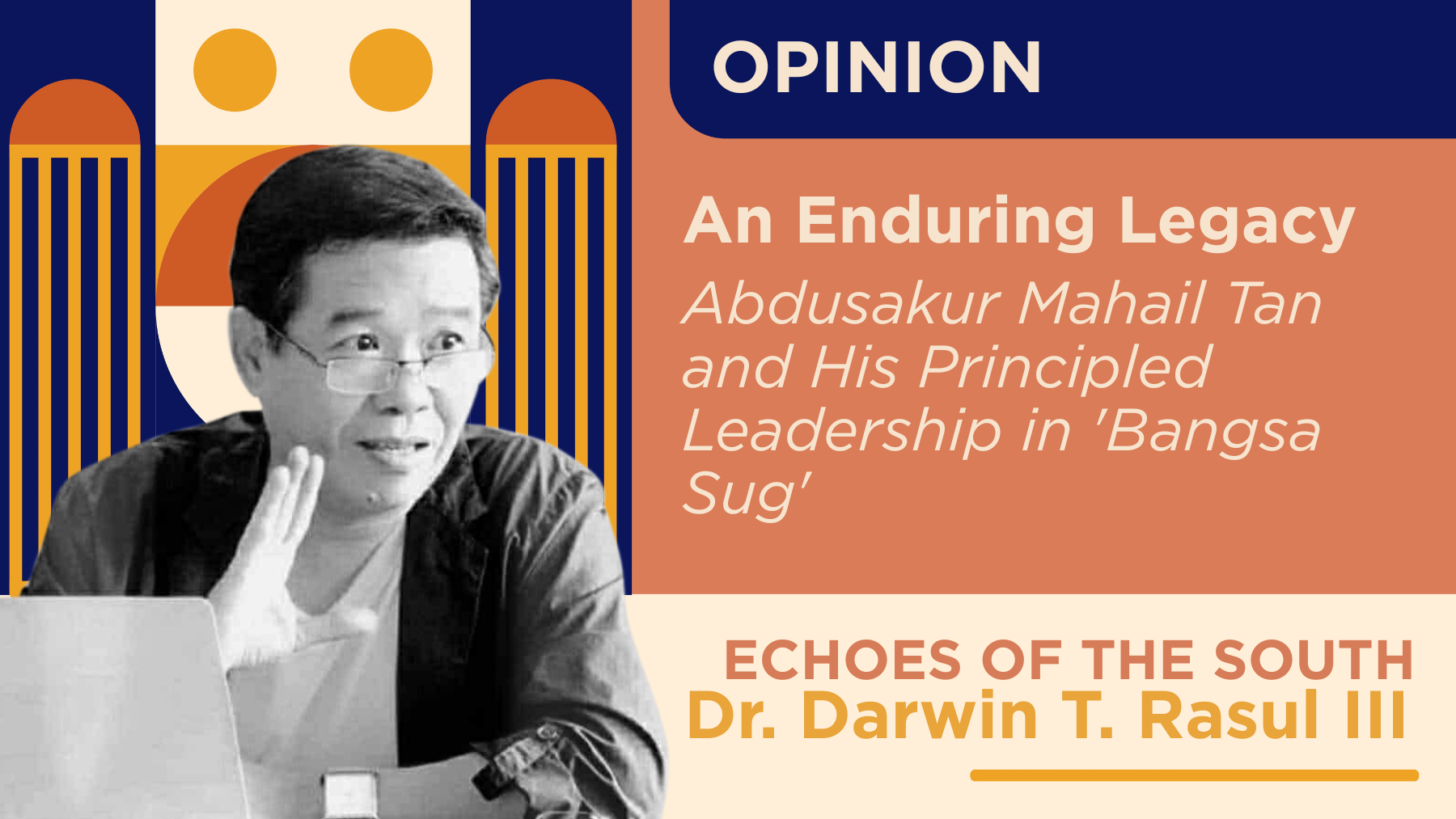

In Philippine politics, extended tenure in public office naturally invites scrutiny. The question is never whether longevity matters, but what it reveals about the relationship between leaders and those they serve. In the province of Sulu we call Bangsa Sug, Abdusakur "Sakur" Mahail Tan has held public trust across decades, a tenure that reflects sustained electoral confidence in a province where such trust is neither easily granted nor lightly maintained.
Known with deep affection and reverence as "Boss Papang" by his constituents, Sakur Tan is no accident of political branding. It emerged organically from the people themselves, a testament to bonds forged through decades of genuine presence, care, and steadfast leadership.
Beyond the surface of politics and public office, his leadership has always been grounded in accessibility and responsiveness. Constituents recall not just grand gestures, but the countless small acts of attentiveness — listening to concerns, providing guidance, and ensuring that no community felt neglected. This deep personal connection has created a legacy of trust that transcends electoral cycles, defining him not merely as a politician, but as a figure who embodies the hopes and resilience of the people he serves.
In the Tausug language and culture of Bangsa Sug, "Papang" means father, protector, the one who provides and guides with unwavering devotion. To be called "Boss Papang" is to be recognized not merely as an official who governs, but as a paternal figure who understands his people's struggles, celebrates their joys, and stands with them through adversity. It is a title earned through consistent compassion, through being present in moments of crisis and celebration alike, through leadership that feels less like imposed authority and more like guidance offered by one who genuinely belongs to the community he serves.
Sakur Tan's distinguished career has traversed local government, national legislation, and many terms starting as Jolo municipal councilor, congressman, vice governor, then provincial governor, and now back as vice governor. Such continuity in a province long marked by armed conflict, geographic isolation, and historical neglect speaks to the exacting standards of Sulu's electorate. In Bangsa Sug, public trust is hard-won and swiftly withdrawn when leaders falter. That Sakur Tan's mandate has endured reflects confidence repeatedly reaffirmed through successive elections—a validation that speaks of a relationship continually renewed by those who know him best.
One of the most consequential chapters of his leadership came in 2023, when Sulu was officially declared free from the Abu Sayyaf Group. The announcement, issued by the Provincial Peace and Order Council under his chairmanship as governor, marked the close of a dark and defining era in Sulu. While this achievement belonged to soldiers, police, intelligence units, and civilians alike, his provincial leadership proved essential. Sustaining community cooperation required credibility, patience, and moral authority. Peace in Sulu was not imposed through force alone; it was gently coaxed back into daily life through leadership that understood the delicate balance between security and compassion.
And so with security came renewed hope. Public spaces grew busier, commerce revived, and communities long accustomed to fear began to exhale. Fishing boats returned more confidently to sea, their sails catching wind and promise. Markets lingered past dusk, their lights now beacons of reclaimed normalcy. These quiet changes, easily overlooked by distant observers, signaled a province courageously reclaiming peaceful everyday life.
Infrastructure followed stability. Roads and ports expanded purposefully, linking municipalities once divided by forbidding terrain and insecurity. Provincial coordination under Sakur Tan's leadership helped align national agencies and regional partners toward practical, inclusive development. For island communities, connectivity was not merely economic, it was symbolic, a powerful reassurance that Sulu was no longer peripheral to the national imagination.
What emerges most tellingly from decades of governance is what has been conspicuously absent: no public record of ostentatious wealth, no systematic silencing of dissent, no weakening of provincial institutions, and no governance distorted by personal interest. The tone of Sakur Tan's leadership has been measured, humble and inclusive, emphasizing coalition-building, respect for partners in uniform and civilian life, and acknowledgment that peace and progress are shared achievements.
On a personal note, my pleasant occassional encounters with Ka Sakur Tan over the years reveal a man disarmingly courteous and genuinely warm. Our conversations were unhurried, marked by sincere attentiveness and quiet humor that put me at ease.
There was calm in his manner and confidence without arrogance. These moments affirmed what many in Bangsa Sug have long known: that Sakur Tan's authority rests not in force or mere familiarity, but in steady grace practiced daily. His approachability, his genuine interest in ordinary citizens' lives, his willingness to be present in the quiet, unglamorous moments of governance—these qualities have woven him into the fabric of Sulu's identity. He has become, in the truest sense, the father figure his people named him to be: "Boss Papang".
At a time when public faith in politics is tested by excess and entitlement, Sulu offers a quieter lesson. Leadership must be judged not by longevity alone, but by tangible outcomes and the trust that sustains it. Sakur 'Boss Papang' Tan's record affirms that a lasting legacy in public service is forged through steadiness in adversity, genuine care for people, and devotion that endures even well after the moment has passed into history.▪︎
______________________________
Dr. Darwin T. Rasul III is a prolific writer, book author, and editorial opinion columnist with extensive experience in governance and political consultancy. He started his career as a legislative researcher and political consultant for some senators in the Senate of the Philippines from 1988 to 1992. He later served as ARMM's cabinet assistant secretary for seven years from 2012 to 2019, during which time he was also editor-in-chief of its official publication. From 2021 to 2024, he was engaged internationally by the European Union (EU), Germany, as a distinguished expert-consultant, writing and annotating legislative briefs of all laws passed by the Bangsamoro Transition Authority (BTA-BARMM). He is currently the chief editor of the Bangsamoro Free Press.▪︎
#WeTakeAStand #OpinYon #OpinYonNews #EchoesofTheSouth