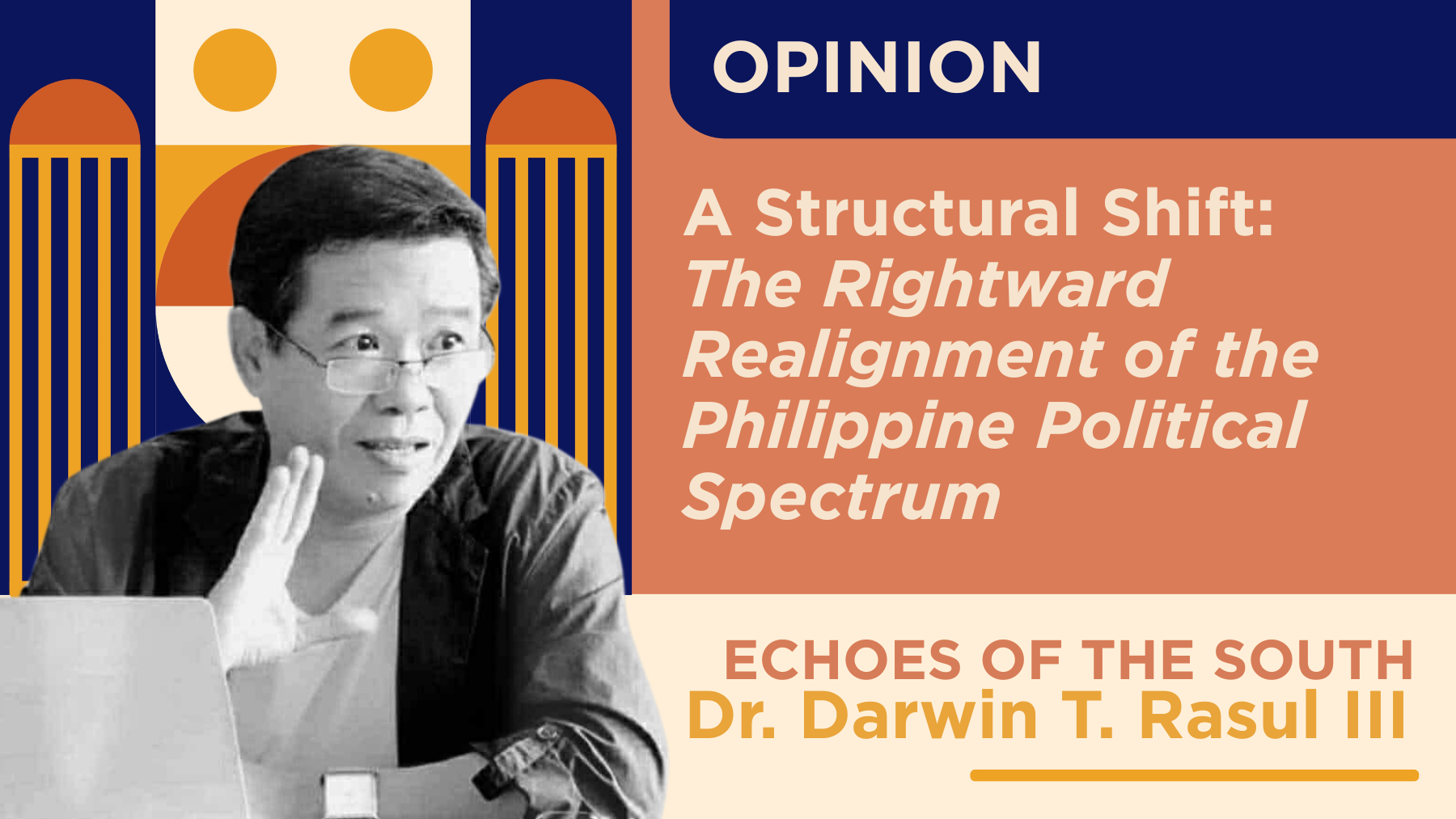

The Philippine political landscape has never been more disorienting — forces that once opposed each other now occupy the same side, and yesterday's opposition is today's majority. The political spectrum provides exactly what is needed: a map that shows not just where political leaders or parties stand, but whether they still stand for anything at all.
The present alignment no longer follows the old ideological map. In the Senate, Akbayan's Senator Risa Hontiveros — one of the most progressive voices in the chamber — finds herself inside the Sotto-led minority bloc, a formation that operates as a Malacañang-friendly coalition in its actual political behavior. This may not be ideological surrender on Hontiveros's part; it is the consequence of a spectrum so thoroughly reconfigured that opposition has no structural footing left to stand on. In the House, the CPP-NDF above-ground Makabayan bloc, ideologically opposed to the Marcos administration, nevertheless finds its legislative actions converging with the administration majority on specific measures, most notably the Sara Duterte impeachment. This is not alignment; it is the paradox of shared enemies producing shared votes across an otherwise unbridgeable ideological divide. Political behavior is now driven less by ideology and more by the gravitational pull of power and survival — pushing nearly every major force toward the Extreme Right.
At the Extreme Left sits the Communist Party of the Philippines, its armed wing the New People's Army, and the National Democratic Front (CPP-NPA-NDF) that has been waging armed struggle for decades. At the Extreme Right sits the Marcos administration — or whoever holds Malacañang — backed by the AFP and the PNP, mandated to suppress that movement. Between them is where the rest of Philippine politics lives.
On the Moderate Left sit the Makabayan bloc party-list groups — Bayan Muna, Gabriela, ACT Teachers, and Kabataan — operating legally within the system as the above-ground political network of the CPP-NPA-NDF. They contest power through Congress and electoral participation, but they remain organically connected to the Extreme Left formation whose armed struggle they do not publicly disavow. Yes, in the House, Makabayan's legislative actions converge with those of Partido Federal ng Pilipinas and Lakas-CMD — core parties of the Moderate Right near the Extreme Right, the Marcos administration — not by coordination, but by the logic of a shared political target.
In contrast, but also on the Moderate Left, is Akbayan which occupies its own distinct ground — a democratic socialist party built on participatory democracy, human rights, and progressive reform. Akbayan contests power within the system and, unlike Makabayan, carries no organic connection to any armed movement. Yet in the Senate, its standard-bearer Senator Hontiveros finds no opposition home outside the Sotto-led minority bloc — a coalition friendly to Malacañang which her Akbayan party was built to hold accountable. The spectrum's reconfiguration has left even the most principled progressive formation structurally without a footing of its own.
On the Moderate Right sit the traditional politicians and their political parties orbiting Malacañang: Partido Federal ng Pilipinas, Lakas-CMD, the Nationalist People's Coalition, and pro-administration party-list groups that move with the gravitational pull toward the Extreme Right, the Marcos administration.
At the Center stands the spectrum's anchor: the Filipino people, together with institutions that historically voiced their interests — the Catholic Church, civil society, professional associations, the business community, and independent media. This Center used to hold power accountable: it filled EDSA in 1986 and finished a dictatorship. Today it is fragmented, disoriented, and silent.
Now read the full spectrum and the present national picture becomes deeply troubling.
The spectrum has not merely shifted. It has been reconfigured. What organizes political behavior today is not ideology but access: to committee chairmanships, budget appropriations, and political survival. The objective may be tactical, but the picture is incoherent: while the objective is to prosecute the Duterte drug war legacy and block VP Sara Duterte's 2028 road by impeachment, the Left — from the Extreme to the Moderate — finds its actions converging with the Marcos administration that it was built to oppose.
The Center has now become the losing middle-ground — the Filipino people and the institutions that speak for them. That Center is fragmented now: portions indifferent, portions exhausted, others captured by patronage and social media narratives that substitute emotion for analysis. Unlike in EDSA 1 People Power where the Catholic Church under then Cardinal Sin mobilized millions, its silence now is deafening. Civil society is also divided. No popular force can discipline the political class or impose real accountability.
In that growing vacuum, paralysis becomes the rational strategy. Investigations stall. Institutions are not seized — they are simply stopped. The Filipino people are left with the most dangerous question in a democracy: what precisely is being protected by all this deliberate stillness? The answer lies in the map — which, after all, does not lie.
This spectrum framework is an analytical tool born in the French Revolution of 1789 when members of the National Assembly arranged themselves by conviction — defenders of the old order to the right, those demanding radical change to the left — and it remains the most reliable guide for reading any national situation.
This was the same guide taught to us during our student activism years under Martial Law in the early 80s — the same tool that shaped our political consciousness, including among those who came of age resisting the Marcos dictatorship. To understand Philippine politics today, be guided by this spectrum framework — and the honesty to read what it now reveals.
▪︎___________________________ DR. DARWIN T. RASUL III Expert-Consultant, European Union Germany (2021-2024) • ARMM's Cabinet Assistant Secretary (Asec., 2012-2019) • Editor-in-Chief, ARMM's Official Publication (2011-2018) • Legislative Consultant, Senate of the Philippines (1988-1992) • Book Author/Feature Writer • Columnist, OpinYon
#WeTakeAStand #OpinYon #OpinYonNews #EchoesoftheSouth