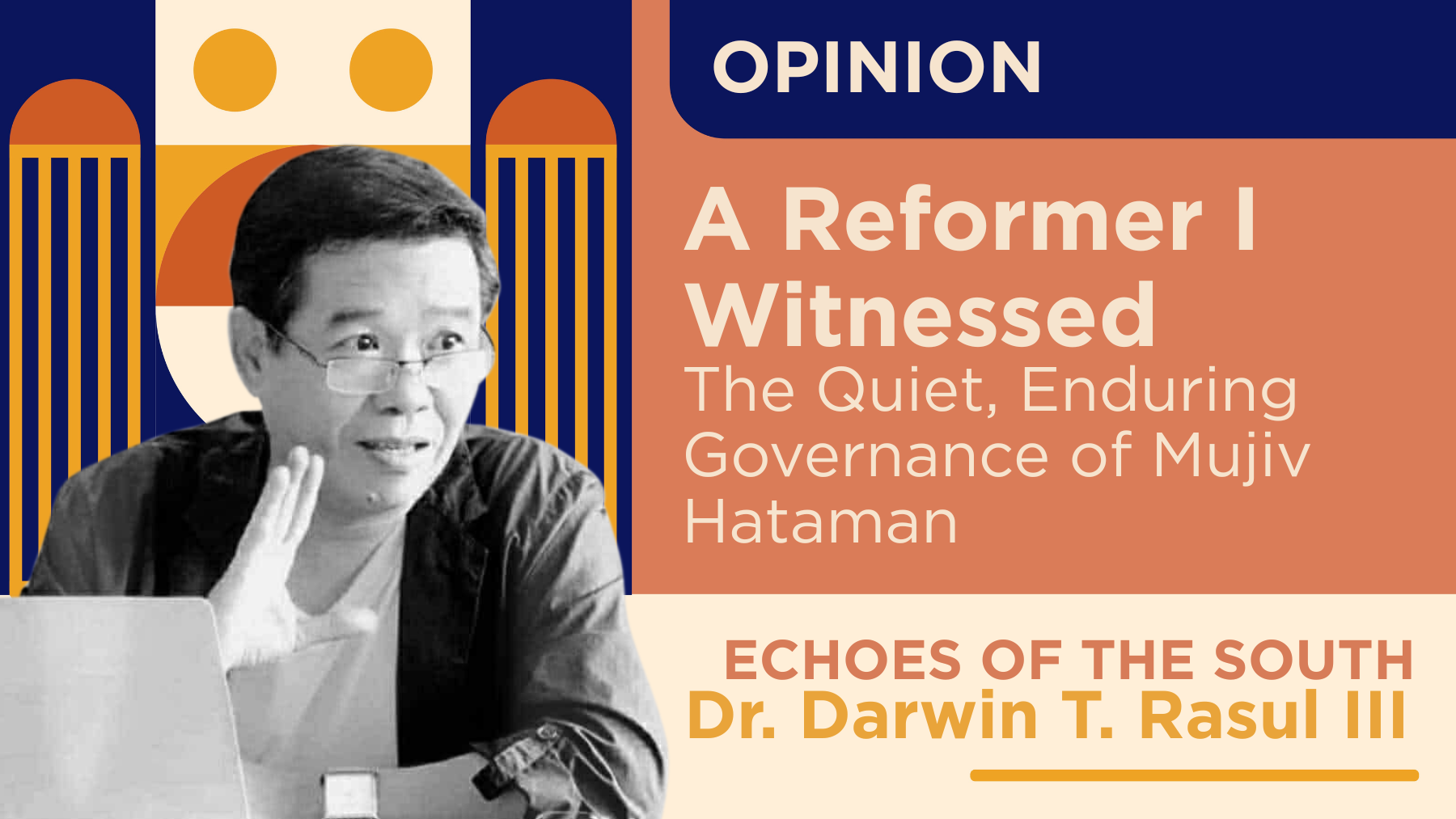

Public leadership in fragile political environments is rarely defined by spectacle. More often, it is measured by the quiet, deliberate restoration of public trust.
The tenure of Mujiv Hataman as Regional Governor of the Autonomous Region in Muslim Mindanao (ARMM) from 2011 to early 2019 stands as a compelling testament to reform anchored in discipline, humility, and institutional resolve. Prior to his appointment, Hataman's reformist narrative was already long taking shape. He was a congressman representing Anak Mindanao party-list from 2001 to 2010 — a legislative tenure that had already established his reformist credentials and his deep identification with the Mindanao constituency.
During the height of public frustration over governance in ARMM, a broad movement emerged, the Reform ARMM Now (RAN), which called for accountability and decisive break from an entrenched system. It was Dr. Tomasito Villarin — before he became a congressman representing Akbayan, and my comrade during our college years as student activists in Youth for the Advancement of Faith and Justice (YAFJ) — who introduced me to Hataman and encouraged me to join RAN, which he convened as a civil society initiative.
In that formative period, I was designated to serve as national spokesman of the movement, articulating its message across platforms and helping frame a reform agenda that would later define Hataman's governance. That early engagement was not merely political; it was foundational, setting the tone for a leadership that would consistently place integrity above expediency.
When Hataman was appointed Officer-in-Charge Regional Governor in 2011, and later elected to the position, ARMM carried the weight of deep institutional failure. Public trust was thin, systems were compromised, and governance often appeared distant from the people it was meant to serve. What followed under his watch was not abrupt transformation, but a steady and intentional recalibration of government.
Central to his administration was fiscal discipline and transparency. Public funds were redirected toward programs that delivered visible, measurable results. Roads began connecting isolated communities, schools rose where there were none, and health services gradually reached areas long neglected. These were not abstract accomplishments. They were concrete shifts that restored government as a functioning and deeply felt presence in everyday life.
From within the regional government, I witnessed this transformation directly. Serving as Cabinet Assistant Secretary and concurrently as Editor-in-Chief of the official regional publication, I was tasked with documenting these changes with fidelity. The responsibility demanded accuracy rather than embellishment. The narrative of reform did not need invention — it revealed itself through communities gaining access, civil servants rediscovering purpose, and institutions slowly regaining public confidence. On two separate occasions, Hataman somehow offered me the position of secretary in the regional government — an opportunity that reflected his trust in my work and alignment with his reform agenda. I chose instead to remain in a role that allowed me to shape public communication and institutional narrative from a broader vantage point, believing that to be where I could contribute most effectively.
Hataman's leadership style was notably unadorned. He avoided political theatrics, favoring a methodical and grounded approach to governance. Decisions were deliberate, programs were scrutinized for real impact, and public service was treated as a duty rather than performance. This cultivated a culture within ARMM's bureaucracy that emphasized merit, professionalism, and accountability — values long overshadowed by patronage and political accommodation.
Equally significant was his administration's role in ensuring a stable and credible transition toward a new political order. As groundwork was laid for the Bangsamoro Autonomous Region in Muslim Mindanao (BARMM), ARMM under Hataman demonstrated that reform within an autonomous framework was not only achievable, but sustainable. It served as a functioning bridge, institutional and moral, between what was and what could be.
From 2019 to 2025, Hataman served again as the representative of Basilan's lone district and was a House Deputy Speaker from 2019 to 2022 — before winning the governorship of Basilan in 2025. Today, as Governor of Basilan, Hataman carries forward the same governance ethos. His years in ARMM continue to inform a leadership style firmly anchored in transparency, accountability, service delivery, and institutional integrity — qualities that steadily shape Basilan's continuing trajectory.
The legacy of Mujiv Hataman is not defined by grandstanding, but by systems made to work and trust carefully rebuilt. For those of us who stood alongside that reform journey from its earliest days, the lesson endures: meaningful change is rarely loud, but when it is real, it lasts.︎
________________________________
Dr. Darwin T. Rasul III is a feature writer, book author, and editorial opinion columnist with extensive experience in governance and political consultancy. He started his career as a legislative researcher, then a political consultant for some senators in the Senate of the Philippines from 1988 to 1992. He later served as ARMM's cabinet assistant secretary for seven years from 2012 to 2019, during which time he was also editor-in-chief of the autonomous government's official publication. From 2021 to 2024, he was engaged internationally by the European Union (EU), Germany, as a distinguished expert-consultant, who wrote and annotated the legislative briefs of all laws passed by the Bangsamoro Transition Authority (BTA-BARMM). He is currently the chief editor of the Bangsamoro Free Press and regular columnist of OpinYon.︎
#WeTakeAStand #OpinYon #OpinYonNews