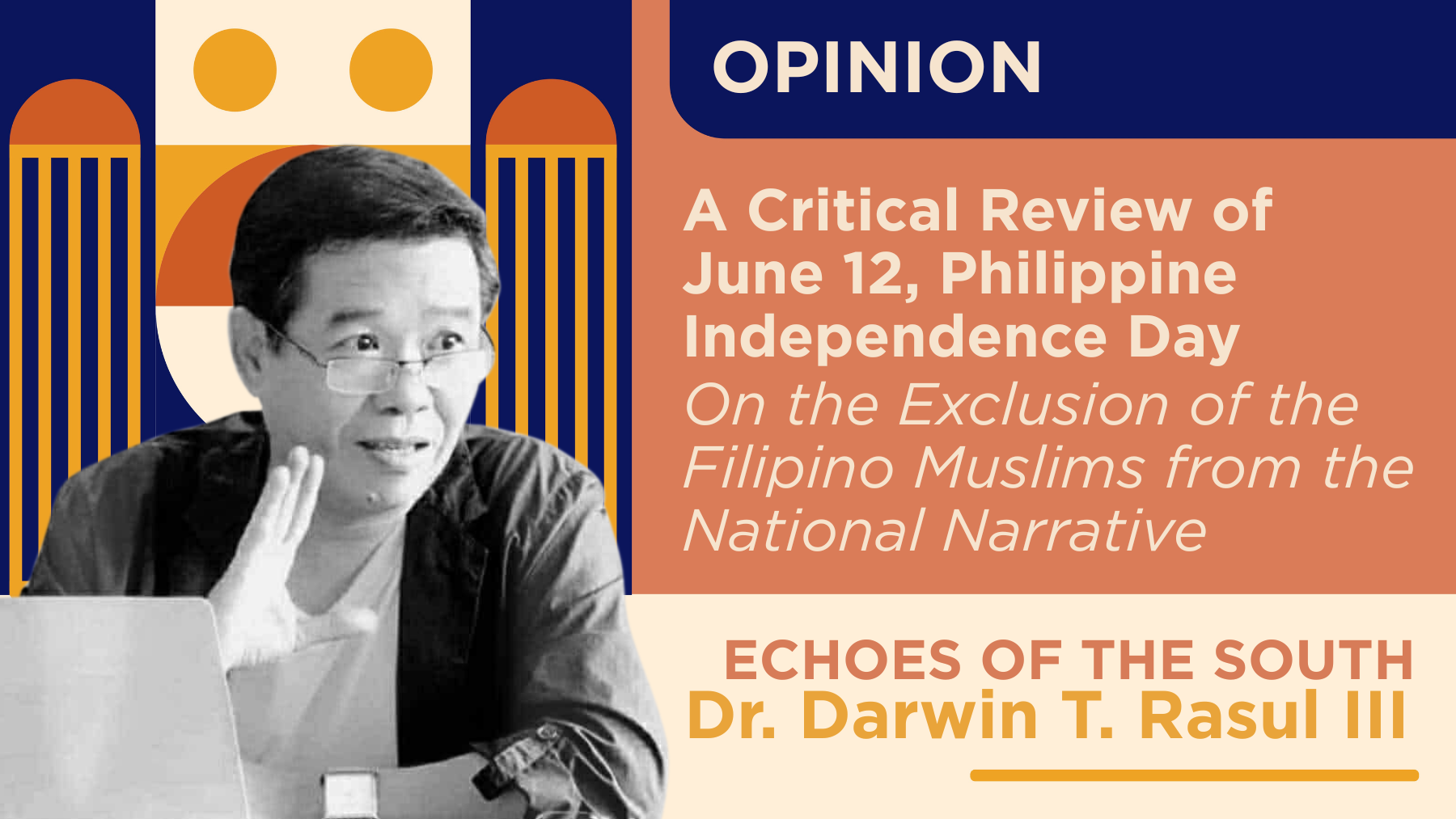

Today is Philippine Independence Day. National holidays are not merely commemorations — they are statements of identity. The celebration of June 12 is often accepted without question as a patriotic symbol of liberation from colonial rule. Yet beneath the flags and festivities lies a more complicated historical reality.
For many Filipinos outside the dominant Tagalog-Christian narrative, particularly Filipino Muslims, the June 12 declaration carries little resonance with their own political experience. This column unpacks the limitations of the June 12 narrative, examines its exclusionary character, and proposes a more inclusive national memory reflecting the plural origins of the Filipino people. This line of inquiry is not entirely new. My late father, jurist and historian Justice Jainal Rasul, first raised it in his seminal 1970 work, 'Philippine Muslims' Struggle for Identity', laying the scholarly groundwork upon which this column builds.
Philippine Independence Day was first declared on May 12, 1962 through Proclamation No. 28. It was followed by Republic Act 4166 on August 4, 1964 transferring Independence Day from July 4, 1946 to June 12, 1898, making the Philippine Republic appear half a century older. This shift was largely symbolic and politically motivated — aimed at reclaiming anti-colonial nationalism by identifying with the Katipunan-led struggle in 1898, rather than American-granted independence in 1946. It also entrenched a Tagalog-centric narrative that marginalized non-Tagalog and non-Christian Filipinos.
As a Filipino Muslim, I find June 12 a strange Independence Day. Proclamation No. 28 has no firm historical basis for the reason that neither the first Philippine Republic nor the revolutionary government existed on June 12, 1898. The declaration was Aguinaldo-dictated, proclaimed at his own residence in Kawit, Cavite, and applicable only to the eight Tagalog provinces. But not to all inhabitants of the Philippines.
It is worth noting that the June 12 declaration was made under the shadow of American presence. According to Teodoro Agoncillo, in his work, 'History of the Filipino People', the United States Navy, then under Admiral George Dewey, had already defeated the Spanish fleet in Manila Bay by May 1898, and Aguinaldo’s return from exile was facilitated by the Americans. The proclamation was thus not a moment of complete sovereignty but a gesture under duress and dependence.
Gen. Emilio Aguinaldo established his unstable dictatorial government on May 24, 1898 — five days after arriving from Hong kong — as an act entirely his own. Its constitutional framework was prepared in Hong kong by a single man, Mariano Ponce. The proclamation carried no endorsement from the people, directly or through representatives, much less from the 'Moros' of the South who refused to be called Filipinos. Even Apolinario Mabini disagreed, precisely because the declaration lacked popular endorsement.
The Malolos Congress was in fact established only 3 months later on September 15, 1898, while the "First Philippine Republic" was claimed to have been established later on January 23, 1899. Aguinaldo's notion of independence was centralized, exclusionary, and blind to political realities in Mindanao and Sulu.
The Forgotten South: Moro Sovereignty and Historical Discontinuity
The June 12 declaration, therefore, did not include the 'Moros', who were then independent. Their Sultanate remained recognized even into the Commonwealth regime in 1936. Aguinaldo himself recognized the Sultanates of Sulu and Mindanao as independent from his own government as he acknowledged that the independence he dictated on June 12, 1898 did not encompass the independence then maintained by the 'Moros' in the southern Philippines, according to Najeeb Saleeby, in his book, 'The History of Sulu'.
The 'Moros' negotiated with the Americans directly as sovereign polities: the Bates Treaty of 1899 and the Carpenter Agreement signed on March 22, 1915 both testify to political recognition accorded the Sulu Sultanate and other 'Moro' leaders, separate from Manila.
While the 'Indios' sought to regain independence lost to Spain, the 'Moros' — who remained independent throughout 320 years of Spanish occupation — lost their political independence only to the Americans through the Carpenter Agreement of March 22, 1915, and the Jones Law of August 29, 1916, which provided for Moro representatives in the Philippine Senate: Sulu Sultanate Prime Minister Hadji Butu Rasul, then later Sultan Alauya Alonto of Lanao and Datu Sinsuat Balabaran of Cotabato. Only then did Congress reflect a declaration inclusive of the Moros of Sulu and Mindanao long after Aguinaldo's capture in Palanan, Isabela in 1901.
National unity cannot be built on selective memory. The commemoration of June 12 as Philippine Independence Day marginalizes peoples, and political experiences — especially those of the Bangsamoro and indigenous communities.
To give justice to Filipino Muslims and indigenous peoples, Philippine Independence Day should be restored to July 4, 1946 as the date that befits the historical experience commonly shared by all inhabitants of the Philippines. It may not reverse historical erasure, but it can acknowledge the multiethnic and multireligious character of the Filipino nation. Only then can the Philippine Republic truly speak for all of its people.
• ________________________x DR. DARWIN T. RASUL III OpinYon Columnist • Expert-Consultant, European Union Germany • ARMM's Cabinet Assistant Secretary (Asec.) • Editor-in-Chief, ARMM's Official Publication • Legislative Researcher and Consultant, Senate of the Philippines • Book Author • Feature Writer
#WeTakeAStand #OpinYon #OpinYonNews #PhilippineIndependence