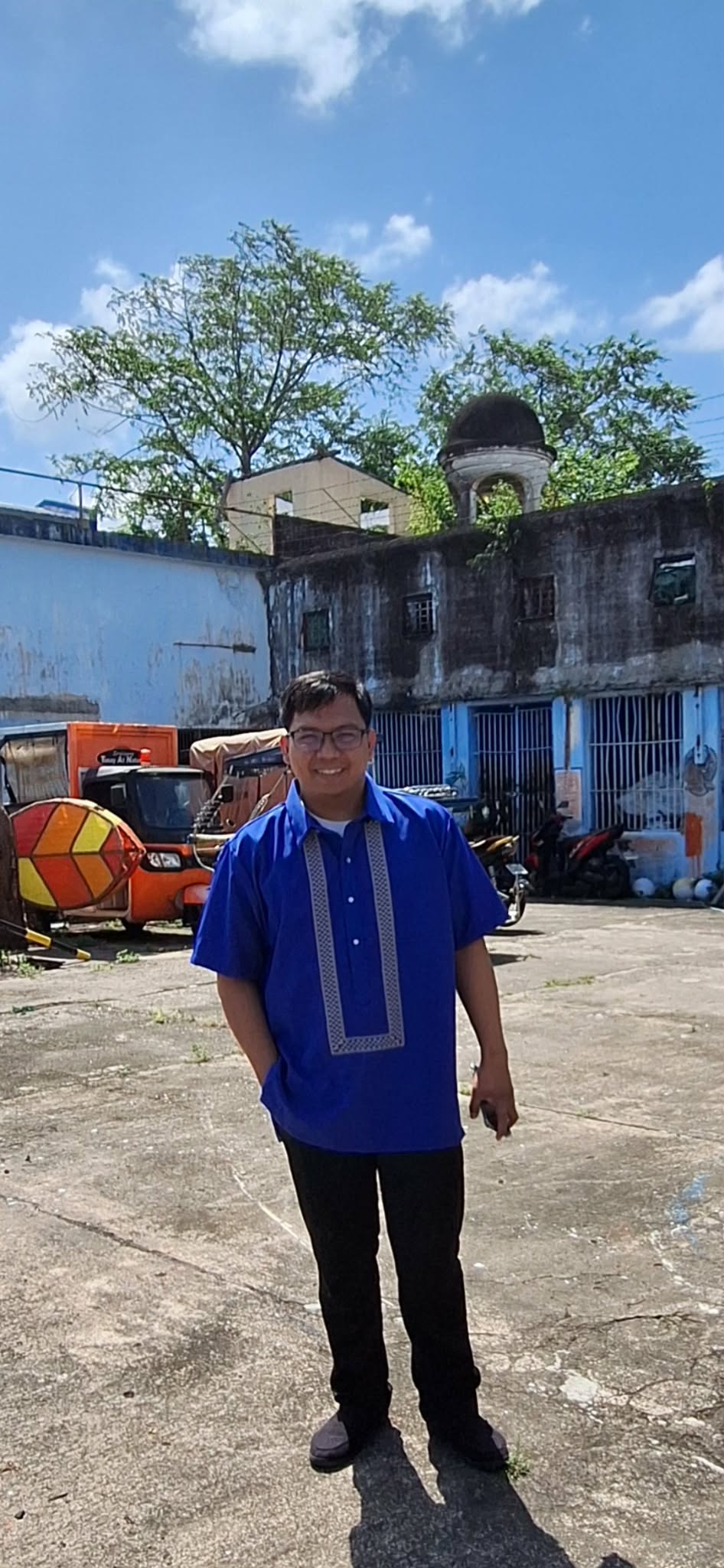

He bears the burden of responsibility in promoting local history on his 32 years young shoulders which at present he is trying his best to do for his tasks as the vice chairperson for external affairs of Quezon Province Heritage, History, Culture and Arts Council (QPHHCAC).
This young man, John Valdeavilla, who has read half of the Filipiniana books in Tayabas municipal public library when he was in Luis Palad High School in Tayabas City, has found his hands full to dig deeper for the council.
The council, created under Quezon Province Culture, Arts and Tourism Code of 2024, is headed by Gov. Helen Tan as chairperson and Vice Gov. Third Alcala as vice chairperson Internal, which also provides for vice chairperson-External to be elected by members of the QPHHCAC.
Valdeavilla said the council is focused on the declaration of National Cultural Treasure (NCT) for the Provincial Capitol Compound, old municipal building of Sariaya and the Welcome Arch of Tiaong.
Valdeavilla - who first fought against the removal and transfer of Rizal monument at Rizal Park in Tayabas City when he was still at the Southern Luzon State University, taking up AB major in History in Lucban - said the declaration of NCT is the highest recognition accorded by the National Commission for Culture and the Arts (NCCA) for heritage structures built during the Spanish and American eras.
Next week, he said, he will try to see and pay courtesy call to tourism officers of Sariaya and Tiaong and to mayors of the 2 municipalities to introduce the project as the LGUs will shoulder the cost on the petition for NCT declaration.
The QPHHCAC has allotted P50,000 for heritage consultant Edgar Allan Sembrano, a cultural heritage advocate from the University of Santo Tomas on the drafting of historical documents.
Also included in the petition for NCT declaration for the Provincial Capitol Compound is the former Provincial Jail and the Regional Trial Court building which were both built during the American colonial occupation of the Philippines.
Valdeavilla noted that in Calabarzon region, the Quezon Capitol Compound - then named Tayabas Provincial Capitol built in 1908 under Governor Domingo Lopez – has been the most well preserved provincial capitol in Calabarzon region.
Hermano Puli holiday and birth year
Last Wednesday, Valdeavilla attended the online zoom meeting of the Sanggunian Panglalawigan Committee on Tourism, Culture and Arts presided by 3rd District Board Member John Joseph Aquivido about the need to revive the Hermano Puli Bill authored by 1st District Cong. Mark Enverga regarding the declaration of Nov. 4 as Hermano Puli Special Non-Working Holiday in the entire province.
He said the province has already been marking Nov. 4 as special public holiday but it still requires the Provincial Tourism Office to write yearly to SP which in turn would ask Malacanang Palace for its declaration.
Valdeavilla said it has been the subject of BM Aquivido’s privilege speech last Monday at the SP regular session. On Wednesday, Aquivido’s committee considered it approved and will forward it to the plenary session on Monday for deliberation.
He revealed that last year, the declaration of Hermano Puli Special Non-Working Holiday almost met a snag due to late submission of communication or most likely it got buried among the papers on the table in Malacanang but fortunately it still pushed through on the day itself.
Valdeavilla said that Cong. Enverga’s chief of staff Zaldy Gariguez has informed the council that the Hermano Puli Bill has been pending at the Senate so it just needs to be revived.
Valdeavilla then pointed out the confusion on the birth year of Puli, whether it is 1814 or 1815.
He said Lucban, where Puli was born, bears his marker showing his birth year to be 1815 and Tayabas local historian Ryan Palad also claimed the same year for the Quezon local hero. The NHCP however said it is 1814 which is also found in most history books.
“I proposed to the council to invite concerned historians and hold a consultative meeting this October to decide on the correct date of Puli’s birth year and to forward it to the SP to draft a provincial ordinance.”
National Flag proper disposal
Valdeavilla turned his attention to the proper disposal of the Phil. Flag which he said cannot just be thrown in any garbage dump.
He recalled seeing a post by Celine Tutor, a well-known local radio broadcaster, about a man atop a garbage truck holding a Phil. flag.
He said the garbage man could have seen it thrown in some place, picked it up and placed a stick and wave it while riding in a garbage truck.
“The Phil. Flag must be respected and must have proper disposal through burning,” he said adding that it is the Boy Scout of the Phil. which is mandated to do it.
Valdeavilla said the council plans to coordinate with the Dept. of Education of Tayabas and Lucena for all local government offices in all towns of the province to ‘surrender’ their old and tattered flags to their respective Tourism Offices which will then bring the flags to the province to conduct a collective and historic flag burning in June in time for the commemoration of the country’s Flag Day.
Old residence of Quezon governors
Valdeavilla said he was coordinating with Luz Calzado, chairperson of Lucena Council for Culture and Arts to put a historical marker about an old residential building along Merchan St. in Lucena City that has served as private residence of Quezon governors, including the late Manuel Luis Quezon, from 1901 to 1907 when there was no capitol building yet.
In his research of various historical books, he found out that the residential building has been rented by the provincial government for P1.50 centavos monthly at that time and at present would amount to P27,000 monthly.
Local history
Valdeavilla, still single at 32, rued the fact that few local history is being written as few show interest in reading and knowing local history. He noted that the last local history book in Quezon province was written in 2007 and mentioned local distinguished historian Dr. Cesar Villariba who wrote a definitive history of Quezon Province written in 1987.
Reflecting about his perspective of history, he simply said:
“You must have different perspectives to write about history, and you cannot be historian if you have not read many books from which you will connect stories from the past.”
He plans of launching a local book funded by the Council which will highlight stories and experiences of local government units on maintenance, preservation along with the defacement and destruction of Rizal monuments in the entire province.
(Photo by John Bello)
#WeTakeAStand #OpinYon #OpinYonNews