



The recently approved ₱35 daily minimum wage increase for private-sector workers in Regional Tripartite Wages and Productivity Board – VIII (RTWPB-VIII) is being hailed as a modest yet welcome move.
However, many labor advocates and workers question whether it truly matches rising costs and the long-standing call for a living wage.
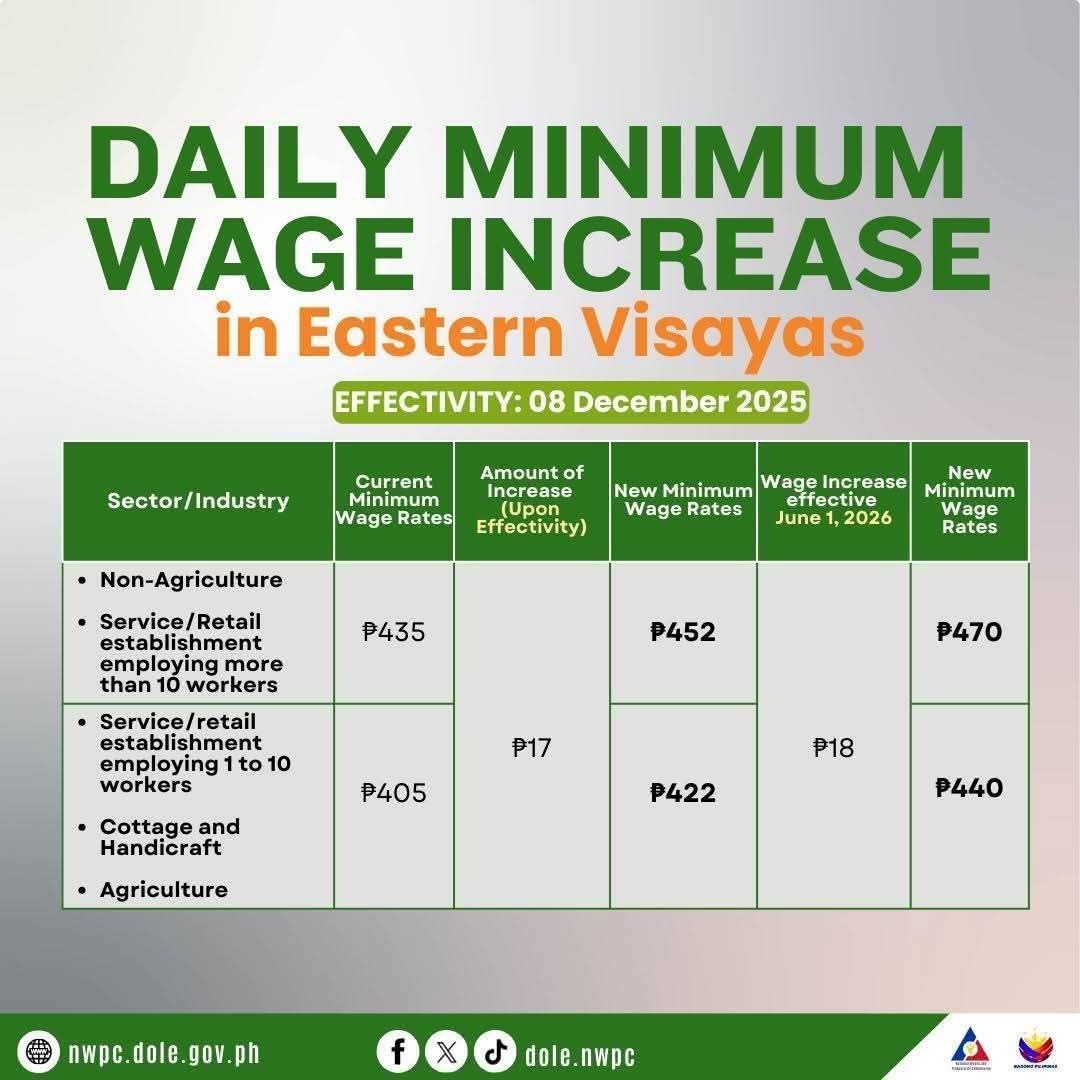
Under Wage Order RBVIII-25, the raise comes in two phases: a ₱17 increase starting December 8, 2025, and a second ₱18 bump on June 1, 2026.
By mid-2026, daily minimum wages will reach ₱470 for non-agriculture and large service/retail establishments, and ₱440 for agriculture, cottage, handicraft work, or small service/retail firms.
Proponents point out that the increase responds to real economic pressures.
According to RTWPB-VIII, the adjustment considered rising consumer prices which are reflected in a 0.68% increase in the region’s Consumer Price Index between December 2024 and September 2025, as well as last recorded poverty threshold data for a family of five and the region’s 6.2% economic growth.
For many workers, especially those earning the current minimum wage of ₱405 or ₱435, the additional ₱35 per day could ease some burden, especially as inflation and costs of essentials bite.
Still, the history and broader context temper optimism.
Only a year ago (Nov 2024), RTWPB-VIII granted a ₱30 daily raise, raising the minimum from ₱405 to ₱435 for many sectors.
That increment itself was framed as a step to “enable workers to cope with rising cost of living.”
The back-to-back raises (2024, 2025) suggest persistent pressure on wages — evidence that the current minimum remains under strain.
From a workers’ perspective, the new rates still fall short of what many experts consider a “living wage.”
While RTWPB-VIII referenced a poverty threshold of ₱444/day for a family of five, that figure reflects only subsistence and not additional costs like education, health, transportation, or emergencies.
Given that many workers in Eastern Visayas support extended families, the new minimum may still leave little room beyond bare necessities.
On the employers’ side, especially micro, small, and medium enterprises (MSMEs) , there’s reason for concern.
While RTWPB-VIII opted for a phased approach to ease adjustment, a near 20% increase (from ₱405 to ₱470) in just over a year could strain businesses already grappling with inflation, supply-chain disruptions, and thin profit margins.
Indeed, critics argue that wage hikes ,however modest , may translate quickly into higher prices for goods and services, possibly triggering a round of “cost-push” inflation that could erode the benefit for workers.
Moreover, a wage floor set uniformly across all provinces and cities in Eastern Visayas masks regional disparities in cost of living.
For instance, costs in city centers like Tacloban or Ormoc may be higher than in rural towns, yet both pay the same minimum wage.
That one-size-fits-all approach risks underpaying workers in higher-cost areas and still overburdening employers in depressed zones.
A relief and a burden
The ₱35 hike is a welcome relief, but it is not a panacea.
It signals goodwill and formal recognition of workers’ plight and perhaps more importantly, it keeps alive the constitutional promise of dignified pay.
But for the increased minimum wage to become a meaningful improvement in living standards, it must be paired with broader structural reforms such as support for MSMEs to absorb wage hikes, stronger social safety nets, and perhaps differentiated wage floors reflecting local cost differences.
For now, many workers will feel a bit of breathing room.
But unless inflation and living costs ease, or unless subsequent wage orders continue to lift the floor , “minimum wage” may remain a barely adequate income, not a truly sustainable one.
#WeTakeAStand #OpinYon #OpinYonNews #WageHike #RTWPB