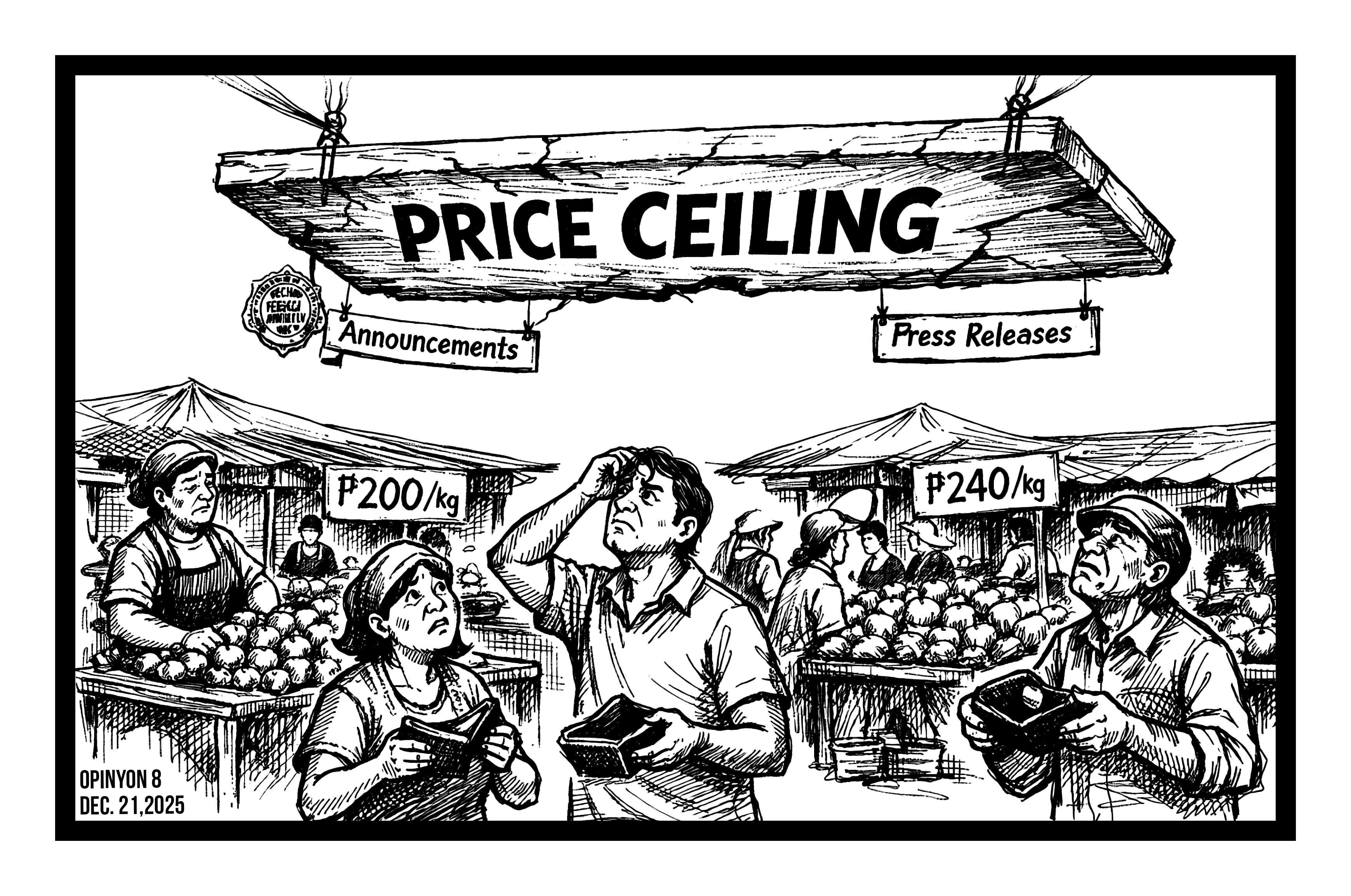

The widening gap between the Department of Trade and Industry’s announced price ceilings and the prices consumers actually pay in markets reveals a deeper governance problem.
The issue is not onions, rice, or any single commodity.
It is the growing disconnect between policy declarations and on-the-ground realities.
The onion issue merely illustrates the pattern.
When a price ceiling or target is announced, it creates an expectation of relief.
Yet consumers repeatedly encounter prices that ignore these ceilings altogether.
The result is frustration, not because markets are volatile, but because official assurances do not translate into enforcement, supply stability, or measurable outcomes.
A ceiling that exists only on paper becomes a symbol of institutional weakness.
At its core, the problem lies in how price policies are framed and implemented.
Price ceilings are presented as quick fixes, but without firm control over supply chains, logistics, storage, and market behavior, they are bound to fail.
The state does not directly control production, and its oversight of traders and middlemen remains uneven.
Declaring a price without securing the conditions to achieve it shifts the burden to consumers, who are left navigating prices that continue to rise unchecked.
This disconnect erodes public trust.
When agencies announce ceilings that markets routinely ignore, citizens begin to question whether policies are informed by real data or by the need to project action.
Over time, price ceilings risk becoming performative, meant to signal concern rather than deliver protection.
What is needed is not louder promises but grounded policy.
This means aligning price announcements with verified supply assessments, clear enforcement mechanisms, and transparent explanations when targets are missed.
It also requires acknowledging limits: if conditions do not support a ceiling, officials should say so rather than announce figures that cannot be sustained.
The onion example is a warning.
When policy language drifts too far from market truth, governance itself becomes suspect.
Bridging that gap is not about controlling prices, it is about restoring credibility.
The Warays are suffering from high cost of food, with their complaints now loud enough to catch OpinYon’s attention.
But the silence of Tingog, the partylist that claims to champion their interests in Congress, is deafening.