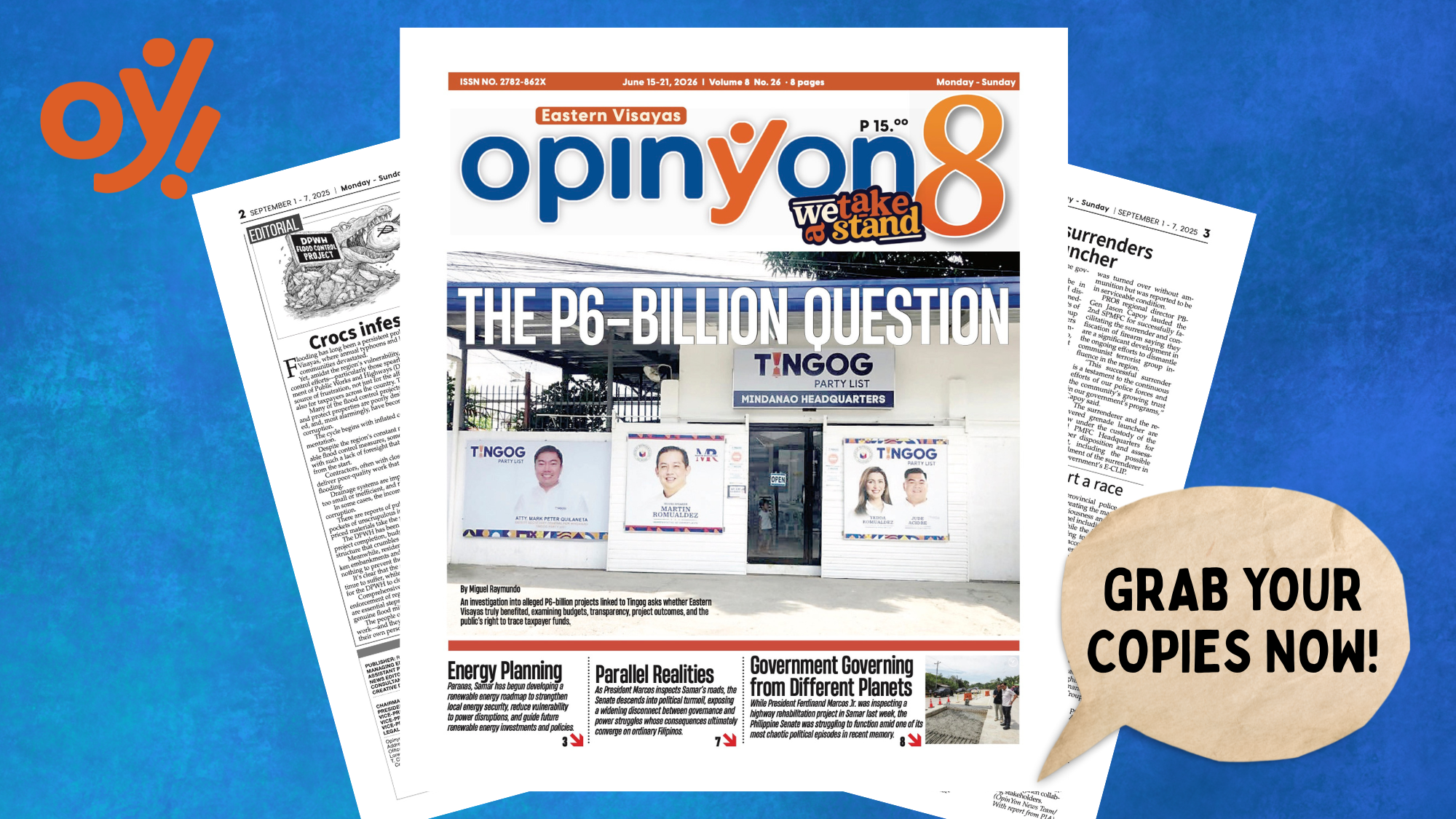

Follow the money.
That is the simplest rule of investigation.
And in Eastern Visayas today, it leads to a question worth nearly ₱6 billion.
In recent months, allegations emerged that more than 70 infrastructure projects worth approximately ₱5.9 billion in the 2025 national budget were linked to Tingog Party-list.
No government agency has concluded that these allocations were illegal. No court has ruled that any budget insertion violated the law.
Tingog leaders have denied wrongdoing. Yet the controversy has triggered a question larger than politics:
Did Eastern Visayas truly benefit?
Since President Ferdinand Marcos Jr. assumed office in 2022, Tingog's influence has grown dramatically.
Its representatives sit close to House leadership. Its network has expanded nationwide.
By 2025, Tingog reported operating 210 assistance centers across the Philippines, providing access to medical aid, educational support, disaster assistance, and government services.
Supporters point to these accomplishments as proof of effective representation.
Critics argue that assistance programs are not the same as long-term development.
Both sides claim success.
But the public deserves evidence.
The Marcos administration has overseen some of the largest national budgets in Philippine history.
National spending exceeded ₱5 trillion annually and reached more than ₱6 trillion under the 2025 General Appropriations Act.
Government budget records also show continuing infrastructure, education, agriculture, and public works funding throughout Eastern Visayas.
But one crucial question remains unanswered:
Exactly how much of this money can be directly connected to projects advocated by Tingog?
No centralized government database currently identifies which projects were sponsored, proposed, endorsed, or politically associated with specific party-list groups.
That gap in transparency makes independent verification difficult.
If billions of pesos were indeed brought into Eastern Visayas through Tingog's influence, the proof should be easy to produce.
Where is the complete project list?
Which projects are located in which province?
How much was appropriated?
How much was released?
How much has actually been completed?
Which projects have undergone COA review?
Which projects can citizens physically inspect today?
These are not political questions.
They are accountability questions.
Government budget documents confirm substantial appropriations for state universities, roads, bridges, flood-control structures, and public infrastructure throughout Region VIII.
Institutions such as Eastern Visayas State University, Visayas State University, Samar State University, Southern Leyte State University, and other regional schools continue to receive national funding through the General Appropriations Act.
Yet attribution remains murky.
When a bridge is funded, who deserves credit?
The implementing agency? Congress? The local government? The party-list group? Or taxpayers themselves?
Politicians often claim success when projects are announced.
Citizens experience success only when projects are finished.
If Tingog helped secure billions for Eastern Visayas, then transparency should strengthen its case, not weaken it.
Release the project lists.
Release implementation reports.
Release completion rates.
Release geo-tagged locations.
Release photographs.
Release inspection findings.
Release COA observations.
Because if the projects are real, effective, and beneficial, the evidence should be overwhelming.
And if the evidence is overwhelming, no political defense is necessary.
Three years into the Marcos administration, the central issue is not whether Tingog has influence.
It clearly does.
The issue is whether that influence translated into measurable improvements in the lives of Warays, Leyteños, Samareños, Biliranons, and Southern Leyte residents.
The people of Eastern Visayas do not need another press release.
They need proof.
The only proof available is that Eastern Visayas currently ranks among the bottom in terms of economic growth in the country.
But this is proof enough of the government neglecting the region's ability to compete with other areas in the Philippines.
Until every peso can be traced from appropriation to completion, the ₱6-billion question remains unanswered:
Did the money transform the region or did the region simply become part of the political narrative surrounding the money?
#WeTakeAStand #OpinYon #OpinYonNews #CoverStory