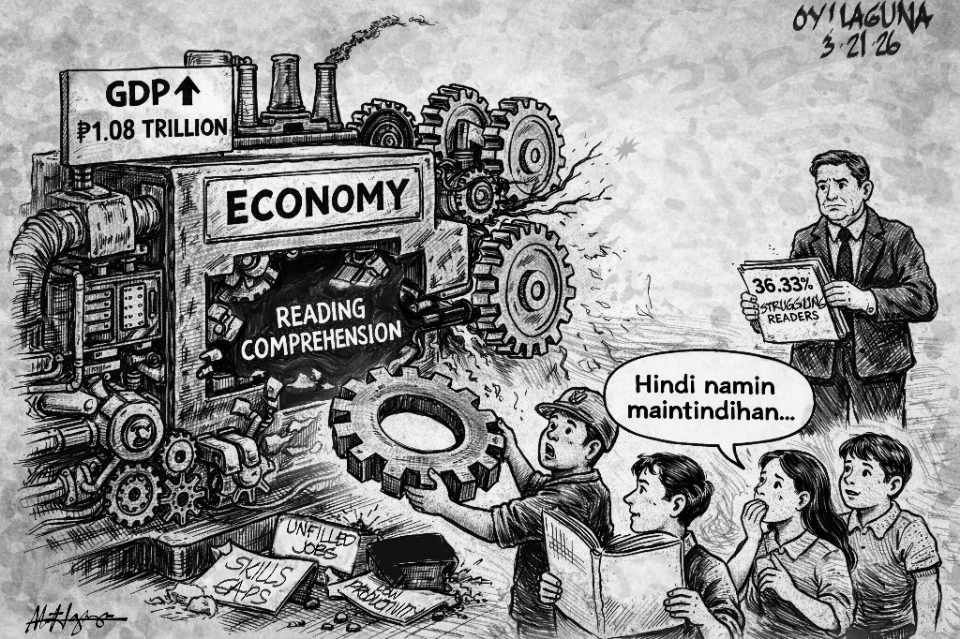

On paper, it sounds like good news: Laguna province has reported less than half of students who struggle to read and understand what they read.
According to the data released by the Second Congressional Commission on Education (EDCOM 2), an average of 36.33 percent of students from the province's six component cities struggle with reading and reading comprehension, based on its 2025–2026 Comprehensive Rapid Literacy Assessment (CRLA).
Sounds like good news? No, not really.
36.33 percent may not sound much to the average layman, but for stakeholders - local government units, educators and school administrators - this poses a huge challenge.
In a province that has, for the most part, played a huge role in the country's economic prosperity, the fact that one-thirds of its students can't comprehend what they read poses long-term risks.
Laguna province's gross domestic product (GDP) grew from P990 billion in 2023 and P1.02 trillion in 2023 to P1.08 trillion in 2024, while its Gross Value Added (GVA) of its industry sector was 9.9 percent of the country's total.
In a growing economy (despite the ongoing economic uncertainties brought by the war in the Middle East), skilled workers are highly in demand, workers who in turn will generate additional livelihood opportunities for their fellow Lagunenses.
But how can we fill that skills gap if a sizable portion of our population can't even be trusted with the most basic instructions or can't even understand the information that is presented to them?
When it comes to the state of our education, stakeholders should be in crisis mode as the full ramifications of Filipinos' lack of reading comprehension kicks in not only on our political life but on our economic life as well.
As a former prime minister of Burma (now Myanmar) U Nu has stated it succintly, how can a country abounding in ignoramuses ever progress?
#WeTakeAStand #OpinYon #OpinYonNews #Editorial