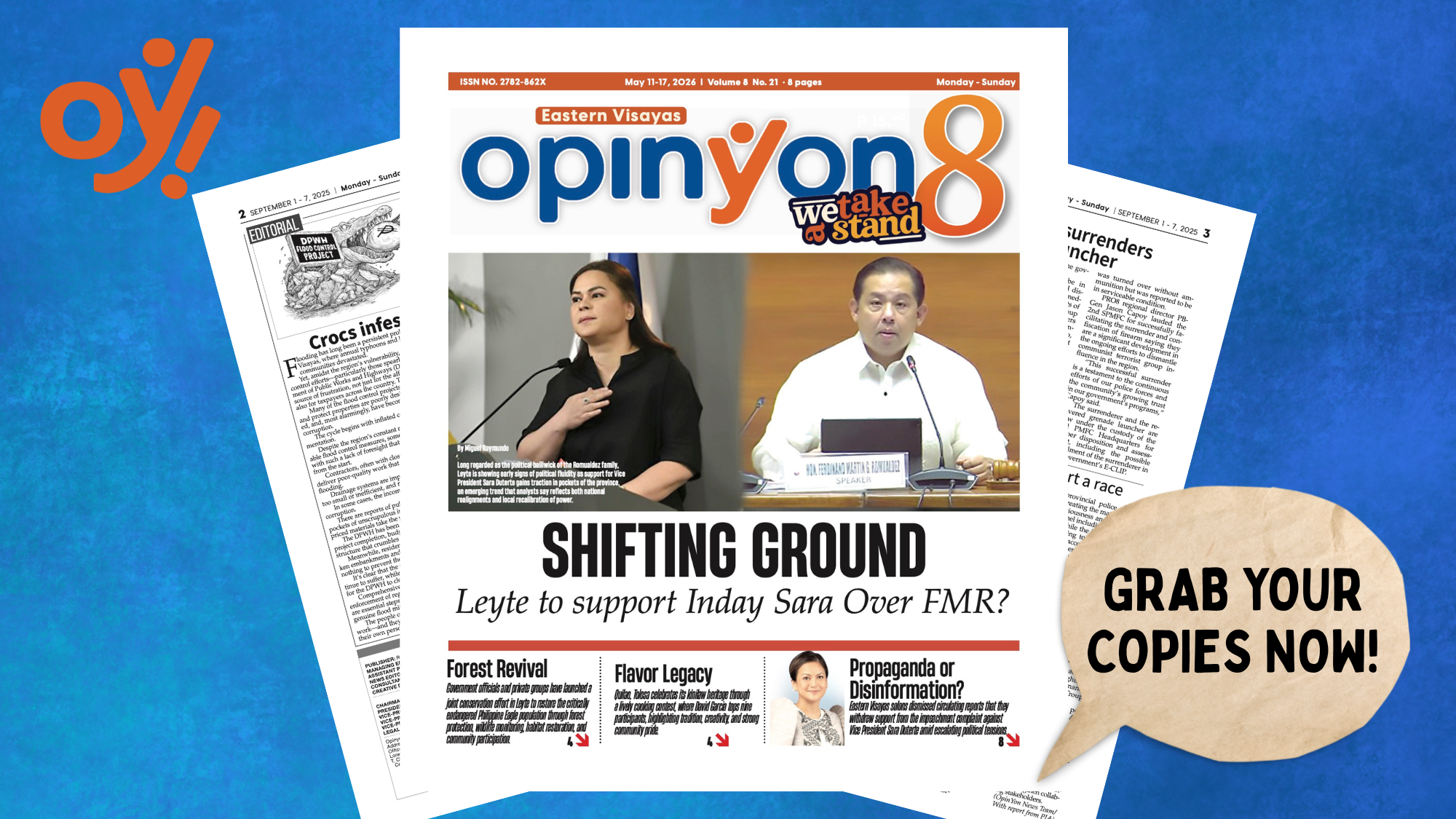

Long regarded as the political bailiwick of the Romualdez family, Leyte is showing early signs of political fluidity as support for Vice President Sara Duterte gains traction in pockets of the province, an emerging trend that analysts say reflects both national realignments and local recalibration of power.
For decades, the Romualdez clan has exercised significant influence over Leyte politics. Martin Romualdez has represented the province’s first district since 2007 and rose to become Speaker of the House, while allied figures dominate both congressional districts and local governments.
The family’s network extends through the Tingog Party List, which has steadily increased its national vote share from 1.40% in 2019 to 4.34% in 2025, indicating a consolidated regional machinery anchored in Eastern Visayas.
Yet cracks in this dominance have become more visible in the wake of evolving national alliances.
Duterte’s political relationship with Romualdez has shifted from cooperation to public tension. In 2022, Romualdez served as a key campaign manager in Duterte’s vice-presidential bid, underscoring a once-synergistic alliance.
However, by 2024, Duterte herself publicly questioned political attacks from administration allies, hinting at deeper fissures within the ruling coalition.
Recent political discourse suggests that these national-level conflicts are filtering down to the local level.
In 2024, reports of Leyte mayors publicly defending Romualdez amid criticisms from Duterte highlight a polarized elite landscape.
At the same time, Duterte’s continued national popularity, often surpassing that of other top officials in broader surveys, provides her with a reservoir of political capital that can be mobilized even in territories traditionally outside her core base.
The dynamics in Leyte reflect an even broader Philippine pattern: local political dominance is no longer impermeable when national narratives shift.
The Duterte family’s enduring influence, particularly in Mindanao, has shown the ability to transcend geographic boundaries, especially when tied to narratives of strong leadership and anti-establishment positioning.
Political analysts note that voter behavior in provincial strongholds is increasingly shaped by national media exposure and personality-driven politics, diluting the once near-absolute control of local dynasties.
Data points reinforce this evolving environment. While the Romualdez-led Tingog party-list continues to grow electorally, its gains are national rather than strictly provincial, suggesting that local loyalty is no longer the sole driver of its success.
Meanwhile, Duterte’s independent political base bolstered by her previous landslide national victory remains intact and potentially expandable.
What emerges is not an outright displacement of the Romualdez stronghold, but a competitive layering of influence.
Leyte remains structurally aligned with the Romualdez network, as evidenced by congressional representation and entrenched party machinery.
However, Duterte’s rising resonance introduces a parallel axis of loyalty, one that could become decisive in closely contested future elections.
In this evolving landscape, Leyte may no longer be a monolithic political fortress. Instead, it is becoming a testing ground for how national political rivalries reshape local power where loyalty is negotiated, not assumed, and where even the most entrenched strongholds must adapt to shifting tides.
#WeTakeAStand #OpinYon #OpinYonNews