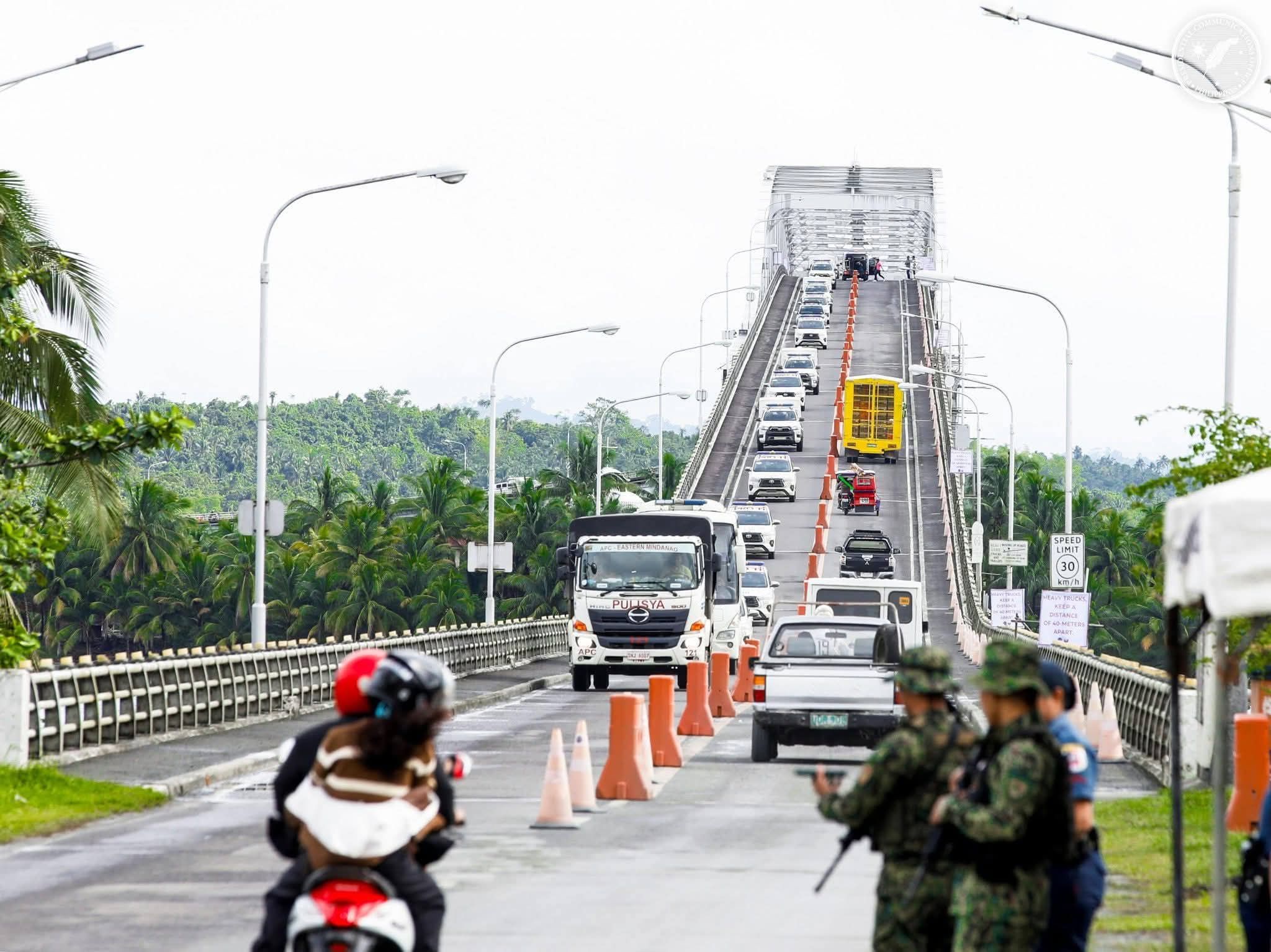

After months of restricted mobility and widespread economic disruption across Eastern Visayas, the San Juanico Bridge will partially reopen to two-way traffic, easing the burden on commuters and businesses dependent on the region’s most critical inter-island link.
The reopening follows the completion of portal shoring works by the Department of Public Works and Highways (DPWH), a key milestone that allows vehicles to safely traverse the bridge under a controlled 15-ton load limit.
The temporary support structure stabilizes the bridge as retrofitting and permanent strengthening continue.
Repairs are additionally expected to be completed next year.
The months-long closure, triggered by severe structural damage detected during inspections in June, had forced daily commuters, cargo operators, and local industries to rely on slower and costlier alternative routes.
Transport groups reported increased fuel consumption and longer travel hours as vehicles were rerouted through sea crossings or provincial roads unable to accommodate heavy trucks.
Small businesses, particularly those engaged in agricultural trade between Samar and Leyte, also felt the pinch as supply deliveries were delayed and logistical costs surged.
Local officials and economic planners have welcomed the partial reopening as a meaningful step toward restoring the seamless movement of goods across the region.
The San Juanico Bridge serves as the spine of Eastern Visayas’ road network, linking the islands of Samar and Leyte and facilitating the transport of agricultural produce, fishery products, construction materials, and consumer goods.
On peak days, the route carries thousands of vehicles and supports the regional economy valued at over PHP 400 billion.
DPWH engineers said the ongoing rehabilitation, costing at about PHP 1.1 billion, aims to restore the bridge’s full 33-ton load capacity, enabling uninterrupted heavy-truck traffic vital for commerce.
Retrofitting works include reinforcing steel components, strengthening the deck, and addressing corrosion in previously unseen areas of the structure.
The agency noted that the bridge’s age and exposure to a harsh marine environment accelerated wear, making major rehabilitation long overdue.
The emergency closure in mid-2025 highlighted the vulnerability of aging national infrastructure.
Local advocates and civil society groups renewed calls for consistent maintenance funding, citing that regular inspection and upkeep could have prevented the scale of repair now required.
Infrastructure analysts also pointed to the wider implications of the disruption, noting that Eastern Visayas’ geographic isolation makes infrastructure reliability essential not only for trade but also for disaster response and regional integration.
Constructed in 1969 and inaugurated in 1973, the 2.15-kilometer San Juanico Bridge remains the longest steel arch bridge in the country and a symbol of inter-island connectivity.
Its restoration to full capacity next year is expected to revitalize economic activity and stabilize transport conditions across the region, offering relief to communities long reliant on its uninterrupted service.
(Photo courtesy of BBM United Hong Kong)
#WeTakeAStand #OpinYon #OpinYonNews #DPWH #SanJuanicoBridge