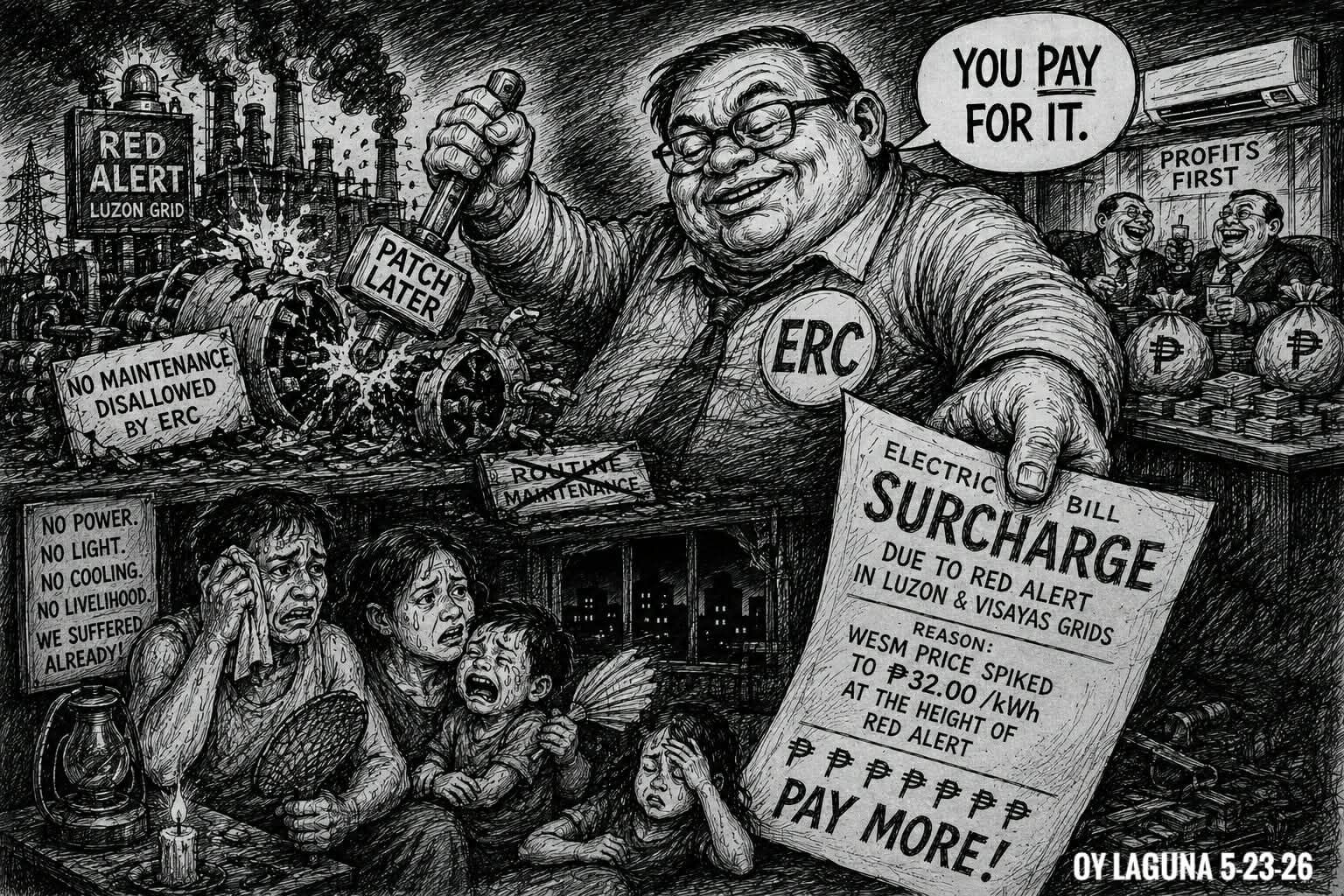

Last week, the Luzon grid was hit with a series of "red alerts" that resulted in whole parts of Laguna province without power for up to three hours.
The fact that this happened during what was traditionally the hottest month of the year in the Philippines left Lagunenses and others steamed, literally and figuratively.
The next week, the Energy Regulatory Commission (ERC), the main government body that is supposed to regulate electricity costs in the Philippines, delivered what could only be a foul blow.
That blow: a warning that electricity rates could go up in consumers' June bills because – and let us emphasize it here, BECAUSE – of the "red alert" issued on the Luzon and Visayas grids last week.
The ERC’s reasoning: electricity rates at the Wholesale Electricity Spot Market (WESM) shot up to the highest level of P32 per kilowatt-hour (kWh) at the height of the Red Alert, when demand for electricity exceeded the capacity of power plants to generate electricity.
To put it another way, it’s like those often-decried cases of “reckless imprudence” where the victim is blamed for the accident.
Speaking of which, a consumers’ group has asserted that it is the ERC’s disallowing of routine maintenance of several power plants (out of concerns that it will cause a shortage of electricity supply at a time when demand is at its highest) actually caused the very problem they were seeking to avoid.
Isn’t that a classic cause of “reckless imprudence” resulting in damage to the national economy?
And the ERC’s response is to pass on the costs of that reckless imprudence to the very people whose lives and livelihood were affected by last week’s rotational blackouts?
#WeTakeAStand #OpinYon #OpinYonNews #Editorial