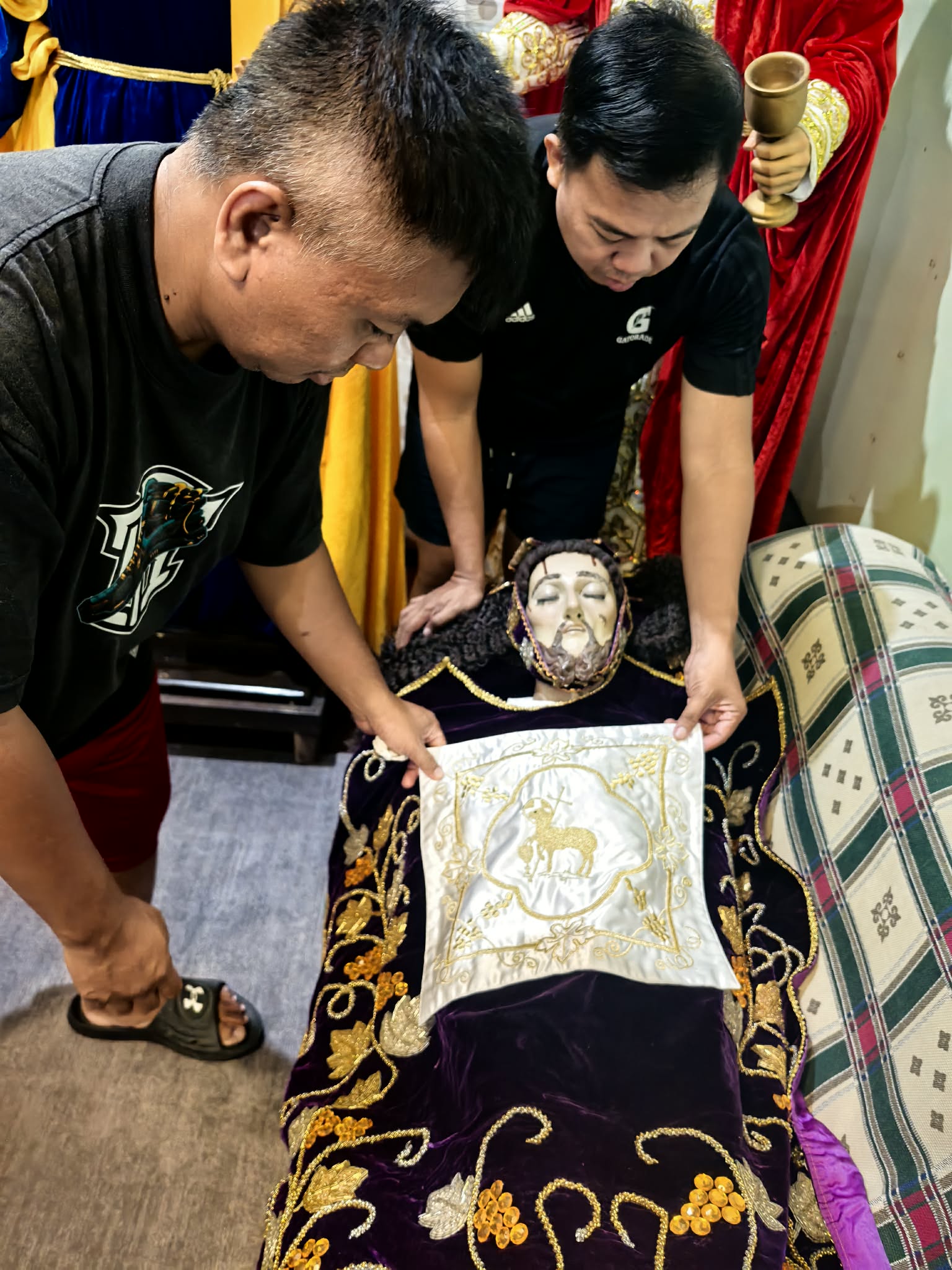

The Valdeavilla-Javal family of Tayabas City has lovingly preserved perhaps the oldest Santo Entierro since 1852 in Quezon Province, maintaining a rich legacy of faith, devotion, and tradition through generations.
Each Good Friday, Tayabas City come alive with the Santo Entierro, a figure cherished by all. The image has been meticulously maintained by the Valdeavilla family for generations.
Since 1852, the task of dressing and safeguarding the Santo Entierro has evolved into both an honor and a sacred obligation.
Now, the fifth generation, perhaps the oldest Santo Entierro in Quezon Province, represented by the Javal brothers, Joeffrey and Justin, continues this tradition. Their journey serves as a testament to the enduring power of faith, the significance of tradition, and the strength of family bonds.
A History of Faith and Survival
The Santo Entierro's story is inextricably linked to the tumultuous past of the nation.
During the Japanese occupation of World War II, the town was a place of turmoil and dread. In the midst of the violence and fear, the family matriarch—Joeffrey and Justin’s grandmother—put herself in danger to safeguard the revered image.
“My grandmother’s story, from the time of the Japanese, was that she carried the Santo Entierro.”
Kahit delikado, hindi niya binitawan. Inilayo niya ito para hindi masira dahil sa bombahan,” the brothers recall.
Thanks to her courage, the Santo Entierro survived the war, and with it, the family’s devotion endured—passing on the responsibility and blessing to every new generation.
A Garment Stitched with History
Among the Santo Entierro’s most treasured possessions is a garment hand-embroidered in Lucban as far back as 1911.
“Isa sa mga pinakapinagmamalaki naming damit ng Entierro ay yung tinahi sa Lucban noong 1911,” shares Justin.
Though it's seen many years, the intricate stitching and skilled work remain intact. The family cherishes it as an heirloom, a physical link to their heritage, and a sign of the love that has been handed down for more than a hundred years.
"Hanggang ngayon, itinatago pa rin namin at ginagamit sa piling pagkakataon—parang pamana ng pananampalataya,” he adds.
Semana Santa
For the Valdeavilla-Javal family, Holy Week mirrors the joy of Christmas. It's the year’s most eagerly awaited period, a time when the family unit, and indeed the whole community, unites.
Para sa amin, ang Semana Santa, parang Pasko na rin. Hindi lang kami-kami, pati buong komunidad, nagkakaisa," Justin shares with warmth.
The preparations are a joyful, shared experience.
Women from the area would arrive, arms laden with kalachuchi blossoms, ready to be woven into garlands for the Santo Entierro's karosa.
At noon, you'd see the women bringing in sacks of plumeria to their homes. They'd all sit together, stringing the flowers, laughing, and chatting as they worked. A scene of pure joy, like a celebration, but entirely devoted to their faith. He remembered it fondly.
Their shared beliefs and customs root the happiness and mirth that permeate their home during these times, making it as cherished as any holiday.
Early Processions: Anting-anting and Restoration
In the early processions, some devoted followers would take pieces from the image, especially from its feet, because they believed in the Santo Entierro's miraculous powers. They hoped to gain good fortune or healing or to use them as anting-anting.
"Noong unang mga prusisyon, may mga kumukuha talaga ng bahagi ng paa ng Santo. Katwiran nila, anting-anting at pampaswerte daw,” Joeffrey recalls.
These acts left the statue damaged, but through the family’s dedication, it was lovingly restored each time, returning the image to its former glory.
Today, however, the Santo Entierro is fully protected. It now rests securely behind glass inside the karosa, preventing anyone from taking even the smallest piece.
"Now, no one can get in because the Entierro is already in the carriage," Joeffrey says, his voice tinged with relief and gratitude.
Devotion in Every Stitch Each Good Friday
The Santo Entierro is dressed in its finest velvet. The air, back then, was thick with the perfume of kalachuchi, while women crafted modest, sweet-smelling bouquets.
"Sobrang bango niyan pag dumadaan ang prusisyon. Now, it's a bit harder to find, so different flowers are used, but we make sure it's still beautiful on the carriage," Justin says, his voice carrying a hint of wistfulness.
Maintaining this tradition requires considerable resources.
"Ang isang burdang damit, aabot ng ₱55,000 hanggang mahigit ₱100,000, depende sa sinulid at disenyo. Pero hindi namin iniisip ang balik-pera. Para ito sa pananampalataya at sa pamilya. Sabi nga namin parati, ‘God will provide,’” Justin explains with quiet conviction.
Heirlooms, Miracles, and the Spirit of Continuity
The family's respect for their past goes far beyond just looking after things.
Old embroidered garments are never dismantled for new ones.
“Mas gusto naming itago at ingatan ang mga luma, parang kayamanan ng pamilya,” Justin adds.
Their guardianship is also punctuated by enigmatic occurrences: misplaced locks of hair, unexplained sounds, or clothing mysteriously torn during the night. They interpret these as subtle nudges from the Santo.
Upholding Tradition Amid Challenge and Change
For Joeffrey and Justin, the preservation of their family's heritage is paramount.
"I don't have my children yet, but I'm teaching my nieces and nephews. Hopefully, it will continue on to the next generation," Joeffrey confesses.
Even after losing their father this month, the brothers pressed on.
"Isang buwan kaming abala bago dumating ang Mahal na Araw. Hindi puwedeng hindi ituloy, bilang pagpupugay at pagmamahal sa tatay namin,” Justin adds, a note of pride and longing in his voice.
Unmeasured Blessings
For generations, the Valdeavilla family's story, now continued by the Javal brothers, fifth in line since 1852, stands as a testament to faith, togetherness, and the willingness to give.
Their most cherished reward isn't measured in currency, but in the warmth that fills their home and the veneration they give to the sacred image.
For Justin, each day is a gift.
"Yung paggising sa umaga ay isa ng blessing," he says, a gentle smile touching his face. Joeffrey and Justine, as they readied the Santo Entierro, a quiet witness to so many expressions of devotion, nodded in agreement.
Through the passing years and the inevitable shifts in the world, the Valdeavilla-Javal family holds fast to their customs, ensuring the Santo Entierro's essence remains alive for those yet to come.
Their narrative speaks volumes about the lasting strength of devotion, kinship, and the past—a vibrant legacy that still resonates with those nearby.
Through each carefully placed stitch, every whispered prayer, and every act of devotion, they underscore a profound truth: genuine blessings aren't counted in possessions but in the love and faith we bequeath to the next generation.
#WeTakeAStand #OpinYon #OpinYonNews