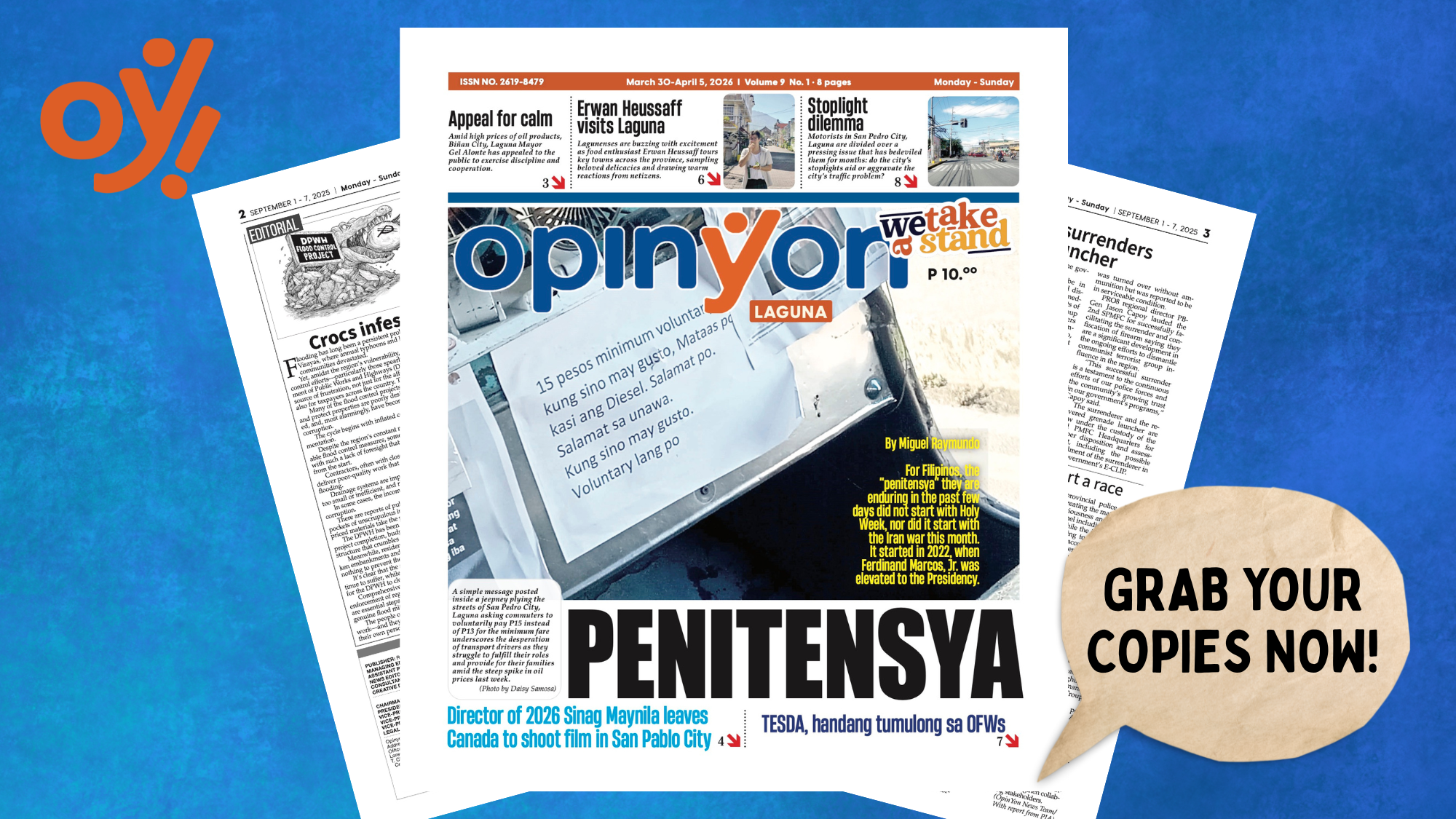

"15 pesos minimum voluntary kung sino may gusto, mataas po kasi ang diesel. Salamat po."
One sign posted inside a passenger jeepney in San Pedro City, Laguna says it all.
In a few words, that unnamed jeepney driver summarized the “penitensya” now being endured by majority of San Pedrenses – and Filipinos, in general – in the past few days.
Double the whammy
As Catholics once again prepare to commemorate the suffering and death of Jesus Christ, commuters and transport drivers alike found themselves caught in a real-life walk of penitence.
Prices of oil products shot as high as P125 per liter (for diesel products) this week, more than double the P50 to P60 per liter recorded before the US-Israeli strike in Iran this month.
Motorists were forced to take public transportation to get to work and school to save on gas.
But here’s the paradox: just as commuters needed them most, jeepney drivers found gasoline prices too steep to even continue operating their units, much less feed their families.
Even before the two-day strike that effectively crippled public transportation in San Pedro City from March 26 to 27, some jeepney drivers have reportedly been forced to suspend their operations due to the high oil prices and its domino effect on the prices of basic goods and commodities.
Not to mention the fact that the administration of President Ferdinand Marcos, Jr. deferred the planned raise in jeepney and modern PUV fares last week, claiming that it is ramping up measures to help transport drivers without resorting to fare hikes.
For many drivers, though, the deferred fare hike may be a death sentence for them and their livelihood.
It started in 2022
The truth is that the “penitensya” residents of San Pedro, Laguna (and Filipinos in general) did not start with the steep oil price hikes last week.
Nor did it start with the US-Israeli strike on Iran this month, which immediately created a ripple effect on the global oil supply chain and once again threatened to destabilize an already fragile region.
When did the penitensya start for Filipinos?
It started on June 30, 2022, when President Ferdinand Marcos, Jr. was elevated to the highest position in the country.
Right from the start, Filipinos found themselves ensnared in an ever-worsening trap of poverty, incompetence and massive thievery of public funds.
Remember that it was during the first months of the second Marcos administration that oil prices also shot up to nearly P100 per liter due to the (still ongoing) Russia-Ukraine conflict.
It appears that in the four years since then, government policymakers have never learned the lessons the Ukraine crisis brought, the simplest lesson of all: prevention is better than cure.
The result? Even Marcos himself has candidly said that our oil reserves could last only until June of this year, while the Philippines reportedly has the highest spike in oil prices in the whole of Southeast Asia due to the Iran War.
Corruption
And let’s not get started on the almost-buried issue of massive graft and corruption that was exposed to the public last year.
San Pedrenses who have suffered for decades due to runaway development, causing heavy floods that seemed to have become a way of life in some areas, have every right to be outraged when the scandal broke out in August 2025.
The billion-peso reason: ostensibly, the city was allocated P2.348 billion by officials of the Department of Public Works and Highways (DPWH) from 2023 to 2025 for flood-control projects, according to data gathered by OpinYon Laguna.
Imagine the shock and anger among concerned sectors when the weeklong monsoon rains on July 2025 demolished all pretense that these flood-control measures worked – or that they even existed at all.
As reported by OpinYon Laguna last year, majority of these projects were handed off to the controversial contractor couple Curlee and Sarah Discaya.
The Discayas are now compared to Janet Lim-Napoles, another personality who raked in billions from fake foundations in 2010, in their duplicity in securing billions of pesos in flood-control projects, allegedly with the complicity of corrupt government officials.
Bleak future?
And even today, as Filipinos continue to bear the brunt of the high costs of fuel products and its impacts on the national government, we are paying the dear price of a government that is more focused on political survival than on public service.
It wasn’t until last week, after continued insistence that there is “no crisis,” did President Marcos finally gave in to reality and declared a State of National Energy Emergency.
It was also last week that Congress – apparently too focused on the impeachment proceedings of Vice President Sara Duterte and their own political survival – finally passed “urgent” measures that should enable the government to implement measures to soften the impact of the high oil prices.
God save the Philippines!
(Photo by Daisy Samosa)
#WeTakeAStand #OpinYon #OpinYonNews #CoverStory