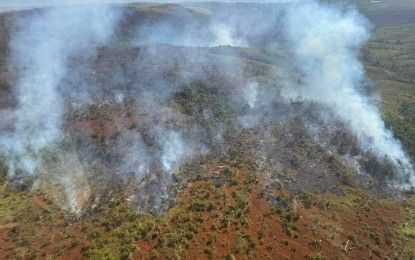

With the onset of the dry season and the possibility of a drier 2026 due to El Niño, authorities in Eastern Samar have warned against the danger of grassfires and forest fires in the province.
Office of Civil Defense (OCD) Regional Director Joel Erestain said practices such as carelessly throwing cigarette butts in areas with dry vegetation can easily spark a widespread fire that could cause extensive damage to property.
“It’s hot and dry during El Niño, so vegetation ignites quickly. Even cigarette butts can easily start fires, especially in areas covered with dry cogon grass,” Erestain told media.
He explained that beyond direct ignition, embers carried by strong winds pose a serious threat, as they can spark fires in nearby areas even after the initial flames are controlled.
“What’s dangerous are the embers. They can be blown by the wind and start fires elsewhere, even at night when people think conditions are cooler,” he added.
The Homonhon fire spread rapidly due to dry grass and windy conditions, highlighting the challenges faced by responders, particularly in remote island areas where access is limited.
The grass fire that began April 15 has affected 100 hectares area in the island.
To contain the blaze, government agencies coordinated response efforts, including the deployment of helicopters from the Philippine Air Force equipped with “Bambi buckets” to assist in fire suppression.
Personnel from the Bureau of Fire Protection (BFP), local government units, and regional responders were also mobilized to contain the fire and prevent it from spreading further.
Erestain noted, however, that while the use of seawater can help extinguish fires, "it may also affect crops due to its salt content.”
The OCD official emphasized the need for preventive measures, particularly during the dry season, as fires can easily escalate under El Niño conditions.
“We need to remove materials that can fuel fires, like dry grass. Community preparedness is key, especially during the dry season,” Erestain said.
He urged communities to strengthen disaster preparedness down to the barangay level, noting that early action can prevent small fires from becoming large-scale incidents.
“We always prepare for the worst-case scenario. It’s better to be ready for the worst than to be caught unprepared,” he added.
(With report from PNA)
#WeTakeAStand #OpinYon #OpinYonNews