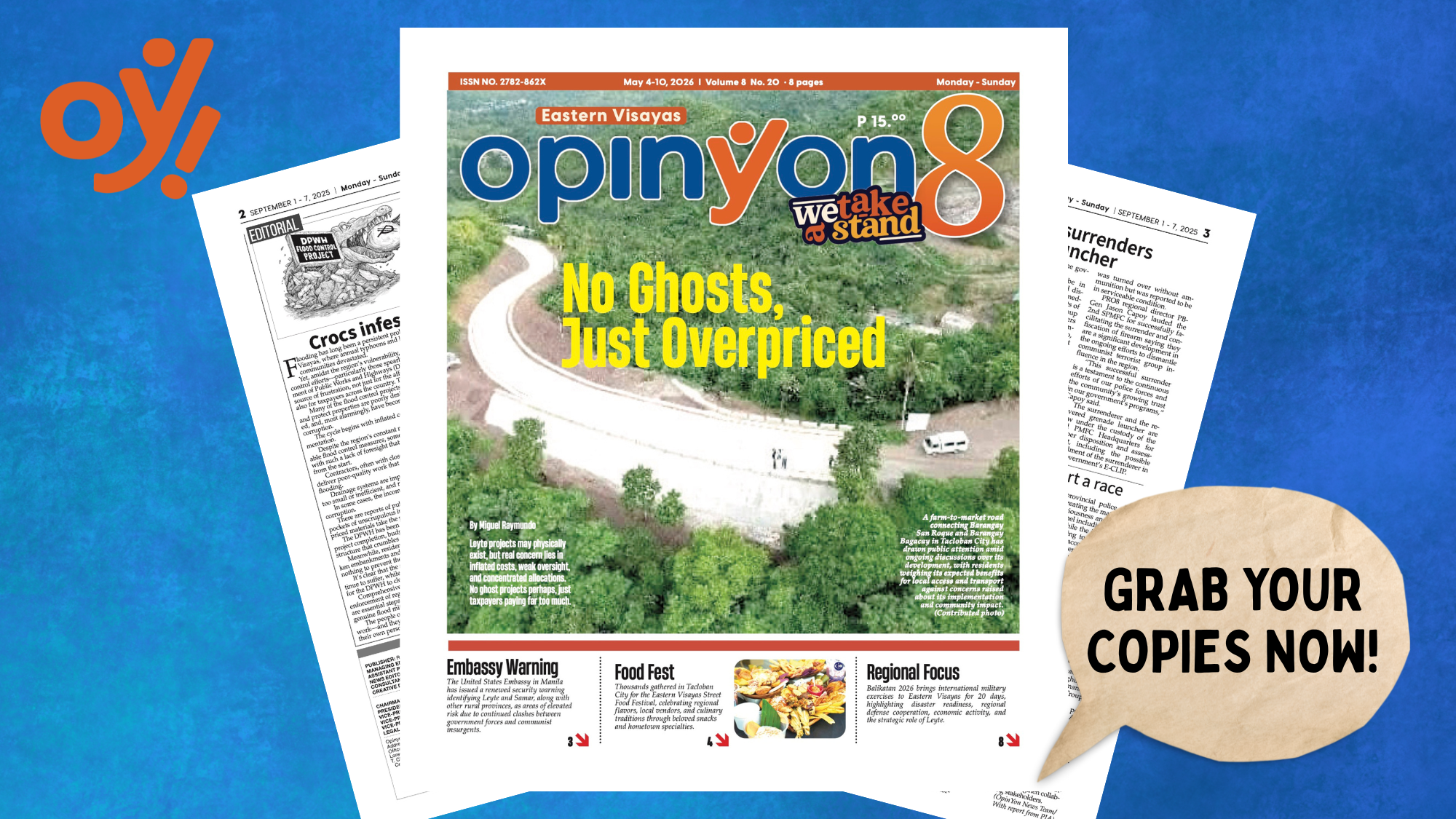

When Leyte Representative Martin Romualdez insists there are no ghost projects in Leyte, he may be arguing the wrong case.
The sharper question is not whether projects exist on paper or even in concrete. It is whether taxpayers are getting fair value.
In public works, a road can be real and still be scandalous. A floodwall can stand and still be overpriced. The absence of ghosts does not prove the presence of honesty.
Romualdez and his allies have repeatedly defended questioned farm-to-market road (FMR) projects in Leyte, saying these passed validation by the Department of Public Works and Highways (DPWH) and the Department of Agriculture (DA).
They argue higher costs were due to steep terrain, slope protection, drainage systems, and right-of-way complications. In short: expensive, yes, but justified.
That defense deserves scrutiny because “technically explainable” is not the same as “economically reasonable.”
A project may need retaining walls and drainage, but the public still deserves benchmark comparisons, transparent unit costs, and independent validation.
How much per kilometer? How much for excavation? How much for slope protection versus concrete paving? Without that breakdown, “engineering reality” can become a convenient slogan.
The bigger context is troubling. The Commission on Audit (COA) found that DPWH failed to efficiently implement P138 billion worth of locally funded projects in 2024 due to weak planning, engineering, supervision, and monitoring.
COA also flagged 747 projects worth P6.5 billion as unusable, idle, or defective. These are not isolated bookkeeping errors.
They point to a system where inflated costs, delays, weak oversight, and poor outputs can thrive even when structures physically exist.
That matters in Leyte because the political defense often narrows the debate to “ghost or not ghost.” But corruption in infrastructure has evolved.
It is no longer limited to invisible bridges or imaginary flood controls. It can be hidden in padded estimates, repetitive variation orders, overdesigned specifications, favored contractors, or concentration of projects in politically powerful districts.
A road that costs twice what it should is not a ghost, it is a transfer of public money disguised as development.
Even Senator Sherwin Gatchalian’s earlier concern was not merely about existence, but about the unusually high concentration of FMR allocations in Romualdez’s district from 2023 to 2025, along with allegedly elevated costs.
That should trigger comparison, not applause. Why so many projects there? How were priorities set? How do those costs compare with similar terrain elsewhere in Eastern Visayas or Mindanao?
Leyte residents know infrastructure is not abstract. Roads determine farm income. Flood controls decide whether homes survive storms.
Every excess peso in one contract is a peso lost from classrooms, hospitals, drainage, and genuine rural access.
So the public should reject the false binary. The issue is not ghost versus no ghost. It is value versus waste.
If Romualdez wants to close the issue, he should release full project documents: detailed estimates, bid abstracts, contractor histories, variation orders, accomplishment reports, and third-party engineering audits.
Let independent experts compare the numbers.
Until then, the most accurate headline is not “No Ghost Projects.”
It is No Ghost, Just Over Priced.
(With report by the OpinYon Research Team)
#WeTakeAStand #OpinYon #OpinYonNews #COA #DPWH #GhostProjects