
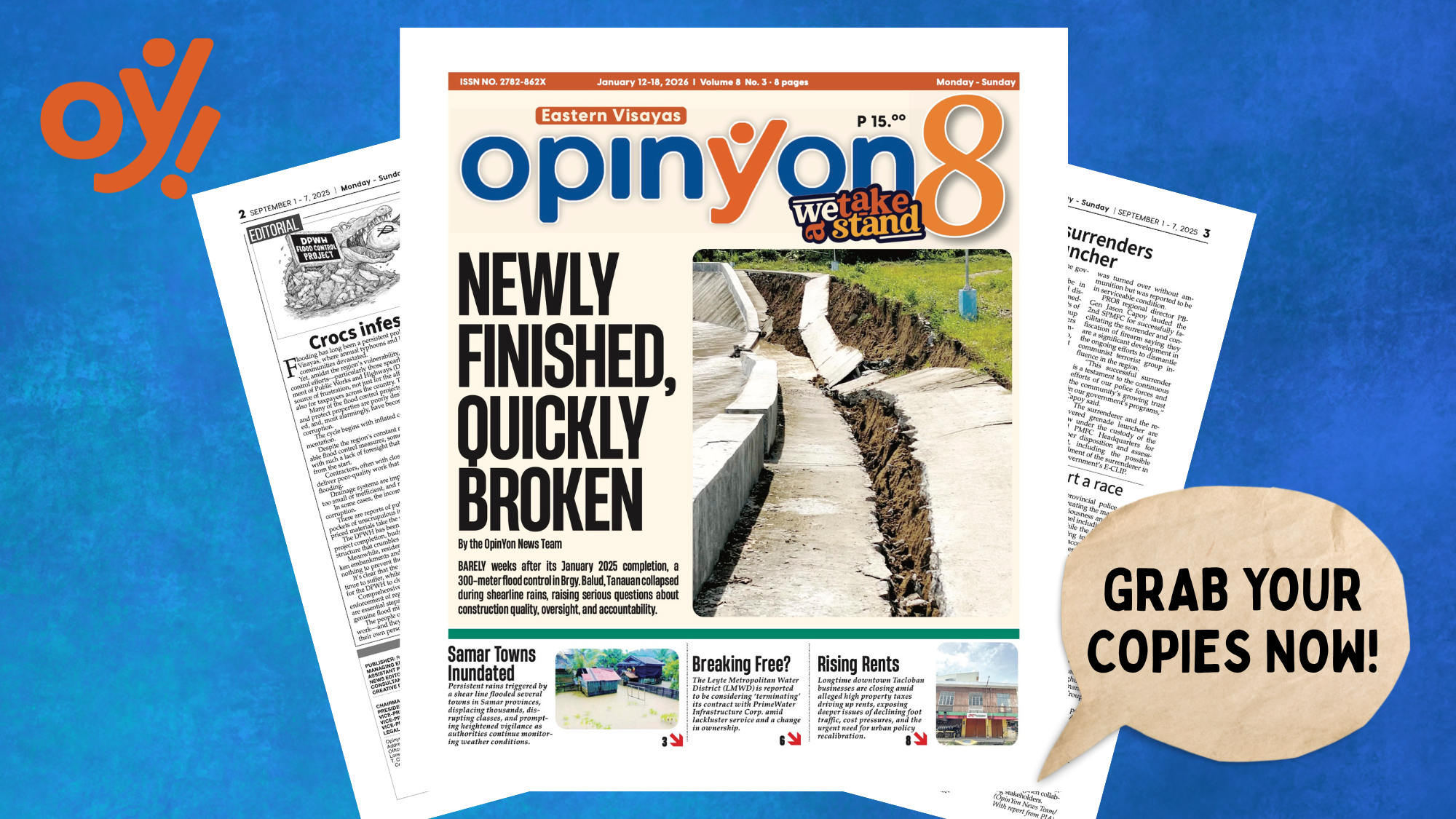



A flood control project meant to shield Barangay Balud from the swelling Binahaan River in Tanauan, Leyte has instead become a stark symbol of infrastructure failure, after roughly 300 meters of the structure collapsed during heavy rains triggered by a shearline, only weeks after its reported completion.
According to barangay officials, the flood control was recently completed in January 2025 and constructed by Aqualine Construction Corporation, making the collapse not just alarming, but deeply unsettling for a community long accustomed to broken promises of protection.
Videos and photos taken by residents show long stretches of concrete embankment giving way, leaving the riverbank exposed and nearby homes once again vulnerable to flooding.
What makes the incident more troubling, barangay officials said, is that the portion that failed was initially a “back job”, a term commonly used at the community level to refer to remedial or corrective work done on a section previously identified as problematic.
That the reinforced section still collapsed has fueled doubts about the project’s integrity and the standards used in its execution.
A Collapse That Raises Hard Questions
The failure occurred amid days of sustained rainfall caused by a shearline, a weather system that brings prolonged rain rather than the short, intense bursts associated with typhoons.
Such conditions are neither rare nor unexpected in Eastern Visayas, where flood control structures are specifically designed to withstand prolonged river swelling.
Yet in Balud, the newly finished embankment worth Php96,440,245.88 did not hold.
For residents, the timing is impossible to ignore. A structure completed in January should not be failing before the first quarter of the year has ended.
Flood control projects are designed not merely for fair weather, but precisely for periods of elevated river pressure, the very scenario that led to this collapse.
Barangay officials stressed that the failure was not a minor crack or localized damage, but the giving way of hundreds of meters of river protection, rendering the remaining sections ineffective and potentially destabilizing adjacent areas.
Silence Where Scrutiny Is Needed
As of this writing, there has been no detailed public technical explanation from implementing agencies on why the structure failed, nor any released assessment clarifying whether the collapse was due to design limitations, construction quality, soil conditions, or hydrological forces.
Meanwhile, Aqualine allegedly sent laborers and workers to repair the damaged areas.
However, this absence of immediate transparency has widened public frustration. For communities like Balud, flood control projects are not abstract line items in a budget, they are lifelines. When these lifelines fail, accountability cannot be optional or delayed.
The involvement of a private contractor and the recency of completion place this project squarely within the window where warranty, compliance, and post-construction responsibilityshould be clearly enforceable.
The public deserves to know whether proper inspections were conducted before turnover, and whether warnings particularly about previously identified weak sections were adequately addressed.
Not an Isolated Concern
Tanauan is no stranger to flooding. The municipality, composed of dozens of barangays situated near river systems and low-lying areas, has endured repeated flood events over the years.
Flood control projects have been promoted as long-term solutions, often at great public expense.
But the collapse in Balud echoes a broader concern seen across flood-prone areas: that structures are sometimes built to meet completion deadlines rather than long-term resilience standards.
When climate patterns are becoming more unpredictable and rainfall more intense, infrastructure failure is no longer a technical inconvenience, it is a public safety risk.
Beyond Repairs, Toward Accountability
Fixing the collapsed section alone will not be enough. What Balud requires, and what the public should demand, is a full, transparent review of the project from design assumptions and materials used, to construction methods and oversight.
If a portion already identified as problematic and subjected to corrective work still failed, then the question is no longer “what broke”, but “why warning signs were not enough to prevent collapse”.
Flood control is built on trust. Trust that public funds are used responsibly, that standards are followed, and that communities will be protected when the rains come.
In Barangay Balud, that trust has been shaken not by an extraordinary storm, but by a structure that did not last even a season.
The rains will return. The river will rise again. Whether accountability rises with it remains the real test.
#WeTakeAStand #OpinYon #OpinYonNews #CoverStory