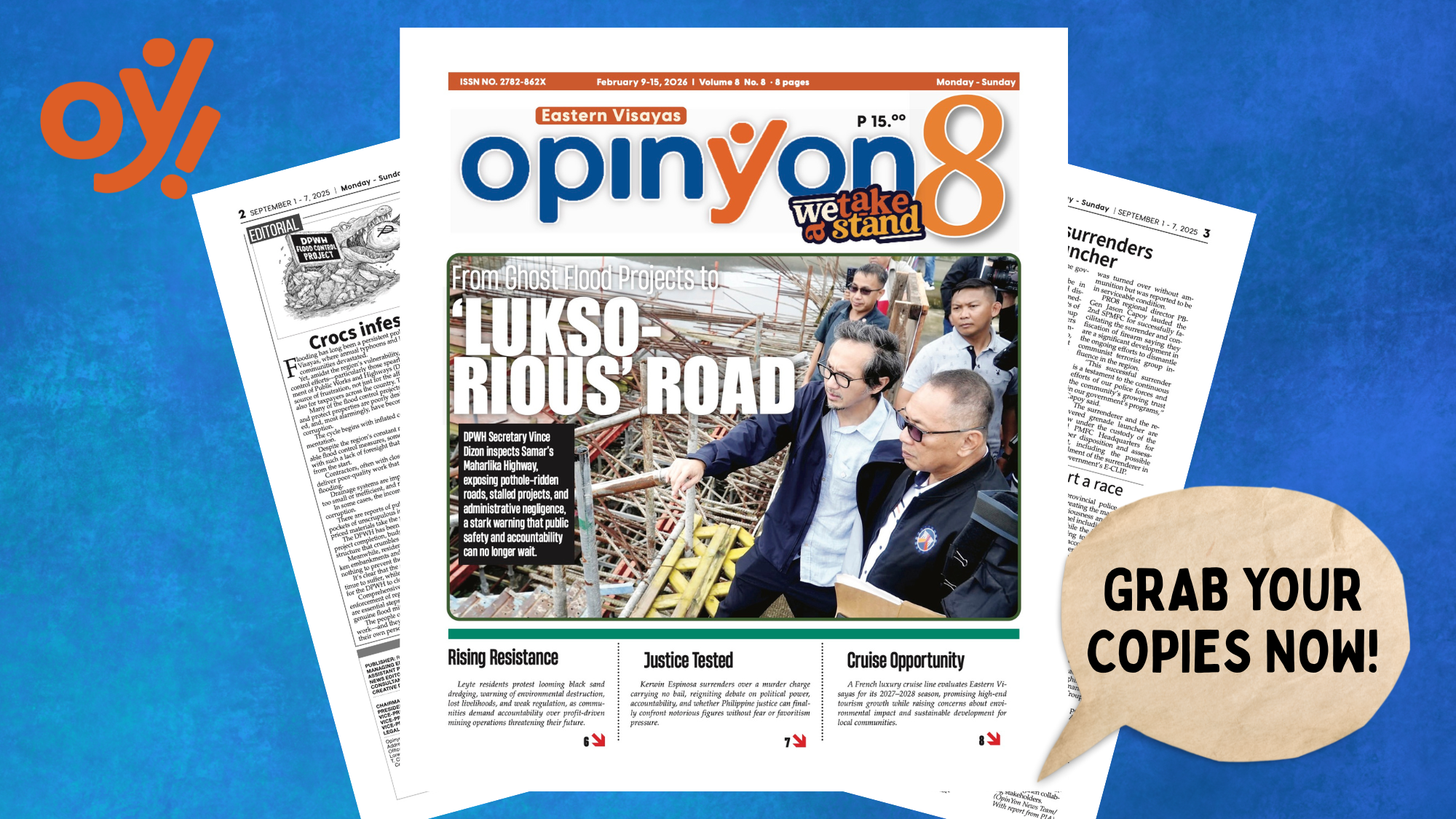

Scolding is not enough. Fire them! Sue them for negligence! Them, are Department of Public Works and Highways (DPWH) officials responsible for failure to keep in good condition that part of Maharlika highway in Samar.
DPWH Secretary Vince Dizon, lately did an ocular inspection of the Maharlika Highway that has become a butt of joke, described now as ‘Lukso-rious’ road. Lukso is waray-waray local dialect for jump.
And Secretary Vince saw for himself a national highway that is more like an off-road endurance test road, a dirt road, prompting the dressing down of engineers involved.
During a recent inspection of Samar’s road network, Dizon found himself jolted through cratered stretches of the Maharlika Highway, a supposedly vital artery of the country’s transport system. This same sorry state of the highway was evident in Quezon province.
The trip was slow, punishing, and telling, a firsthand encounter with what Samar motorists endure daily.
At several points, vehicles were forced to crawl at near walking speed as deep potholes, uneven pavement, and mud-filled depressions turned the highway into what locals grimly describe as a “lukso-lukso” road.
In some sections, the road surface had deteriorated so badly it resembled a dirt track rather than a paved national highway.
This is no minor provincial route. The Maharlika Highway runs more than 200 kilometers across Samar and forms part of the 3,500-kilometer backbone linking Luzon, Visayas, and Mindanao.
Yet DPWH data presented during the visit show that around 30 percent of the highway nationwide is already damaged, with Samar among the most neglected.
The condition of the road is not just embarrassing, it is dangerous. Motorists routinely swerve into opposing lanes to avoid deep holes.
Public utility vehicles slow to a crawl, stretching travel times and raising fares. Emergency response is delayed. Accidents are no longer anomalies but expectations.
Dizon, visibly frustrated, did not frame the issue as inconvenience. He called it what it is: a public safety failure.
Roads do not collapse to this extent overnight. What Samar’s highways reveal is a long trail of deferred maintenance, substandard repairs, and weak supervision that allowed deterioration to reach a critical point.
Fixing the damage will not be cheap. DPWH estimates that nearly ₱30 billion will be required to rehabilitate the Maharlika Highway in Samar alone, including full reconstruction, drainage upgrades, and slope protection.
This is not an expansion budget, it is the cost of recovery from years of neglect.
And the failures do not end with roads.
In Calbayog City, Dizon confronted another example of broken governance: the unfinished Calbayog Coastal Bypass Road. Intended to ease congestion, the project has instead become a stalled structure, years behind schedule.
The reason, Dizon pointed out publicly, is inexcusable. The construction allegedly began without securing clearance from the Philippine Ports Authority (PPA), a basic requirement for coastal infrastructure.
The DPWH secretary openly scolded District Engineer Raulito Yangzon, a rare but pointed moment that cut through the usual bureaucratic politeness.
Proceeding without clearance, Dizon said, reflects either negligence or a disregard for procedure, both of which waste public funds and erode trust.
The bypass road now stands as a physical reminder of how projects fail not because of a lack of money, but because of poor planning and accountability gaps at the implementation level.
Elsewhere in Samar, aging bridges add another layer of risk. Several structures are now under weight restrictions or further assessment, raising fears of disruptions, or worse, structural failure, if problems remain unresolved.
For residents, these are not abstract policy discussions. Bad roads mean higher transport costs, damaged vehicles, lost work hours, delayed medical care, and isolation.
In a province already vulnerable to typhoons, weak infrastructure magnifies every disaster.
Dizon’s visit stripped away any remaining excuses. When a national highway feels like a dirt road, the problem is no longer invisible. It is felt in every jolt, every delay, every near-miss on the road.
Whether this firsthand experience leads to real accountability or fades into another unfulfilled inspection, will determine if Samar’s roads remain a symbol of neglect or finally become what they were always supposed to be: highways, not hazards.
#WeTakeAStand #OpinYon #OpinYonNews #CoverStory