



“OK ka lang?” These three words are one of the most hard-to-say among Filipinos, especially in today’s world.
Even as mental health and well-being are becoming more and more talked-about in the Philippines, those suffering from depression and other mental health-related issues still find it a challenge to find relief.
According to a 2024 study conducted by students from the Ateneo de Manila University, chief challenges include “lack of prioritization and insufficient budget for the mental health agenda, fragmentation of health services, absence of community-based guidelines, inadequacy of mental health facilities and personnel, and weak political will among lawmakers.”
Add to this the prevailing attitude among Filipinos, who often prefer to hide behind the “everything is fine” facade, to dismiss the concerns of people suffering from mental illness as a passing issue, or worse, as “pag-iinarte.”
But a recent study conducted by students from the University of the Philippines (UP) Manila has highlighted the urgent need for stakeholders in Laguna province to prioritize mental health.
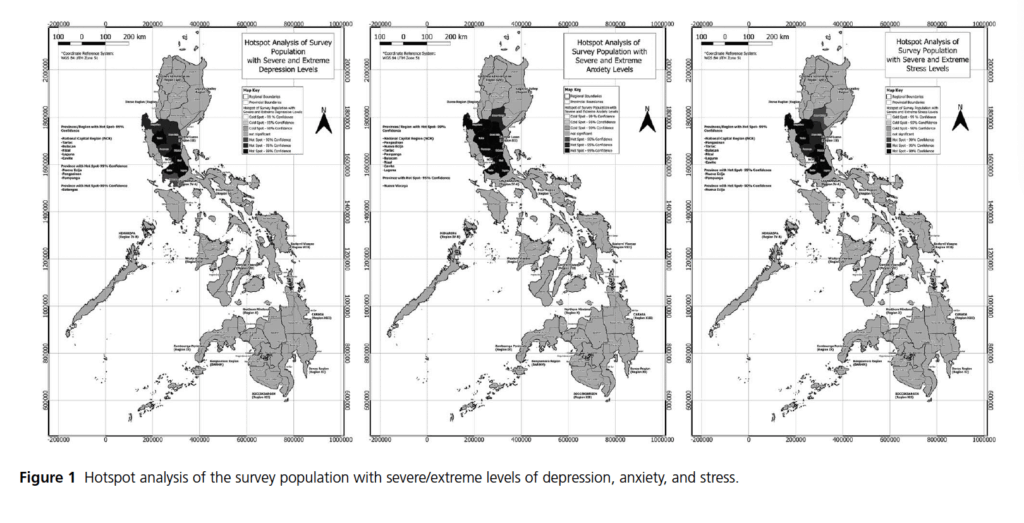
The reason: according to that study, Laguna province can now be considered as a “hotspot” for "severe and extreme levels" of depression, especially among the youth.
‘Depression clusters’
The study, entitled "Levels of depression, anxiety, and stress among emerging adults in the Philippines: an exploratory spatial analysis," aimed to identify spatial clusters of depression, anxiety, and stress among Filipino emerging adults.
"Despite the enactment of the mental health law, mental illness in the Philippines is the third most prevalent form of morbidity; hence, screening is warranted, especially among Filipino emerging adults," the researchers, led by Zypher Jude Regencia of the College of Medicine at UP Manila, explained in their study.
"The study advances the application of spatial epidemiology in mental health research and supports the call for improved accessibility to mental health services in the Philippines," they added.
While studies have explored the extent of mental health issues, especially among young Filipinos, this study was among the first to identify “depression clusters,” or places where the youth are more prone to such issues.
The study collected data from 2,779 Filipino emerging adults (those under the 18- to 29-year-old range) through an online self-administered survey.
Analysis of the data showed that Laguna province, as well as Pangasinan, Nueva Ecija, Tarlac, Pampanga, Bulacan, Rizal, Cavite, and the National Capital Region (NCR), have the highest prevalence rates of severe and extreme distress.
These conditions were most prevalent among early emerging adults and females, the group noted.
"Our findings highlight the need for localized mental health interventions, particularly in identified hotspot areas, where community-based screening and support programs can be prioritized," the study abstract postulated.
“By integrating spatial analysis with mental health data, we provide an evidence-based framework to enhance public health strategies and address mental health disparities among emerging adults. Future studies should examine socioeconomic and environmental factors influencing these patterns to develop more comprehensive, targeted solutions," the researchers added.
The study was published in the June 2025 issue of the Oxford University Press' Journal of Public Health.
#WeTakeAStand #OpinYon #OpinYonNews