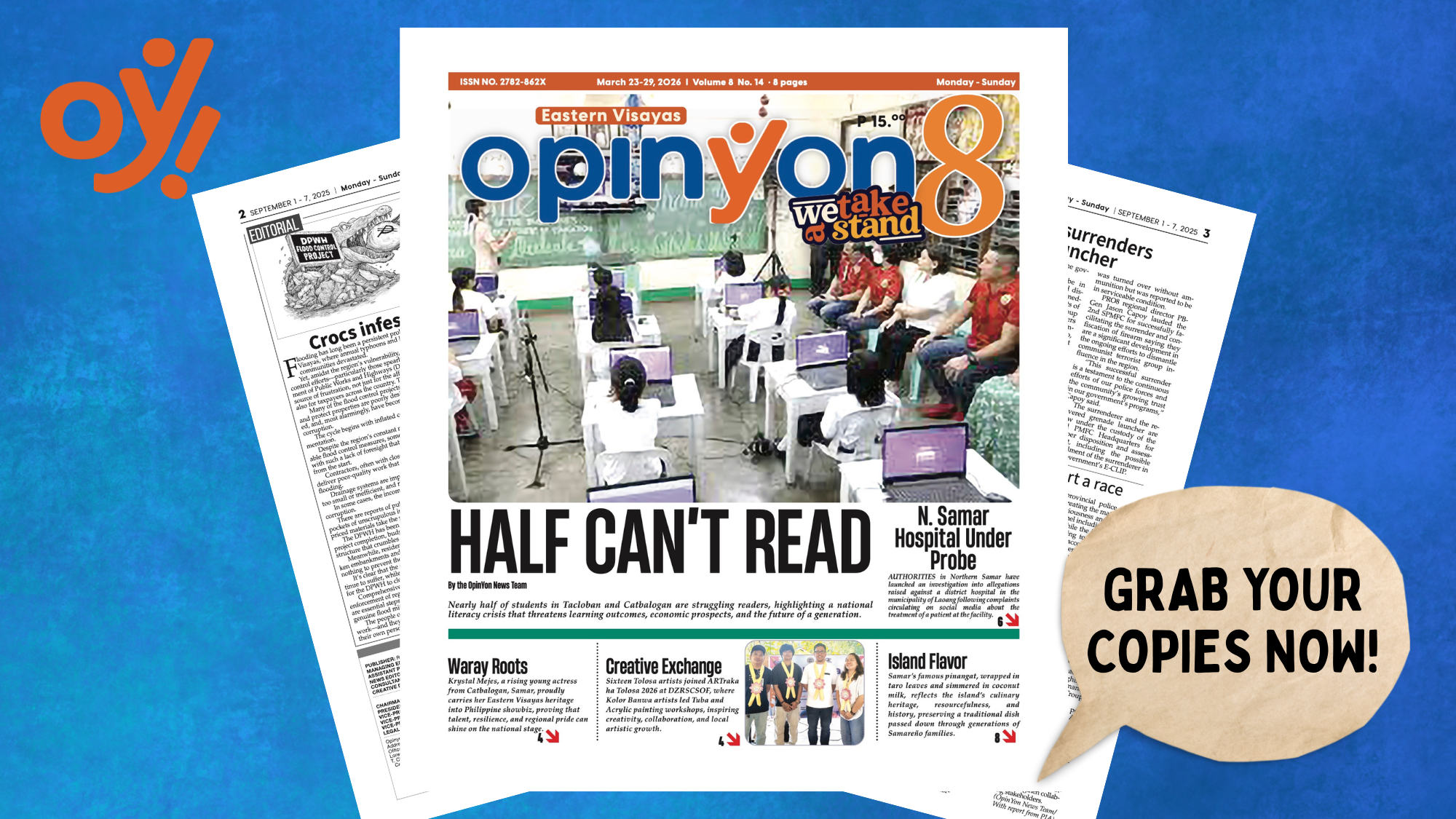

City and Catbalogan City have emerged as stark symbols of the Philippines’ deepening literacy crisis, after new data released by the Second Congressional Commission on Education (EDCOM II) showed that roughly half of their early-grade learners are struggling readers.Tacloban
Based on the Department of Education’s Comprehensive Rapid Literacy Assessment (CRLA) cited by EDCOM II, around 49.95 percent of learners in Tacloban City and 50.87 percent in Catbalogan City are considered struggling readers or students unable to read at the level expected for their grade.
The figures place both cities squarely within a national pattern of severe foundational learning gaps, where reading, the most basic academic skill, remains out of reach for a significant share of Filipino children.
A crisis in the making
The latest findings are part of EDCOM II’s sweeping evaluation of the Philippine education system, which describes the country as facing a “learning crisis.”
Nationally, 48.76 percent of Grade 3 learners are not reading at grade level, according to the commission’s final report.
The implications extend far beyond elementary school.
Early literacy is widely regarded as the foundation for all other learning. When children cannot read by Grade 3, they struggle to understand lessons in other subjects, creating a learning deficit that compounds year after year.
EDCOM II data shows how dramatically these gaps widen. While about 30.52 percent of Grade 3 learners are considered proficient, proficiency collapses further along the education pipeline with only 19.56 percent by Grade 6, 1.36 percent by Grade 10, and 0.4 percent by Grade 12 meet proficiency standards.
These numbers reveal a harsh reality wherein the system is failing to build foundational skills early, leaving students increasingly behind as they move up the grades.
Regional implications
For Eastern Visayas, the CRLA results serve as both a warning and a call to action.
Tacloban and Catbalogan are not alone. Across the country, some divisions report even higher proportions of struggling readers, particularly in disadvantaged areas.
In the Bangsamoro region, for instance, divisions such as Tawi-Tawi report struggling reader rates exceeding 75 percent, highlighting the stark inequalities in learning outcomes nationwide.
Yet the near-50 percent figures in two major Samar and Leyte cities show that the literacy problem is not limited to geographically isolated or conflict-affected areas. Even in regional urban centers with better school access, the ability to read remains alarmingly fragile.
Education analysts point to a mix of structural and social factors.
Among them is the lingering impact of pandemic-era learning loss, when prolonged school closures disrupted the development of foundational literacy. But EDCOM II emphasizes that the crisis predates COVID-19 and reflects deeper systemic problems.
The commission cites several contributing factors including limited access to early childhood education, widespread child malnutrition, teacher shortages, and policies that promote students despite weak academic performance.
Another challenge lies outside the classroom. Studies cited by EDCOM II show that children from homes with few books or limited parental literacy often struggle more in school, reinforcing the link between household conditions and educational outcomes.
Actions taken
Local education officials say interventions are already underway.
In Tacloban, thousands of learners identified as struggling readers have been placed in targeted reading programs, including summer tutorials and literacy remediation sessions aimed at bringing students back to grade level which is allegedly also being adapted in other districts in the province.
But educators acknowledge that remediation programs alone may not be enough to reverse years of learning deficits.
EDCOM II has called for a nationwide shift toward strengthening foundational literacy in the earliest years of schooling, supported by stronger partnerships between schools, parents, and local governments.
Ultimately, the reading crisis carries consequences far beyond education statistics.
Literacy shapes a student’s ability to learn, graduate, and participate in the economy. Without it, the promise of schooling itself becomes uncertain.
For cities like Tacloban and Catbalogan, the numbers are more than data points, they are a warning about the future of a generation.
And unless the country acts decisively, today’s struggling readers may become tomorrow’s struggling workforce.
#WeTakeAStand #OpinYon #OpinYonNews