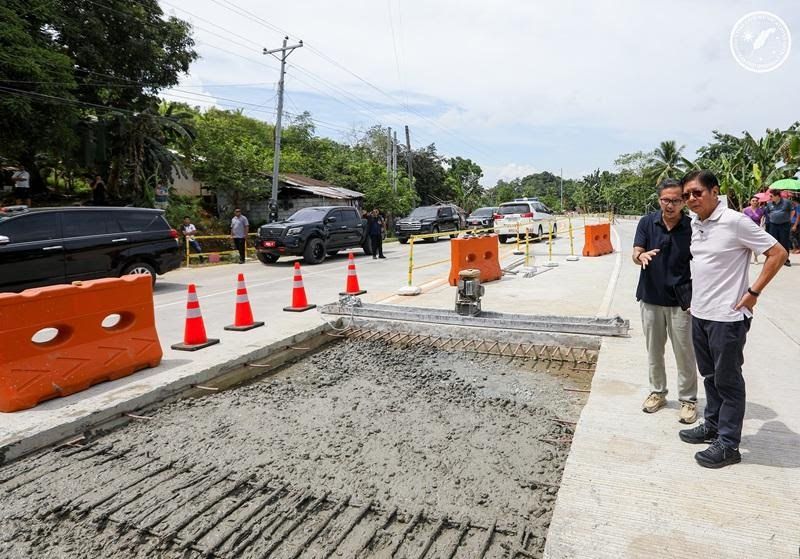

While President Ferdinand Marcos Jr. was inspecting a highway rehabilitation project in Samar last week, the Philippine Senate was struggling to function amid one of its most chaotic political episodes in recent memory.
On one side of the country, cameras followed the President as he examined the ongoing rehabilitation of the Maharlika Highway in Pinabacdao, Samar, a project government officials say will improve mobility, strengthen interconnectivity, and reduce travel time between Tacloban City and Catbalogan City.
The administration presented the visit as evidence that government remained focused on infrastructure and economic development.
The road project is scheduled for completion in August.
On the other side of the political universe, the Senate was locked in a bitter power struggle that temporarily paralyzed legislative business.
Rival blocs fought over leadership, quorum, and control of the chamber, all while the institution prepares to handle the politically explosive impeachment proceedings involving Vice President Sara Duterte.
President Marcos himself publicly urged senators to "get back to work" as the deadlock intensified.
Individually, neither story is unusual. Roads need to be built.
Legislatures fight over power. Both are part of democratic governance.
Together, however, they paint a troubling portrait of a Philippine political system whose major actors increasingly appear to operate on different planets.
The Samar inspection represented the language of governance: roads, connectivity, logistics, economic opportunity.
The Senate crisis represented the language of political survival: alliances, rival camps, leadership contests, impeachment calculations, and institutional brinkmanship.
Citizens watching both stories unfold could be forgiven for wondering whether the country's leaders understand that these events are connected.
Infrastructure projects do not exist in a vacuum.
They require functioning institutions, credible budgeting, legislative oversight, and public confidence. Likewise, political crises do not stay confined to Senate halls.
They influence investor sentiment, policy continuity, government credibility, and ultimately the state's capacity to deliver services.
Yet the public spectacle often suggests a disconnect.
The President stands beside engineers discussing asphalt and timelines. Senators trade accusations about legitimacy and procedure.
One branch projects stability. Another projects dysfunction.
The result is not balance. It is fragmentation.
Ordinary Filipinos do not experience government in separate compartments.
A farmer in Samar does not distinguish between "infrastructure governance" and "political governance."
A commuter does not care whether delays originate from a failed road project or a paralyzed legislature.
A small business owner does not separate economic opportunity from political uncertainty.
They experience government as a single reality.
When roads are repaired, people benefit.
When political institutions descend into chaos, people also pay the price.
That is why the symbolism of the past week matters.
The administration's message from Samar was that development continues.
The message from Manila was that political combat remains the dominant currency of national leadership.
Both messages are true.
The danger is that national leaders appear to believe they can exist independently of one another.
They cannot.
A road inspection does not insulate the government from a credibility crisis in Congress.
Political turmoil does not become harmless simply because construction projects continue moving forward.
The country's institutions rise or fall together.
The rehabilitation of the Maharlika Highway may indeed shorten travel times and improve economic activity in Eastern Visayas.
That is a tangible achievement. But roads alone cannot compensate for public institutions that appear consumed by internal warfare.
At some point, the nation's leaders must recognize what ordinary citizens already know: there is only one Philippines.
The road in Samar and the chaos in the Senate are not separate stories.
They are the same story.
One is about where the country is trying to go.
The other is about whether its leaders are capable of getting there together.
#WeTakeAStand #OpinYon #OpinYonNews