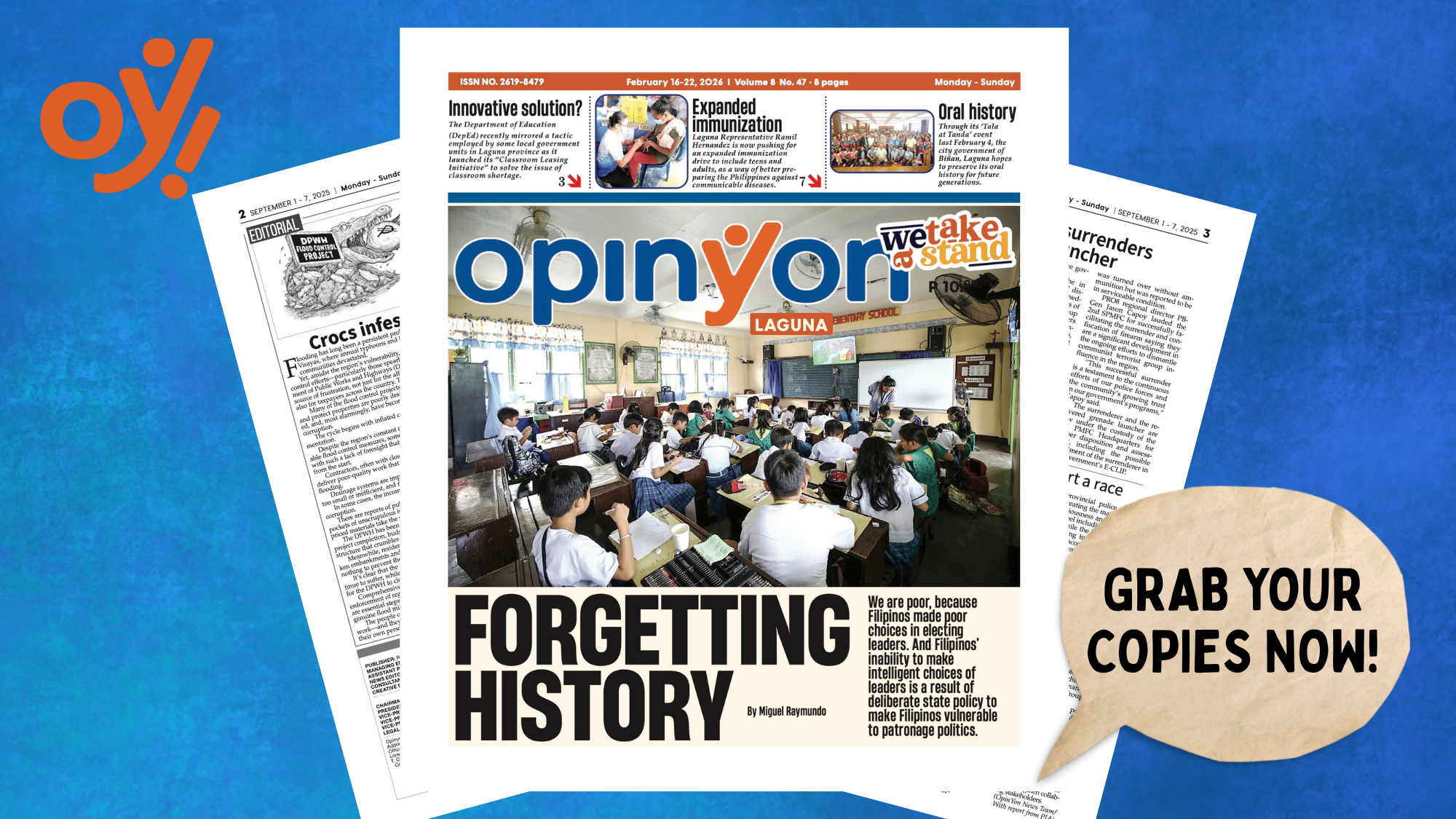

No matter how hard the government's propaganda machinery tries to spin it, prospects for Filipinos remain dire in 2026.
The country recently fell six places at the international 2025 Corruption Perceptions Index (CPI).
This reflects recent surveys showing a gradual loss of public trust in the government's capability to solve corruption.
Another "Trillion Peso March" slated later this month is expected to inflame the anger and rage of Filipinos furious at government inaction and shielding of its allies from the law.
The Philippines' inflation rate also quickened to 2 percent last January, from 1.8 percent in December 2025.
Unemployment rates, while remaining steady at 4.4 percent last December, masked the fact that millions of Filipinos are barely scraping by with their daily wages or now have to work two jobs in order to survive.
The main reason for the mess we are in right now? Filipinos have forgotten the lessons of the past – left behind by a system that favors an ignorant populace.
EDCOM 2 report
That the average Filipino can’t even comprehend what is happening to their country is reflected in the recent report by the Second Congressional Commission on Education (EDCOM 2), which essentially confirmed that our education sector is now in a crisis.
Look at the statistics: 88 percent of Grade 7 students are still “unable” to read at that level, while 40 to 52 percent of all junior high school students “are at least two grade levels down in reading.”
Only 30 percent of students who reach Grade 3 are considered “proficient” in their subjects. By the time they reach Grade 12, that number drastically drops to 0.4 percent – less than one percent!
Another factor in the Filipino’s “tendency to forget,” according to some educators, is the decision to scrap the teaching of Philippine History at the secondary level under the new curriculum that was implemented following the enactment of the Enhanced Education Act of 2013.
In most cases, too, the study of Philippine history and culture is also relegated to mere memorization of dates, names and facts.
Students often didn’t have a chance to discuss, much less understand, the impacts of these historical events in their everyday lives and in their future.
Underfunded
The alarming decline in Filipinos’ ability to grasp their understanding of history and culture can be traced to the simple fact that education in the Philippines has been given low priority in past decades.
The 2026 General Expenditures Act (GAA) puts the budget for the Department of Education (DepEd) at P1.015 trillion, the “highest” in history according to the administration.
Critics, however, believe that it still falls way short of what is needed to bring Philippine education back from a state of “comatose.”
ACT Teachers Partylist France Castro said the 2026 allocation represents only 4.4 percent of the Philippines' gross domestic product (GDP).
This meant that the 2026 budget for the country's education sector falls short of the international standard of at least 6 percent.
It shouldn’t be a no-brainer why education in the Philippines has been so underfunded and why politicians have been disinterested in elevating our country’s education sector, much less getting Filipinos interested in their history and culture.
The late Senator Miriam Defensor Santiago herself had the best way to put it: traditional politicians are scared of intelligent voters.
Political oligarchs, aided by business oligarchs, have found the perfect combination to keep the populace under their snares: keep them poor and ignorant at the same time.
‘Walang pakialam’
The lack of knowledge interest in the average Filipino in their history and culture have raised concerns that they are now also apathetic (“walang pakialam”) about changing the course of their own country's history.
BJ Borja, head of the Biñan City Culture, History, Arts and Tourism Office (BCHATO), himself believes that what is needed is to revive interest not only in history but also in art and culture among the masses, particularly the youth.
Borja has led a series of programs aimed at reviving interest among Biñanense youth in local history, the most recent being the “Tala at Tanda” event during February 4 where elderly Biñanenses were given a chance to share their own experiences with a new generation.
Kailangan munang buhayin ang kamalayan ng tao kung paano nababago ng sining at kultura ang mundo. Only if mare-realize ng mga tao na bawat minuto o oras ng kanilang buhay ay napapaligiran ng sining at kultura, yun ang magiging rason...na magiging part siya ng nation-building," he explained in a message to OpinYon Laguna.
#WeTakeAStand #OpinYon #OpinYonNews #ForgettingHistory