
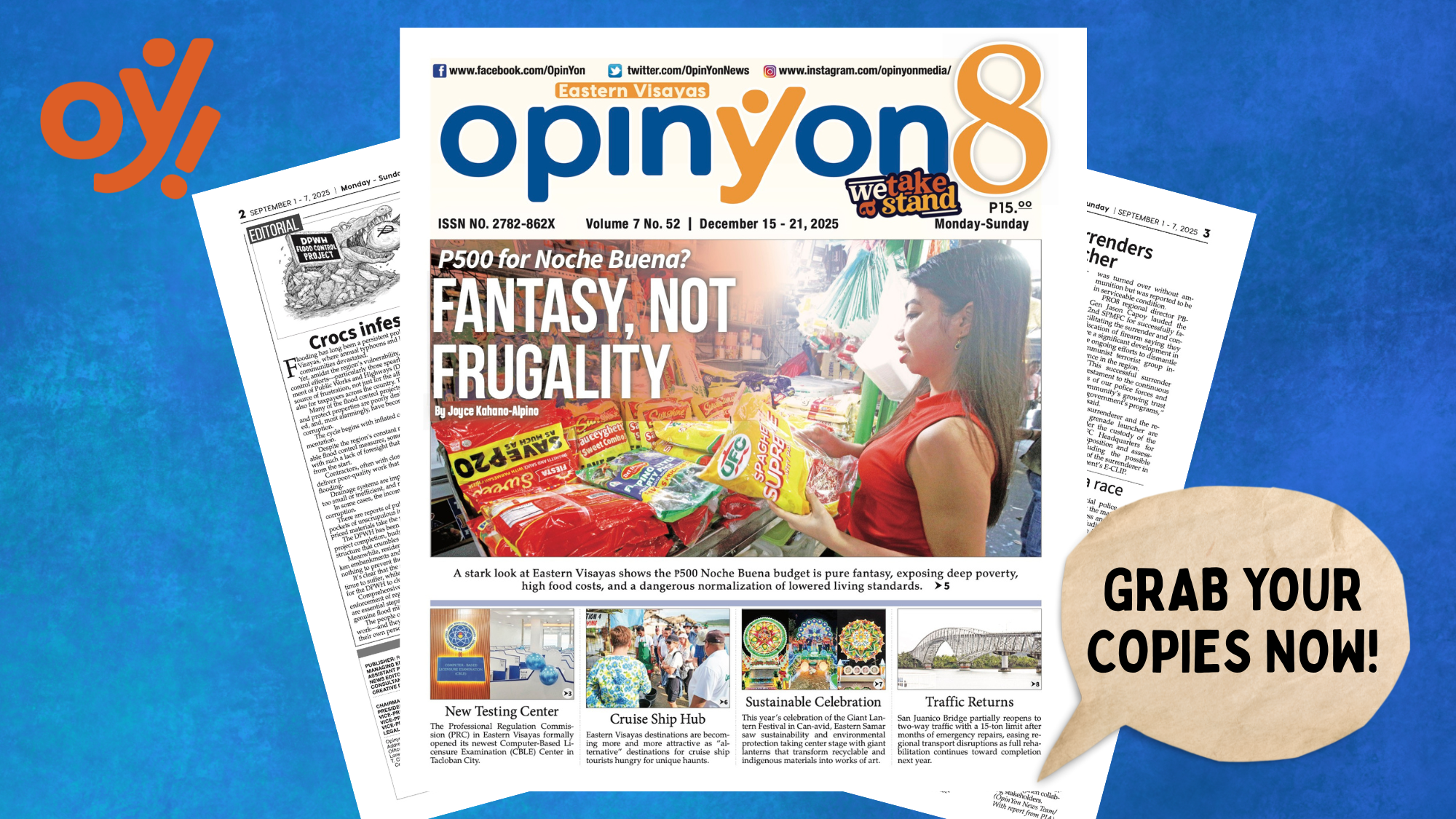



In 2023, about 1 in every 5 families in Eastern Visayas lived below the poverty threshold, that’s a poverty incidence among families of 20.3 percent.
For a family of five in the region to meet even their basic minimum food and non-food needs, the regional benchmark is an average of ₱13,492 per month.
Against that backdrop, officials or commentators who suggest that ₱500 is enough for a Noche Buena meal are effectively ignoring the reality that many families already struggle just to meet the basics, much less afford something “extra” for Christmas.
In real-world markets around the region, for example, data for Tacloban City give a telling glimpse that even a minimal “everyday” food basket for one adult (enough for ~2,400 calories/day) costs ₱472.64 per day.
Multiply that by five persons for a single day and you’re already past ₱2,000, well over four times the proposed Noche Buena budget.
Even if families scale down to the cheapest possible “Asian-style” diet staple (rice, eggs, etc.), Tacloban-area price data suggest about ₱310.96 per person/day just for basic nourishment.
That’s still roughly ₱1,550 for five people for one day and again more than triple ₱500, before adding any “festive” items such as meat, ham, fruit and other extras.
Meanwhile, wages in the region remain modest. As of December 2025, the daily minimum wage in Eastern Visayas was adjusted to ₱422–₱452 depending on the sector.
Even assuming full attendance, a minimum-wage worker would need many days of full pay just to cover one “bare-minimum” meal for a family of five and that’s without considering other essential monthly expenses.
Thus the “₱500 Noche Buena” budget doesn’t map to the cost of living or income realities in Eastern Visayas.
It isn’t thrift. It’s a demonstration of how far off the suggested “budget” is from actual socioeconomic conditions.
What’s worse, promoting ₱500 as adequate for a “decent” holiday meal implicitly lowers the bar on what constitutes dignity and comfort.
It sends a message that people whose monthly basic-needs threshold is over ₱13,000 should be happy with a symbolic, bare-bones dinner.
That’s not just unrealistic, it’s condescending.
In a region where roughly one-quarter of families are poor and many are already stretched over basic subsistence, holiday meals should not become a national performance of “resilience”, they should highlight the need for real economic uplift such as stable jobs, living wages, and social support that makes dignity the baseline, not the exception.
If ₱500 becomes the official benchmark for Christmas dinners, what does that say about how far policymakers think ordinary Filipinos should hope to go?
Because in places like Eastern Visayas, ₱500 doesn’t buy celebration.
It buys a reminder of how little our government officials look at the Filipinos and how they romanticize resilience to cover incompetence of its leaders.
And to think that Leyte province is home to former House Speaker Martin Romualdez, who is now aspiring to become the next President of the Philippines.
#WeTakeAStand #OpinYon #OpinYonNews #CoverStory #500PesoNocheBuena