
Local government units across Eastern Visayas are beginning to reshape how government work is done as they adapt to the newly implemented four-day workweek, a policy that blends fiscal necessity with the realities of modern governance.
Beginning March 9, several provincial and municipal governments in the region shifted to a compressed workweek following the directive of President Ferdinand Marcos Jr. through Memorandum Circular No. 114.
The policy requires government offices to complete the standard 40-hour workweek within four days, usually from Monday to Thursday, with longer daily hours.
Under the new setup, many offices now operate from 7:00 a.m. to 6:00 p.m., extending daily hours but reducing operational days in an effort to conserve electricity and fuel amid rising global oil prices.
Early adopters in Eastern Visayas
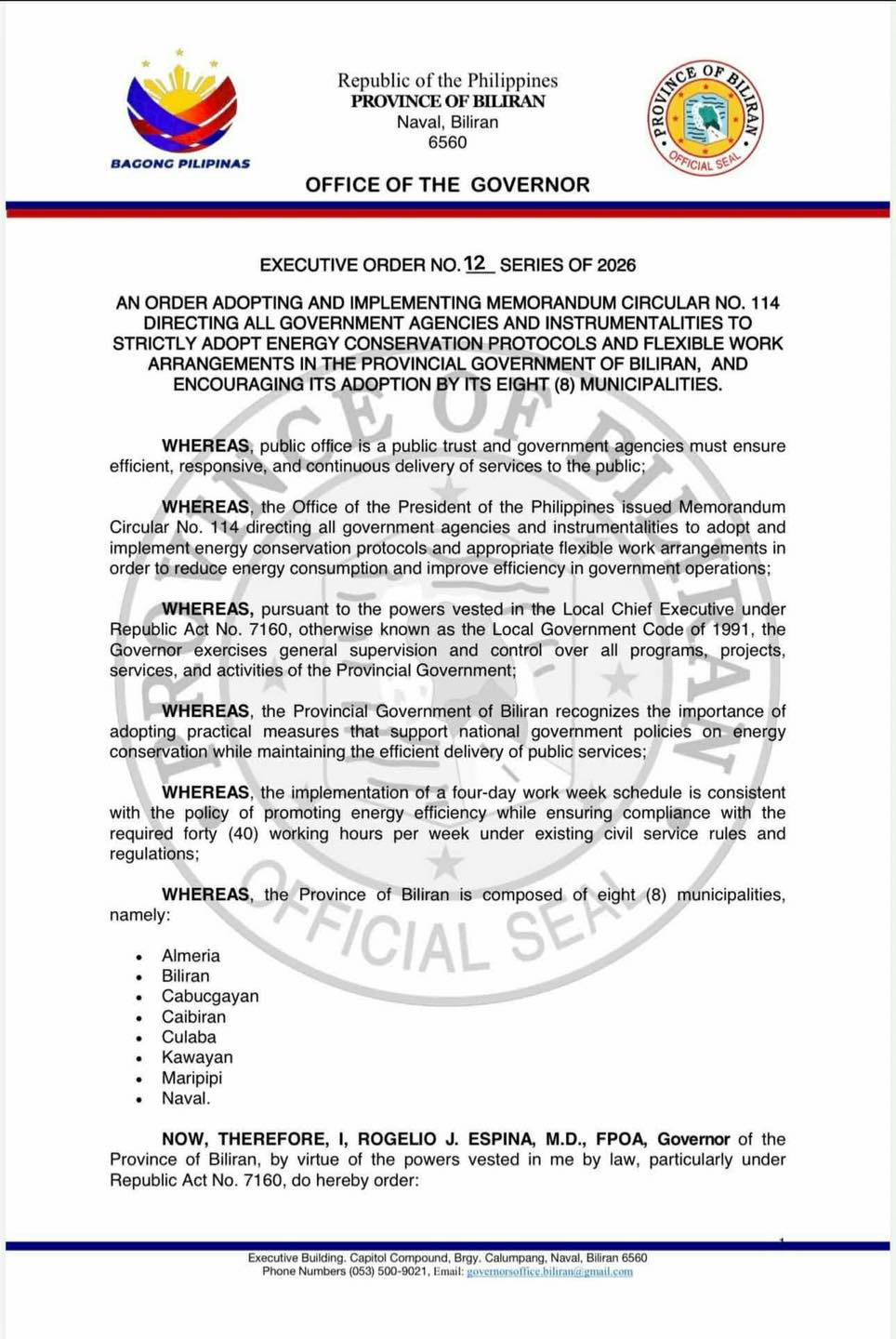
Among the first to implement the compressed workweek is the Province of Biliran, which rolled out the arrangement across provincial government offices.
Biliran Governor Rogelio Espina said the schedule change aims to balance energy conservation and public service delivery.
“There will be a 10-hour workday for four days a week to still complete 40 hours,” Espina said, urging government employees and residents to follow the new schedule.
In Naval, the capital town of Biliran, Mayor Gretchen Espina issued Executive Order No. 36, advising residents to plan official transactions within the new working hours while assuring that essential services will remain uninterrupted.
Other LGUs in the region have followed suit. Maasin City in Southern Leyte, led by Mayor Luz Mercado, adopted the compressed schedule through Administrative Order No. 25, citing the need to cut electricity use and respond to rising fuel costs.
Meanwhile, the municipality of Pinabacdao in Samar also implemented the four-day schedule as part of energy conservation efforts while maintaining government efficiency.
Several municipal governments including Macrohon in Southern Leyte have likewise issued public advisories confirming the shift to a compressed workweek for local offices.
Essential services remain open
Despite the reduced office days, local governments emphasize that frontline services will not be disrupted. Health offices, disaster response units, sanitation services, and public safety agencies remain on regular schedules to ensure continuous service delivery.
“Essential and emergency services will continue operating without interruption,” one LGU advisory noted, emphasizing the importance of maintaining access to public services even during operational adjustments.
An experiment in governance
Beyond energy conservation, the policy reflects a broader shift in how local governments think about productivity and efficiency.
The national government has urged agencies to reduce electricity and fuel consumption by 10 to 20 percent, part of a wider austerity strategy linked to global energy uncertainties and rising fuel costs.
Still, the policy is not without critics. Some residents worry that fewer office days could complicate transactions, particularly for those traveling from remote municipalities.
Yet the early response from many LGUs in Eastern Visayas suggests cautious optimism. If services remain efficient while operational costs drop, the four-day workweek may prove more than a temporary crisis response, it could become a practical model for a more flexible and sustainable local government system.
For now, the region is learning whether or not good governance is not about working more days, but about working smarter.
#WeTakeAStand #OpinYon #OpinYonNews #EVFourdayWorkWeek