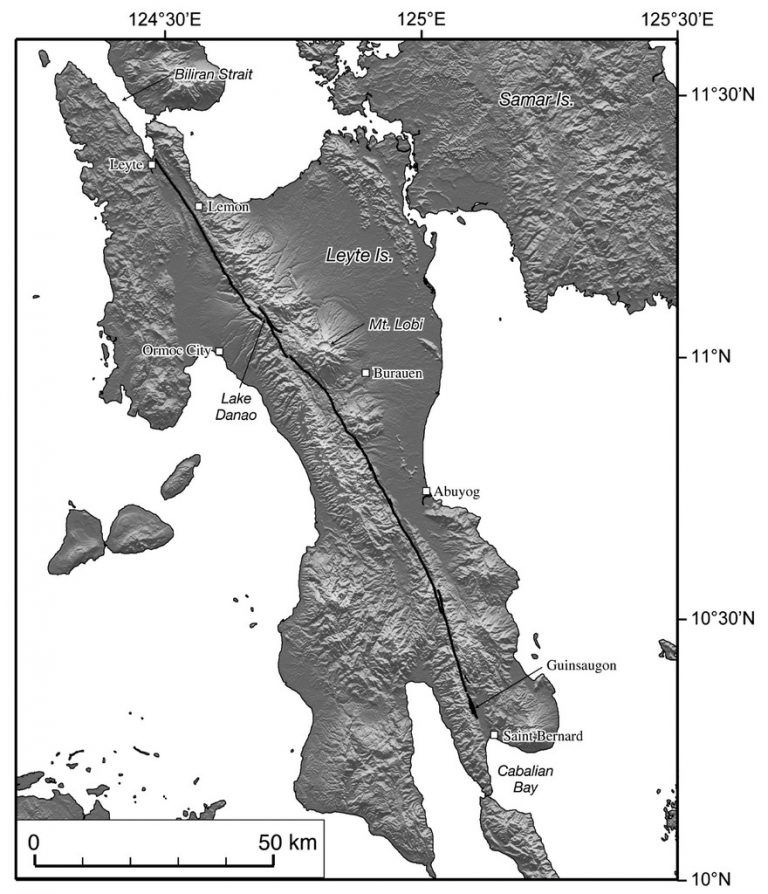

Leytenos may not know it, but deep below the island is a hazard that can strike at any moment, according to officials of the Department of Science and Technology (DOST).
At a recent Maghanda Summit in Palo, Leyte, Philippine Institute of Volcanology and Seismology (Phivolcs) senior science research specialist Jeffrey Perez once again raised awareness on the presence of the Central Leyte Fault line - a fault that according to officials is “ripe” for a possibly strong earthquake.
Perez noted that the fault segment, which runs from Burauen, Leyte, to Saint Bernard in Southern Leyte, has not moved in more than 100 years.
“There have been no movements of this fault since the Spanish colonization; it is capable of generating a magnitude 7.1 earthquake that will affect not just Leyte, but other parts of Eastern Visayas,” Perez said.
The segment is connected to a 24-km. fault line that moved on July 6, 2017, an event that killed four people and injured over a hundred others in Kananga and Ormoc City.
The Leyte Island fault line is a component of the 1,200-km. Philippine Fault Zone, a major tectonic feature transecting the archipelago from Luzon to Mindanao.
This left-lateral strike-slip fault has been the source of historical large-magnitude events, including the 1990 Luzon earthquake and the 2003 Masbate earthquake.
Experts noted that the high seismic risk posed by the zone requires large-scale active fault maps as fundamental datasets for regional hazard mitigation.
DOST Secretary Renato Solidum explained that tectonic pressure continues to build up because friction locks the rocky surfaces of the faults in place.
“Energy stored increases if it doesn’t move; at some point, it surpasses the friction threshold, leading to sudden movement and earthquakes,” Solidum said.
(With report from PNA)
#WeTakeAStand #OpinYon #OpinYonNews