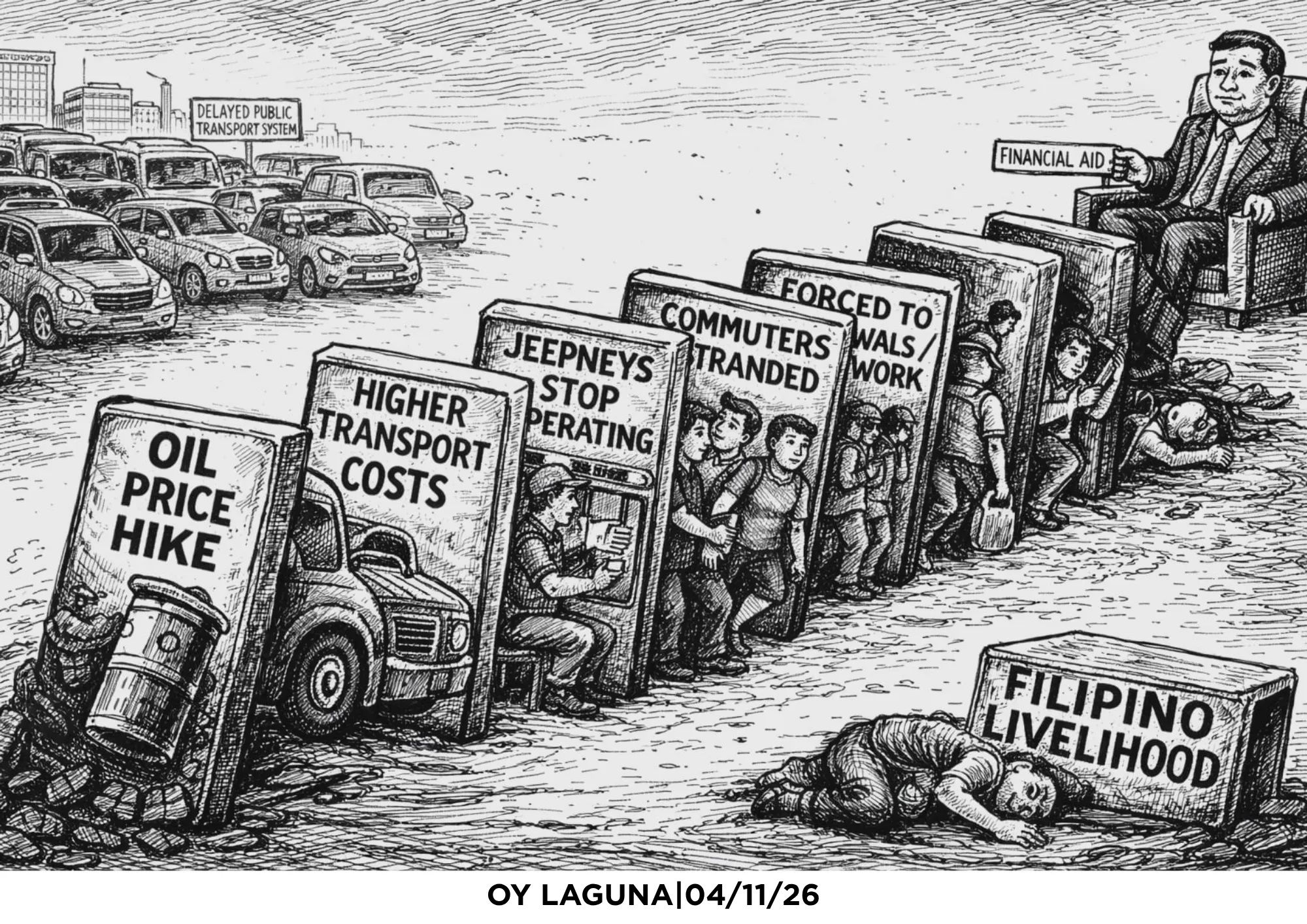

We are now witnessing the projected “domino effect” of the spike in oil prices on the lives of ordinary Filipinos.
And we’re not just talking about the corresponding rise in the price of basic commodities as traders adjust to the high prices of oil products in the past few weeks.
Let’s talk about the disruptions in our everyday routines, as Filipinos caught in the worst doldrums of this crisis now face desperation.
Consider our public transportation sector, now seen as one of the main bulwarks of keeping our everyday routine in the midst of this crisis.
The supreme irony is that Filipinos who own a car are now forced to take public transportation to get to work or school and back home.
Meanwhile, transport companies and cooperatives are now forced to cut back their trips, while jeepney drivers have suspended their operations as their daily income can hardly cope with the current oil prices.
This meant that commuters are now faced with a growing scarcity of public transportation – a symptom, and a result, of our national government’s focus on a “car-centric” transport policy and slow development of our public transport sector.
To put it bluntly, simply providing financial assistance to drivers affected by the oil crisis is a mere palliative measure that won’t address the already worsening issue of the lack of viable mass-transport options.
What needs to be done is a change in policy – and a change in culture.
But what can we expect from a government who is clearly stalling on even implementing the most basic of measures to mitigate the impact of this current crisis on our everyday lives?
#WeTakeAStand #OpinYon #OpinYonNews #Editorial #OilPriceHike