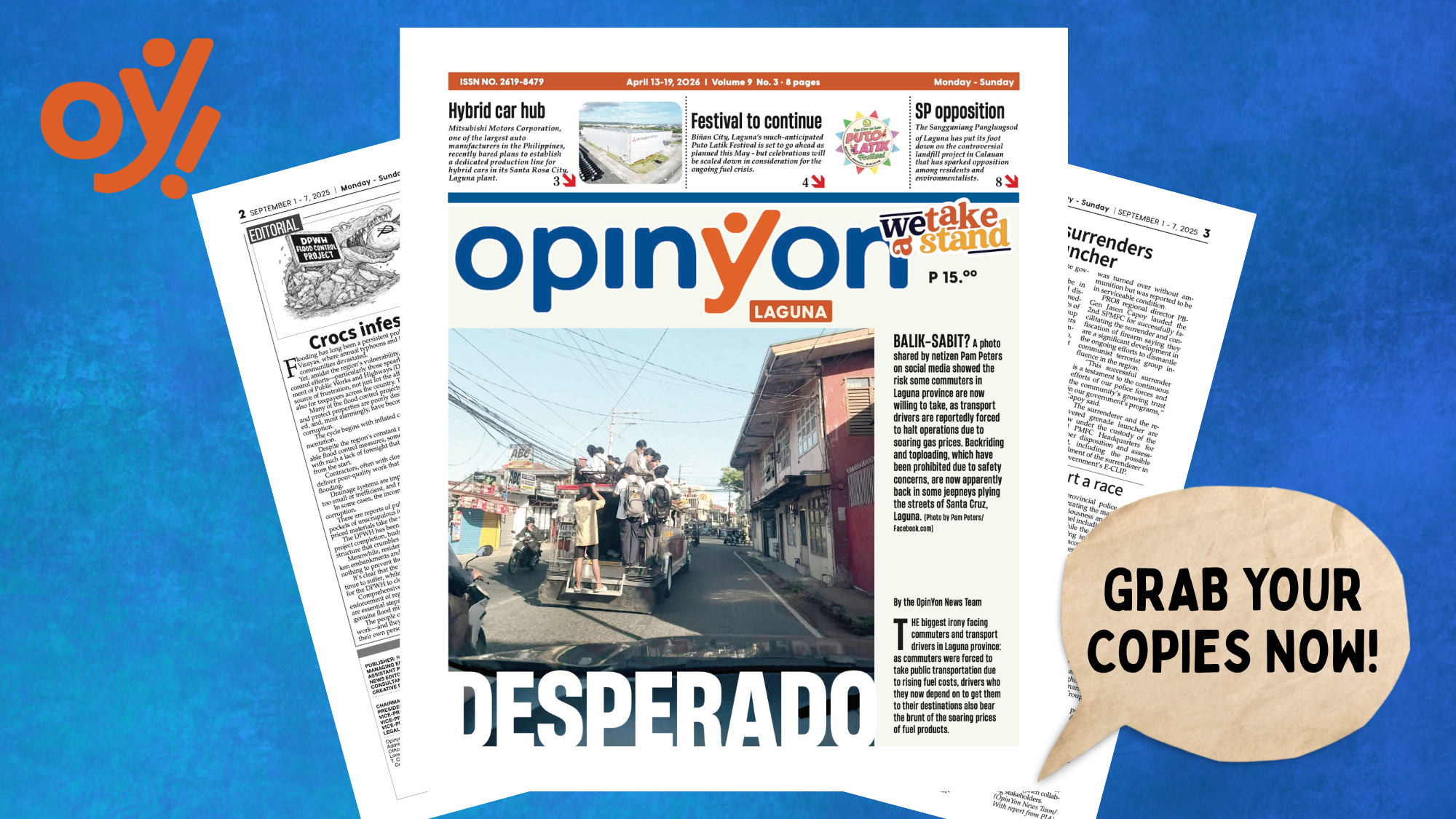

A video shared by netizen Pam Peters on Facebook last April 7 showed the desperation of commuters and transport operators alike as they coped with the continuing hike in oil prices.
That video showed a group of commuters – mostly students – hanging on the back or perched on the roof of a passenger jeepney in Santa Cruz, Laguna.
Although once common in the provinces, back-riding and toploading has been prohibited on public utility jeepneys in past years, primarily due to concerns for passengers’ safety.
Now, however, with no end in sight to the oil crisis, the dangerous trend is reportedly making a comeback on Laguna’s roads.
"Nakakalungkot na umabot na sa ganito. With the continuing rise of oil prices, mauubusan na talaga ng jeep sa daan and this would be the daily life of commuters," Peters commented on her post.
Caught
As prices of diesel, the primary fuel of public utility vehicles, breached the P165 per liter mark last week, many transport drivers are now caught in a dilemma.
The dilemma: how to effectively serve their commuters while at the same time providing for their families, as their daily revenues now barely cover their daily fuel expenses.
Another video shared by a netizen on Tiktok showed a driver in Alabang, Muntinlupa City who ran out of fuel in the middle of his trip.
“What should’ve been a five-minute ride turned into almost 30 [minutes]. Hindi pala nasiraan kundi naubusan na ng diesel si tatay,” the uploader shared.
The driver, she added, was forced to look for a cheap source of fuel and ended up paying P400 for a single gallon.
“Doon ako natahimik. Hindi pa siya kumikita pero bawas na agad ang araw niya. Ganito kabigat ang buhay para sa ilan,” she added.
Hard commute
In San Pedro City, meanwhile, some commuters particularly in the city’s “Upper Village” routes reported a decline in the number of jeepneys plying these routes since two weeks ago.
Daisy, an admin assistant working in Pacita Complex, says she now has to shell out P82 for a motorcycle ride from her work to her house in Cavite.
While this was significantly more than double the P30 she usually pays for two jeepney rides for the same route, she says she had little choice in the matter.
“Convenience na rin po kasi, lalo na’t dumalang ang biyahe ng mga jeepney papunta sa amin,” she told OpinYon Laguna.
“Bihira na rin po kasi ang biyahe ng mga jeepney papunta sa amin. Minsan po, pagdating pa lang ng SM Center San Pedro, puno na lahat ng mga jeepney na dumadaan, tapos sa mga modern PUV naman po, nagsisiksikan na ang mga pasahero.”
Here lies the irony of the situation.
As commuters who once used private cars to work or school were forced to take public transportation due to rising fuel costs, the transport drivers who they now depend on to get them to their destinations also bear the brunt of the soaring prices of fuel products, leaving them with little or no money left at all to feed their families.
Financial assistance
National and local government officials have quietly rolled out measures that, they hoped, will enable transport drivers to continue with their duties amid the ongoing oil crisis.
Last April 8, over 7,000 tricycle drivers received fuel subsidies worth P5,000 from the Department of Social Welfare and Development (DSWD) in Biñan and Santa Rosa cities.
This does not include the P1,000 that were also given out to over 5,000 tricycle drivers in Biñan City through the initiative of the local government.
Meanwhile, the Department of Labor and Employment (DOLE) is reportedly preparing to roll out support to transport drivers through its Tulong Panghanapbuhay sa Ating Disadvantaged/Displaced Workers (TUPAD) program.
“The proposed intervention will engage affected transport workers, particularly bus and jeepney drivers, in emergency employment under the TUPAD framework,” DOLE IV-A Regional Director Erwin Aquino said in a statement.
Under the DOLE program, transport drivers will be contracted by DOLE to continue performing their usual transport services, with the added component of providing free rides as a public service.
In return, they will receive wages corresponding to their service duration, in accordance with TUPAD guidelines.
“This approach ensures beneficiaries remain productively employed while extending immediate relief to commuters grappling with rising transportation costs,” Aquino added.
DOLE IV-A has directed Regional Tripartite Industrial Peace Council (RTIPC) IV-A and the Transport Industry Tripartite Council (ITC) to begin identifying and consolidating a list of prospective beneficiaries.
Priority will be given to bus and jeepney drivers who are among those most severely affected by fuel price volatility.
The agency noted that the initiative is expected to address multiple challenges brought about by the fuel crisis.
“For drivers, it provides a temporary yet meaningful source of income amid declining earnings due to high fuel costs. For commuters, it offers financial relief through free transportation services. More broadly, the program helps sustain mobility, support local economies, and maintain stability within the transport sector during a period of uncertainty,” Aquino said.
(With reports by Catherine Go and Christian Magdaraog; additional reports from the Philippine Information Agency)
#WeTakeAStand #OpinYon #OpinYonNews #CoveStory #Transportation #Commuters #DOLE