
Not so much as even a memo on energy-saving measures?
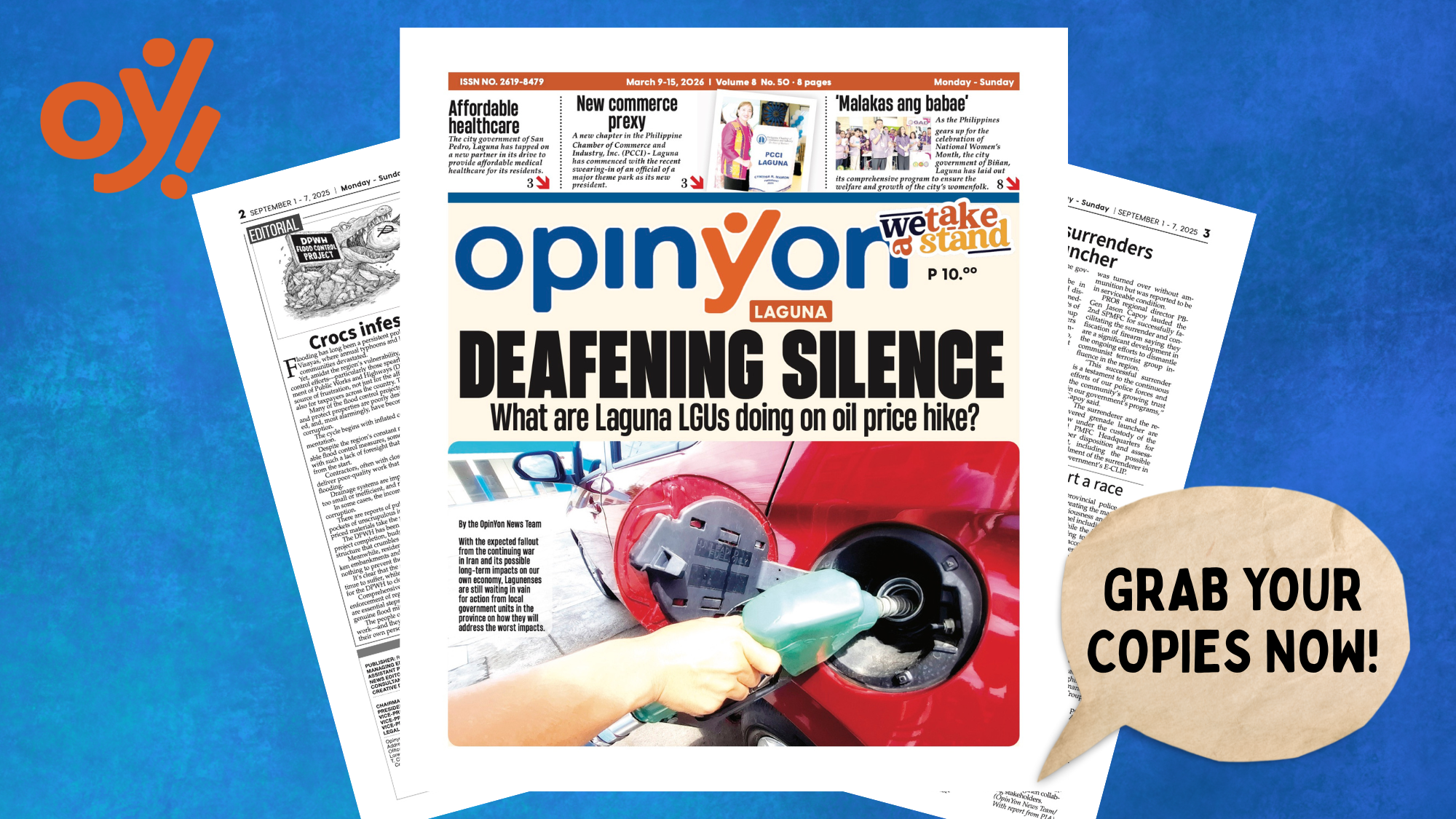
With the expected fallout from the continuing war in Iran and its possible long-term impacts on our own economy, Lagunenses (as of press time) are still waiting in vain for action from local government units in the province on how they will address the worst impacts.
Double-digit hike
It’s been a week since the United States and Israel launched a series of attacks on Iran, and there is no indication that either side is willing to scale down their offensives.
The conflict, in fact, has spilled to almost the entire Middle East, wreaking havoc on international trade in one of the largest oil-producing regions in the world.
And it’s now clear that the economic impact of the Iran war could spell doom for ordinary Filipinos already reeling from a “slight uptick” (a big understatement) in the country’s inflation rate, which rose to 2.4 percent last February – the highest in 13 months.
As of March 5, industry insiders claim prices of oil products could go up to P16 per liter for gasoline, P26.95 per liter for diesel and P28 per liter for kerosene.
This meant that oil prices could zoom by up to P100 per liter or even higher by the end of this week – a scenario that was last experienced by ordinary Filipinos in 2022 during the Russia-Ukraine conflict.
Feeling the pinch
Even now, many ordinary Lagunenses are now feeling the effects of the steep hike in oil prices due to the Iran conflict.
For instance, Kathlyn Joy, a florist in Barangay Pacita 1, says she might have to hike the prices of her flowers if oil prices continue to rise.
“Yung, nagbebenta ng bulaklak galing pa sa Dangwa o Baguio, bale pinupuntahan pa namin. Kung nagtaas ang presyo ng gas kaya magtataas din ang presyo ng bulaklak. Yan po ang inaasahan talaga namin,” she told OpinYon Laguna. “Pero hindi naman ganoon katas, para lang ba makabawi dahil sa ganyang nangyayari.”
Bong, a tricycle driver, also worries about the possible impact of the current oil prices to his livelihood.
“Ano na mangyayari sa amin? Ano ang kikitain namin? Lalo na sa kagaya namin ang iba nagbo-boundary lang diyan. Kaya halimbawa, tatanggalin pa ang boundary na P150 isang araw, gasolina mo P200, tapos kikita ka ng P500. Magkano pa mauwi mo sa pamilya mo, di ba?” he pointed out.
While the government has floated the idea of fuel subsidies for public transport drivers, some, like Grab driver “Bryan,” feel left out.
“Malaki rin kasi syempre mababa lang yung pera sa amin ngayon,” Bryan told OpinYon Laguna.
“Tapos dumagdag pa yun. Siyempre, imbes na sa iba mo na lang maitutustos yung pang gastos mo edi madadagdag mo pa don. Kumbaga kung dati nag-ga-gas ka lang. Halimbawa, P150 o P200 ngayon madadagdagan pa yon; imbes na ipang-dadagdag mo nalang sa ibang pagkaka gastusan mo o pangkain mo doon pa madadala.”
Not even students are spared the impact of high gasoline prices, as MC, a student of a private school in Pacita 1, explained to OpinYon Laguna: “Kapag tumaas po kasi ang gasolina, siyempre baka tumaas rin po ang pamasahe. E di po ba, marami rin tayong pang-araw-araw na gastos sa school.
“Siyempre yung ibang mga pang estudyante yung minimal lang may mga ano lang may tansya lang sila kung gaano lang ang gagastusin, kasi parang kasi nga sobrang daming gawain, lalo na po sa mga school project.”
No word?
The national government has said it is already “studying” several measures that it could implement to ease the burden on the ordinary Filipino.
These include reducing the number of workdays or implementing “work-at-home” arrangements (which, unfortunately, could also spell trouble for certain sectors of the economy such as transport drivers and ambulant vendors), fuel subsidies for the transportation sector, suspending excise taxes on oil products, and reducing overall energy consumption.
In fact, starting March 9, government offices have been ordered by President Ferdinand “Bongbong” Marcos, Jr. to adopt a four-day workweek in response to the projected rise in the prices of oil prices.
Given the quick pace of events in the Middle East, what is concerning is the “lackadaisical” approach of the Marcos administration to the crisis, replete with banal assurances that the country’s oil stocks can weather the situation.
But what is more alarming is that as of press time (March 6), there has been no word yet from local government units in Laguna province on what they plan to do to address the situation.
There has not been a memorandum on cost-cutting measures, unlike what the provincial government of Quezon did last week as it outlined measures to reduce fuel consumption.
Not to mention that there has been absolute silence from local leaders on plans to alleviate the potential impacts of the double-digit rise in oil products to the local economy.
It’s worrisome to think that in these times of crisis, it’s often the local government units who the people most look at – and up to now, there hasn’t been even a single peep of what they intend to do in such a vital issue as the economy.
(With reports by Jeremy Rago, Kenneth Sacro and Criselle Lucban)
#WeTakeAStand #OpinYon #OpinYonNews