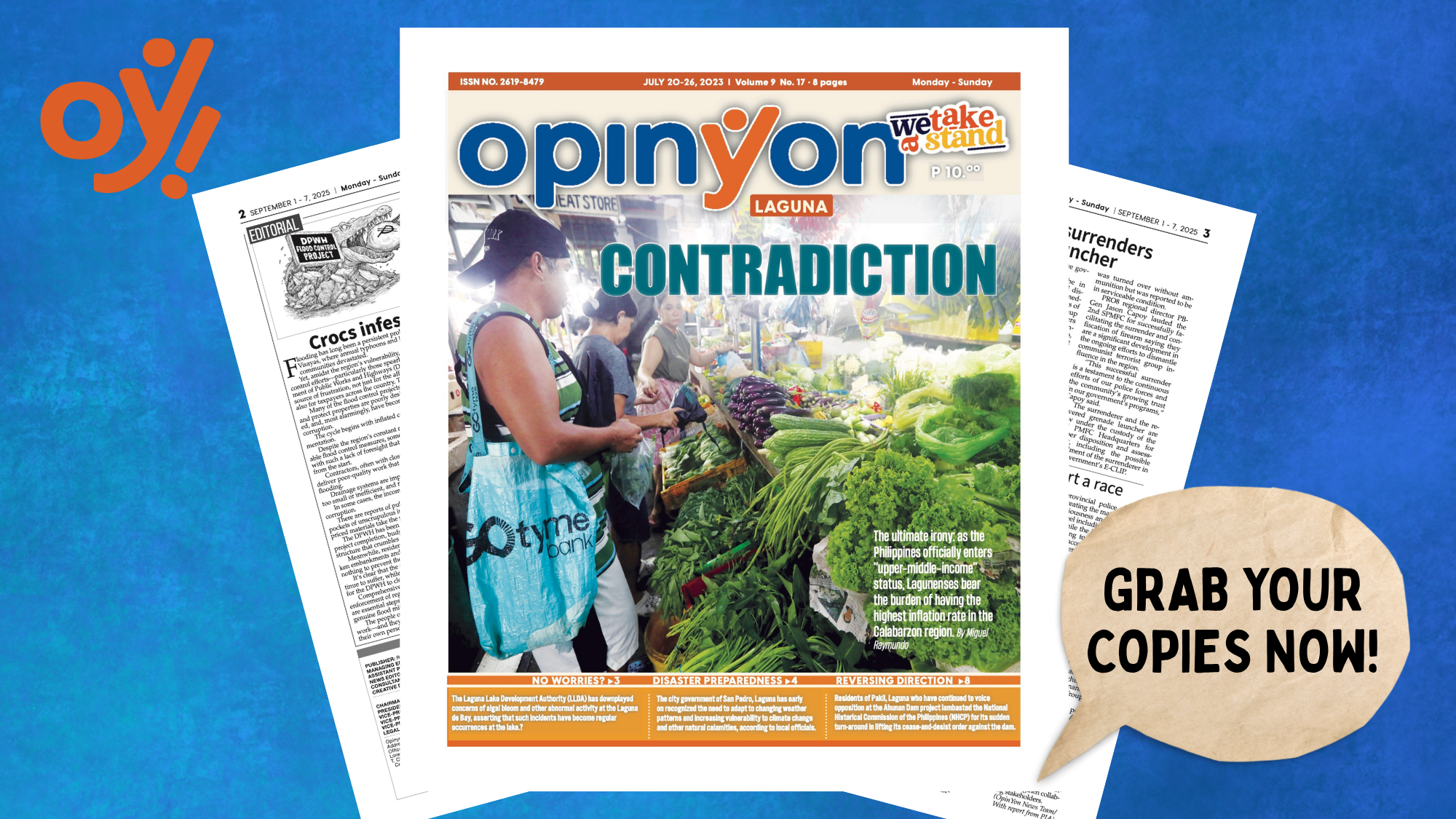

This month, the Philippines officially crossed into the ranks of upper-middle-income countries, according to the World Bank.
This, after the country achieved an annual gross national income (GNI) of $4,850 (P298,738 at current exchange rates).
World Bank defines gross national income as “the total income earned by all residents within an economic territory during an accounting period.”
Economists and policymakers of the Marcos administration have hailed the “milestone” as “proof that the country is moving in the right direction and that years of economic policies and reforms have bolstered the economy,” to quote Meralco spokesperson Joe Zaldarriaga’s op-ed for the Philippine News Agency (PNA).
For ordinary Filipinos, however, the reality is much, much different.
Nowhere is this more evident than in Laguna province, where even government statisticians are forced to admit that the recent oil crisis brought by the war in Iran has impacted ordinary lives harder than previously thought.
Record highs
Data released by the Philippine Statistics Authority (PSA) last July 15 placed the province’s year-on-year headline inflation rate at 8 percent last June.
This was the highest inflation rate recorded for the province since it breached an all-time high of 8.4 percent last April, at the height of the global oil crisis.
While inflation rates for the province dropped slightly to 7.7 percent in May, it once again accelerated to 8 percent in June.
It was also much higher than the 2.3 percent recorded in June 2025, according to government statisticians.
Driving forces
In its report, PSA noted that food and non-alcoholic beverages contributed the highest share of the increase in overall inflation last June, with an inflation rate of 4.4 percent and a share to the uptrend of 54.5 percent.
This was followed by education services (with an inflation rate of 12.2 percent and a share to the uptrend of 16.8 percent) and housing, water, electricity, gas and other fuels (with an inflation rate of 13.9 percent and a share to the uptrend of 13.0 percent).
PSA officials also noted that utility costs pushed the province’s inflation rate up during the same period.
The top commodity group contributing to the higher overall inflation? No surprise: housing, water, electricity, gas and other fuels, which contributed a 32.5-percent share in the spike in inflation rates.
June 2026, after all, is the time when consumers began to pester the Manila Electric Company (Meralco) about the sudden uptick in their electricity bills.
This also came as the country was just recovering from the worst effects of the global oil crisis brought by the war in the Middle East.
Food inflation
Food inflation at the provincial level increased to 4.4 percent in June 2026 from 3.4 percent in the previous month, and much higher than the 2.7 percent recorded during the same month in 2025.,
“The acceleration in food inflation in June 2026 was primarily driven by the faster annual increase in the index of vegetables, tubers, plantains, cooking bananas, and pulses which recorded 3.0 percent during the month from -7.8 percent in May 2026,” the PSA reported.
Higher inflation rates were observed in cereals and cereal products (5.9 percent from 4.5 percent), fish and other seafood (14.3 percent from 13.1 percent), fruits and nuts (7.2 percent from 3.4 percent); and oils and fats (15.4 percent from 14.4 percent).
On the other hand, “a slower annual decline was observed in the index of meat and other parts of slaughtered land animals which recorded -2.2 percent in June 2026 from -0.8 percent in the previous month.” (Less people eating meat due to the high cost of meat products compared to other foodstuffs?)
Living wage
The province’s high inflation rate comes amid a push both in the regional and national level to boost wages for minimum-wage earners.
Recently, the Regional Tripartite Wages and Productivity Board (RTWPB) IV-A has begun a series of public consultations on whether to grant another increase in the minimum wage in the Calabarzon region.
At present, the prevailing wage rate for private sector workers in CALABARZON is governed by Wage Order No. IVA-22, which took effect on October 5, 2025.
The wage order prescribes a daily minimum wage ranging from P550 to P600, depending on the industry sector and establishment classification.
Meanwhile, the current minimum wage for domestic workers in the region is P6,750 per month, as provided under Wage Order No. RB-IVA-DW-05, which became effective on March 7, 2025.
Even that, critics charge, isn’t enough to cover the skyrocketing cost of living.
Think tank IBON Foundation, for instance, has noted that the current minimum wage in the Calabarzon region falls short of the P1,214 a day it has calculated to meet the “living wage” of the average family in the region.
Postscript
By the way, here's another shocker: oil prices are expected to go up again this week, according to industry sources.
Prices of diesel are expected to go up again by P9.50 to P10.50 per liter on July 21, while gasoline prices will increase by P3.50 to P4.50 per liter and kerosene by P11.00 to P12.00 per liter.
So here’s the question for the policymakers of the Marcos administration who have tended to gloss over labels of progress while ignoring the real situation on the ground: “upper middle-income class” status, are you for real? What now?
#WeTakeAStand #OpinYon #OpinYonNews