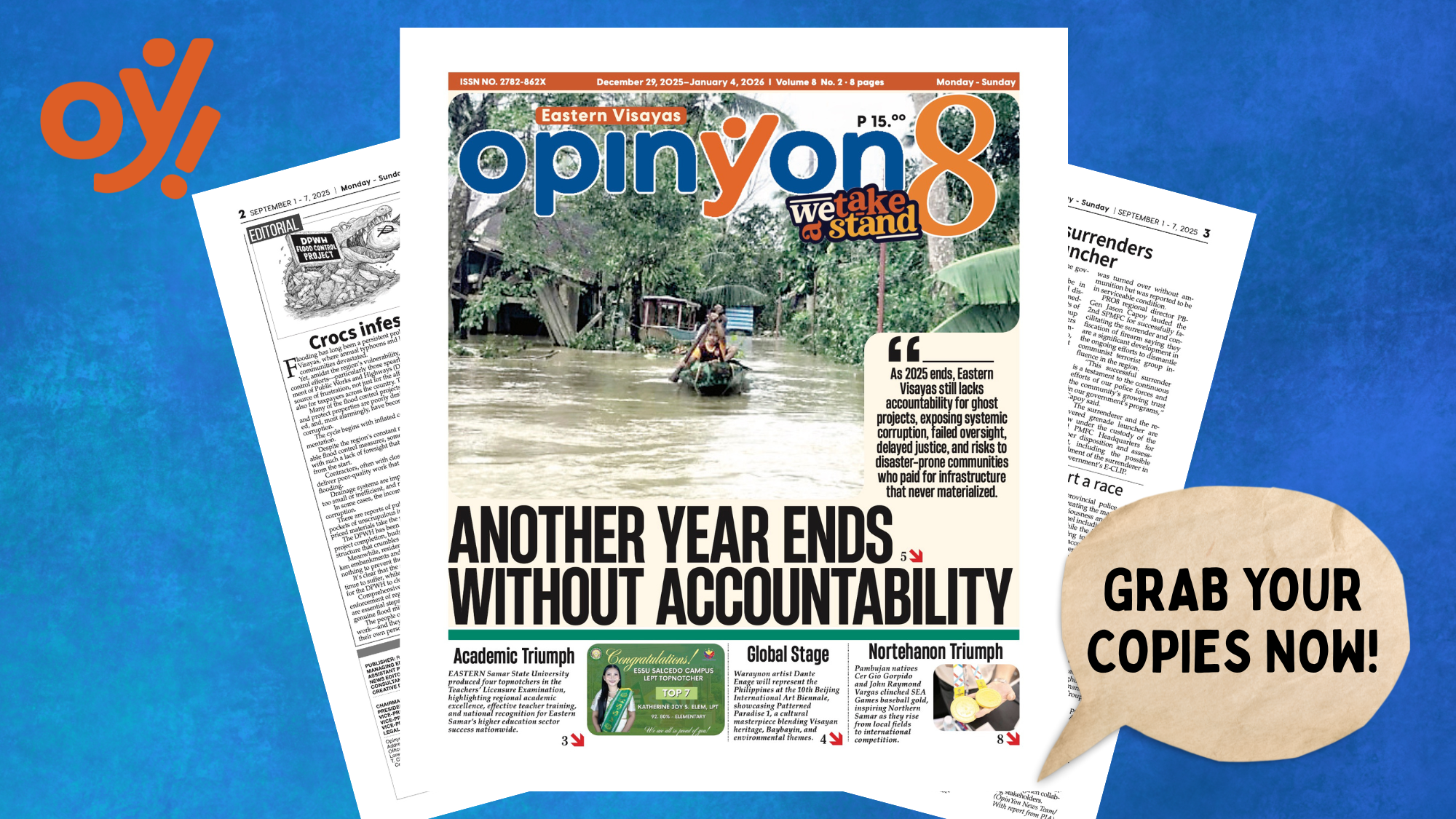

As 2025 closes, Eastern Visayas is once again forced to confront an uncomfortable truth: public money has vanished into projects that exist only on paper, and no one has been held to account.
The issue of so-called government-funded infrastructure listed as completed despite being missing, unfinished, or unusable has dominated national headlines this year.
At the center of the controversy are flood control projects under the Department of Public Works and Highways (DPWH), many of them meant to protect disaster-prone regions like Eastern Visayas.
Yet despite confirmed irregularities, investigations, and political noise, accountability remains elusive.
Nationally, DPWH inspections conducted with the Armed Forces of the Philippines and the Philippine National Police revealed that hundreds of flood control projects were either non-existent or grossly deficient, even though they had already been paid for.
These findings validated what communities have long complained about which are concrete safeguards promised in budgets never materialized on the ground.
Eastern Visayas, a region still scarred by Super Typhoon Yolanda and repeatedly battered by floods and storms, has every reason to demand urgency.
Flood control is not a luxury here, it is survival infrastructure.
Yet reports and field checks in parts of Eastern Samar and Leyte show rivers left unprotected, embankments incomplete, and drainage systems either substandard or entirely absent despite millions of pesos released for these projects.
Lawmakers have called for probes. The National Bureau of Investigation has been urged to step in.
The Commission on Audit has flagged idle, unusable, or questionable infrastructure nationwide.
Malacañang has promised tighter scrutiny and vowed that both “inserted” and regular projects will be investigated.
But as the year ends, these efforts have produced more press releases than prosecutions.
This is the heart of the problem, exposure without consequence.
Ghost projects thrive not because anomalies are hard to detect, but because the system is slow to punish.
Fraud audits take years. Ombudsman cases crawl through procedural bottlenecks.
Contractors continue bidding. Officials retire or move posts. Meanwhile, the public forgets, until the next flood washes away another community.
For Eastern Visayas, the damage is immediate and concrete.
Every peso lost to a phantom flood wall is a peso not spent on real protection.
Every fake completion report increases the risk of submerged farms, damaged roads, and displaced families.
Corruption here does not just waste money, it magnifies disaster.
The pattern is depressingly familiar. Budgets swell. Projects are announced. Tarpaulins go up. Reports say “100 percent completed.”
But residents see otherwise. When questioned, agencies cite paperwork.
When challenged, officials promise investigations. When the news cycle moves on, so does the urgency.
What is missing is political will translated into action.
Naming anomalies is not accountability. Suspending officials is not justice.
True accountability means filing cases, freezing assets, blacklisting contractors, and recovering stolen funds.
It means making examples not quietly reassigning people while communities remain unprotected.
As 2026 approaches, Eastern Visayas stands as a stark reminder of the cost of inaction.
A region that should be a priority for climate resilience instead becomes a case study in how corruption undermines disaster preparedness.
Ghost projects may be invisible on the ground, but their consequences are painfully real.
Until accountability is delivered and not promised, the people of Eastern Visayas will continue paying for infrastructure that never existed, and protection that never came.
#WeTakeAStand #OpinYon #OpinYonNews