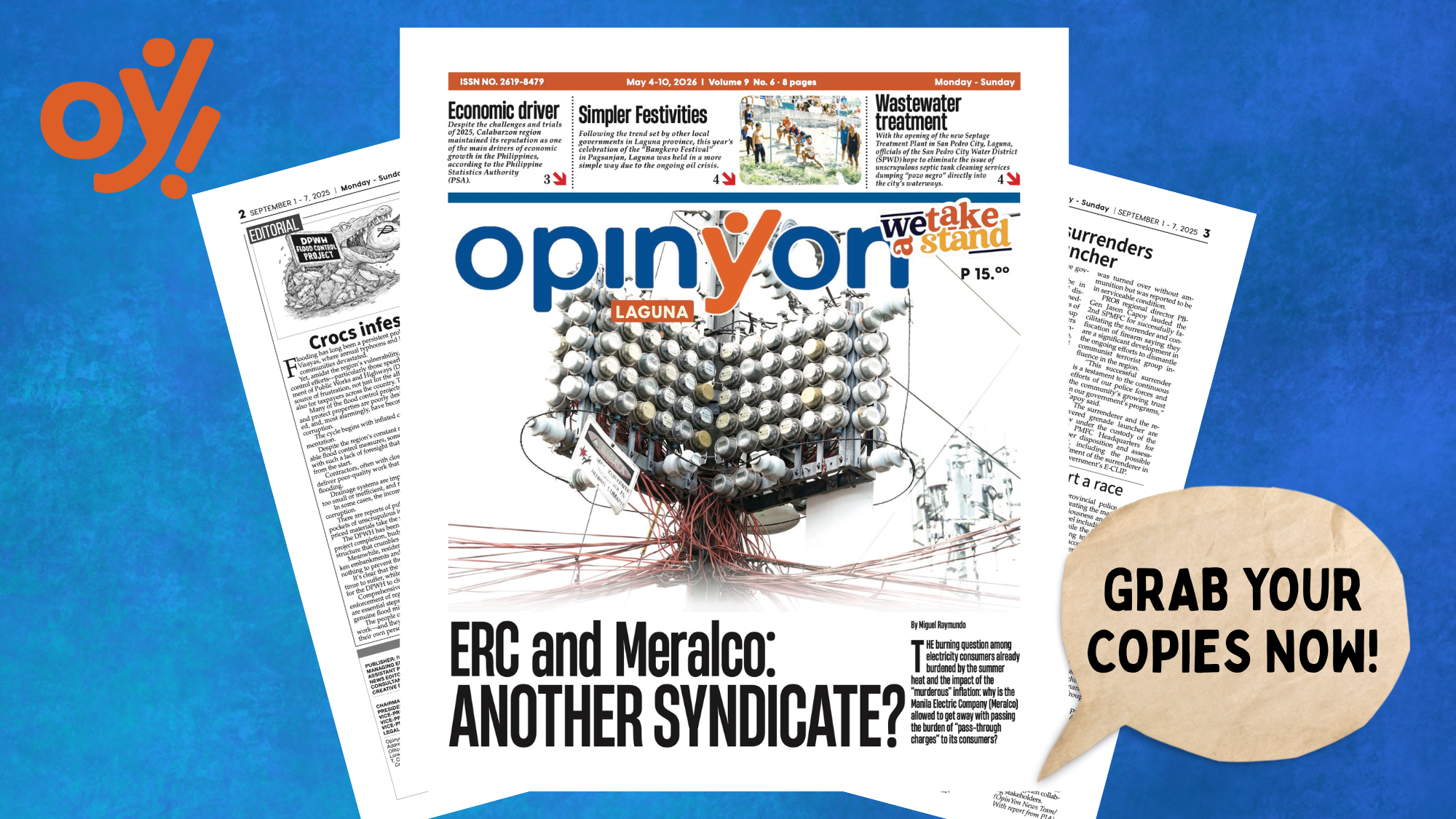

As the Philippines enter the hottest season of the year – and amid the continued effect of skyrocketing oil prices due to runaway inflation, keeping prices of basic goods and commodities out of reach – consumers are up in arms.
The reason: a blatant case of daylight robbery.
Robbery, in the form of “pass-through charges” that were being charged by the Manila Electric Company (Meralco) to their consumers.
Bill shock
Meralco consumers who are still grappling with the effect of the Middle East war that had sent oil prices spiking up last March received the shock of their life on their April electric bill.
Adjustments in generation charges had largely been anticipated due to the “domino effect” of the Middle East war and its effects on the global and local economy.
In fact, Meralco had warned that higher generation charges could drive electricity costs by up to P0.5335 per kilowatt-hour (kWh) (or the equivalent of a P107 increase for a customer consuming an average of 200 kWh) in their customers’ April bills.
But netizens took umbrage at what they believed was a clear case of deception and robbery on the part of Meralco.
The sudden “bill shock” has had many consumers doing what they have never done before: check the back of their electric bill, which lists the breakdown of the charges and fees collected by Meralco.
And this is when the dam broke, so to speak.
Pass-through charges
It was then that netizens pointed out that ordinary consumers are being charged for fees that, in theory, should be shouldered either by the government or the energy sector.
Here are some of these pass-through charges that has had Meralco consumers raising their eyebrows:
- Feed-in Tariff Allowance (FIT-All): a fee imposed on all electricity end-users to support renewable energy development in the Philippines.
- Lifeline rate: subsidized rates given to qualified low-income electricity utility customers who are financially unable to pay their electricity, including beneficiaries of the Pantawid Pamilyang Pilipino Program (4Ps).
- Senior citizen rate: subsidy rates charged to cover the 20-percent discount mandated by law for senior citizens
Long story short, this meant that Meralco consumers – not the government nor Meralco itself – shoulder the losses incurred in shouldering the benefits of 4Ps and senior citizens.
As OpinYon had said months earlier, it’s like robbing Pedro to pay Juan.
Just following the law?
And what is more infuriating for consumers is that all these hidden charges are legal and allowed by the government.
Or so officials of Meralco and the Energy Regulatory Commission (ERC), the main government agency that is supposed to check the abuses of big business in the power sector, claim.
“Meralco, just like other electricity distributors across the country, operate under strict regulatory oversight that ensures all charges are lawful, transparent, and properly vetted,” Meralco vice president and head of corporate communications Joe Zaldarriaga said in a statement.
Zaldarriaga also claimed that Meralco and other electricity distributors do not earn from these pass-through charges.
“We act solely as collection agents for these costs. These do not form part of our revenues in any way. Again, we are highly regulated, with all charges in electricity bills subject to rigorous review and regulatory clearance prior to implementation," Zaldarriaga said.
This claim, incredibly, was parroted by the ERC in a statement released April 27.
"The ERC did not independently invent or create these charges; they are imposed in accordance with existing laws and policies," the commission said in its statement.
The real irony, however, is found at the end of the statement: "[ERC] continues to regulate distribution and transmission wheeling rates to ensure that regulated entities recover only just and reasonable costs based on the legal standards under EPIRA [Electric Power Industry Reform Act]."
Regulate or permit, ERC?
Review of EPIRA
This apparent legalized robbery has led to renewed calls in Congress to review and amend the EPIRA Law, which has been used as the legal basis for all these pass-through charges.
"When EPIRA in 2001 established the lifeline subsidy as an exception to the policy to abolish cross-subsidies in power, government must pay for it out of the taxes on power," electricity advocate Butch Junia said in a Facebook comment.
However, Junia added, the EPIRA Law did not specify who should be paying for the lifeline subsidies.
"That was left to ERC and, true to form, ERC dumped it on consumers, with neither an 'excuse me' nor a 'thank you,'" he stressed.
#WeTakeAStand #OpinYon #OpinYonNews #ERC #Meralco #EPIRA