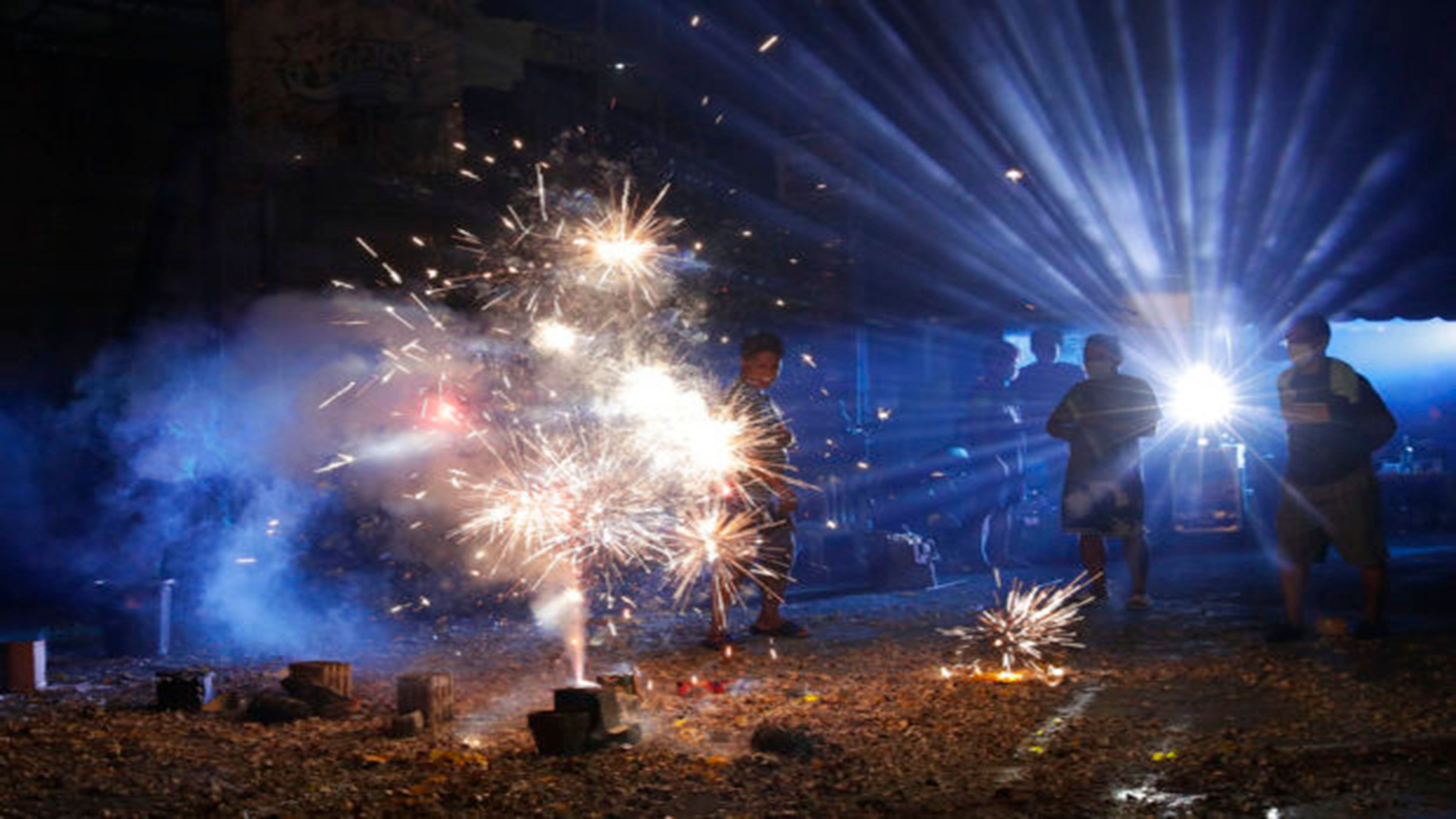

DENR: Air pollution levels in parts of Metro Manila went up during New Year revelry
The Department of Environment and Natural Resources-Environmental Management Bureau (DENR-EMB) said air pollution levels in two Metro Manila cities have exceeded the safe standards during the first two hours of January 1, 2022.
The DENR-EMB report showed that the air pollution levels in the cities of Marikina and Manila went beyond the standard of 150 micrograms per normal cubic meter (ug/Ncm) of particulate matter 10 or PM10.
Meanwhile, it is still conducting manual monitoring of 11 stations and is expected to come out with the laboratory analysis results on January 7.
"Now more than ever we should work together to correct this way of celebrating New Year revelries as we are all aware of the pulmonary health risks these firecrackers carry,” DENR Secretary Roy A. Cimatu said.
To prevent spikes in air pollution levels, Cimatu encouraged the local government units to strictly enforce Executive Order No. 28 series of 2017 or the Regulation and Control of the Use of Firecrackers and Other Pyrotechnic Devices.
The DENR chief also called on Filipinos to use alternative ways to welcome the New Year such as making noise with pots and pans and blowing party horns or trumpets.
PM10 in firecrackers consists mainly of residues of the explosive powders wrapped in paper which consists of a mixture of sulfur (S), carbon (C), and potassium nitrate (saltpeter, KNO3), and other fine minerals which contain heavy metals.
According to health experts, particles in PM2.5 are able to travel deeply into a person’s respiratory tract and can cause ill effects and worsen the medical conditions of people with asthma or heart diseases.
Based on the data from the DENR-EMB, Marikina City's PM10 peaked at 347 ug/NCM around 2 a.m. of January 1, 2022, with an average concentration of 271 ug/NCM monitored from 12 a.m. to 2 a.m., or a 215 percent increase compared to the 2021 New Year’s eve PM10 data.
In Manila, PM10 reached 156 ug/NCM between 1 a.m. and 2 a.m. but with an average concentration of 116 ug/NCM from 12 a.m. to 2 a.m., or a 68 percent increase compared to the 2021 New Year’s eve PM10 data.
The short-term limit for 24-Hour Averaging Time for PM10 is 150 ug/Ncm under the National Ambient Air Quality Guideline Value (NAAQGV) of Republic Act 8749 or the Clean Air Act.
For PM2.5, only the Manila monitoring station in Mehan Garden recorded a maximum concentration of 113 ug/Ncm and an average concentration of 84 ug/Ncm from 12 a.m. to 2 a.m. on January 1, 2022.
Outside Metro Manila, five air quality monitoring stations (AQMS) recorded an increase in the average concentration of PM10 between 12 a.m. and 2 a.m. of January 1, 2022, compared to 2021.