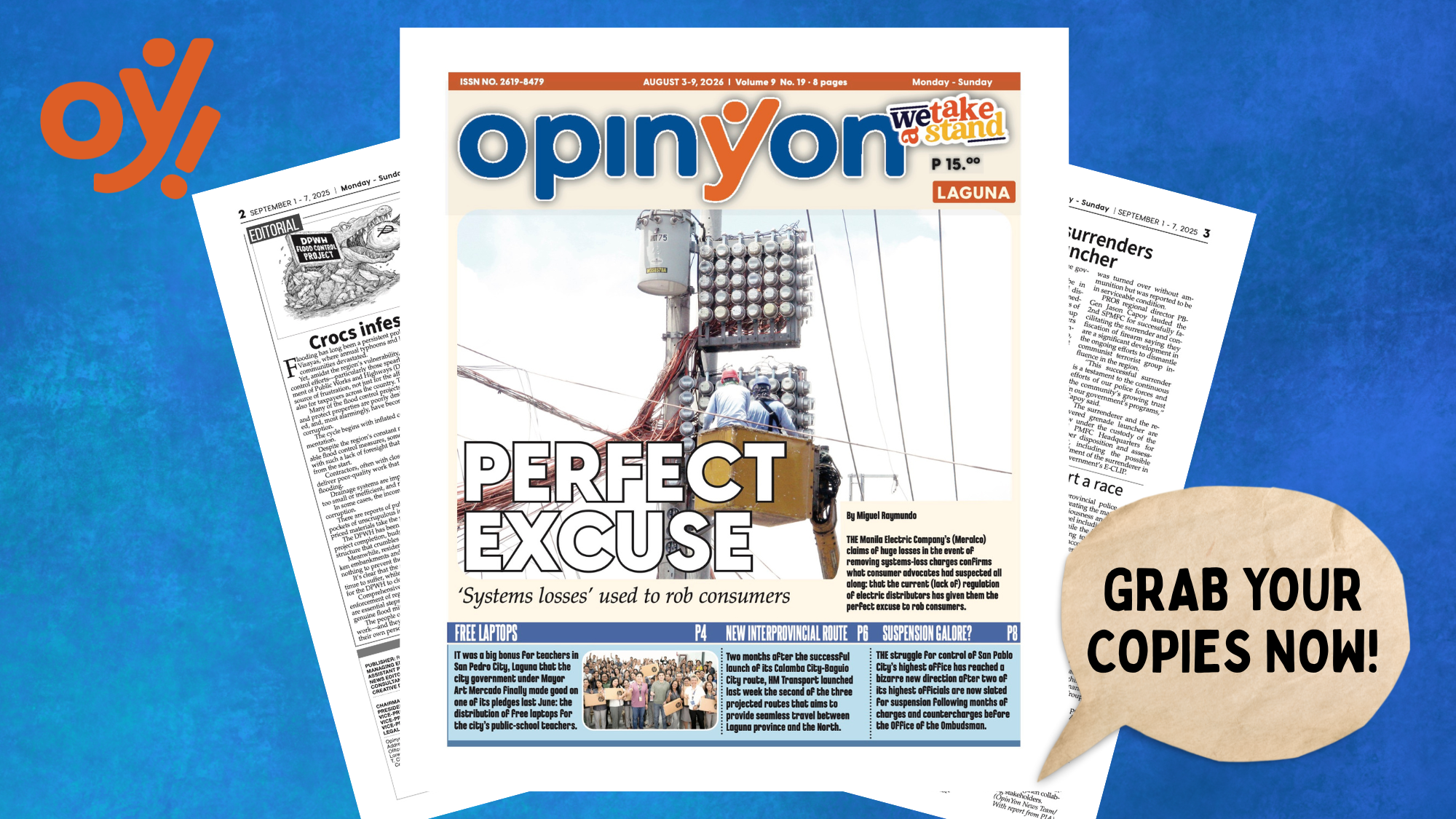

Whatever one’s political alignment might be, we cannot argue that the fifth State of the Nation Address (SONA) of President Ferdinand “Bongbong” Marcos, Jr. has brought into the open one issue that has had electricity consumers fuming all summer.
That issue: the “hidden charges” that, some have claimed, are responsible for the high cost of electricity in past months.
No doubt the President’s urgings to Congress to immediately amend the Electric Power Industry Reform Act (EPIRA) of 2001 and “prohibit charging systems loss against consumers” elicited the loudest applause and cheers during the one-and-a-half-hour SONA last July 27. And with good reason.
The response of the power distribution sector, however, has confirmed what consumer advocates had suspected all along: that the current (lack of) regulation of electric distributors has given them the perfect excuse to exercise what is tantamount to legalized robbery.
‘Huge losses’
Soon after the SONA, business tycoon Manny V. Pangilinan made the bold claim that removing system loss charges from consumers' monthly electricity bills will result in "billions" in losses that could destabilize the country's energy sector.
Pangilinan, who is the chairman and chief executive officer of the Manila Electric Company (Meralco), one of the largest power-utility distributors in the country, raised a question: if not the consumers, who will bear the cost of systems losses?
“Who’s going to pay for that? The industry? It’s going to cost tens of billions of pesos. We will not survive,” he was quoted as saying.
‘Minimal’
For energy advocates, however, Pangilinan’s griping about “billions of losses” is tantamount to gaslighting consumers.
Here's the thing: even some energy officials have admitted that shifting the burden of system losses will actually enforce discipline among power distributors.
At a recent Senate Committee on Energy hearing, ERC Chief Executive Officer Francis Saturnino Juan himself said that non-technical system losses account for only about 1 percent to 1.5 percent of a utility’s total system loss.
“It would represent a reduction in their income, but it is small compared with the total system loss,” Juan said.
Enforcing discipline
Since the expected losses will be minimal, he argued, utilities would be expected to adjust to the new regulation and strengthen their campaign against electricity theft to minimize the financial impact.
“Maaaring mas magiging masigasig sila sa panghuhuli ng mga nagnanakaw ng kuryente,” he said.
Energy Undersecretary Riolita Inocencio also pointed out that lowering the allowable system-loss cap could serve as a self-regulating mechanism that would compel distribution utilities and electric cooperatives to become more efficient.
She said eliminating non-technical losses could be pursued sooner, while reducing unavoidable technical losses would require long-term infrastructure upgrades, particularly among electric cooperatives.
Reluctance
Meralco, however, appears unwilling to spend all that extra money on improving their services.
At that same hearing, Meralco representative Jose Ronald Valles claimed that driving non-technical losses to zero could require additional personnel, equipment and capital spending to monitor illegal connections around the clock.
Valles said Meralco’s system loss stood at 4.22 percent in 2025, below the ERC’s 5.5-percent cap, with less than 1 percent attributed to non-technical losses.
He argued that the cost of completely eliminating power theft could exceed the savings consumers would obtain from removing the charge, with reasonable operating and capital expenses still subject to ERC evaluation for possible inclusion in tariffs.
The perfect excuse
The consensus among consumer advocates, however, is this: “Problema ninyo iyon. That is your business. Hindi kami part ng Meralco. Kami po ang mga consumer.”
The issue was actually reminiscent of the recent beef some consumers had had with water utilities who they claimed were charging consumers for losses due to leaky water pipes and illegal connections.
The same analogy applies here.
If Meralco had been more enthusiastic in pursuing the problems of “bleeding” connections and electricity theft, we wouldn’t be talking about systems losses in the first place.
But the reason why Meralco has been continuously harping on the issue of systems losses is just too obvious.
Removing systems losses from the equation will deprive Meralco of the ideal excuse to pass on additional charges to consumers.
These are charges that no doubt contributed to its record core net income of P26.5 billion during the first half of 2026, up from P24.46 billion during the same period last year.
Which means Juan and other officials of the ERC have a lot of explaining to do on one single question: why has it allowed discipline among power distributors, including Meralco, to slip through the cracks?
It is high time our country’s power supply and utilities are nationalized.
Meralco’s P50.6 billion in reported core profits in 2025 could’ve gone for, say, improving our education sector, if power distribution is back in the hands of our government.
#OpinYonLaguna #CoverStory #Meralco