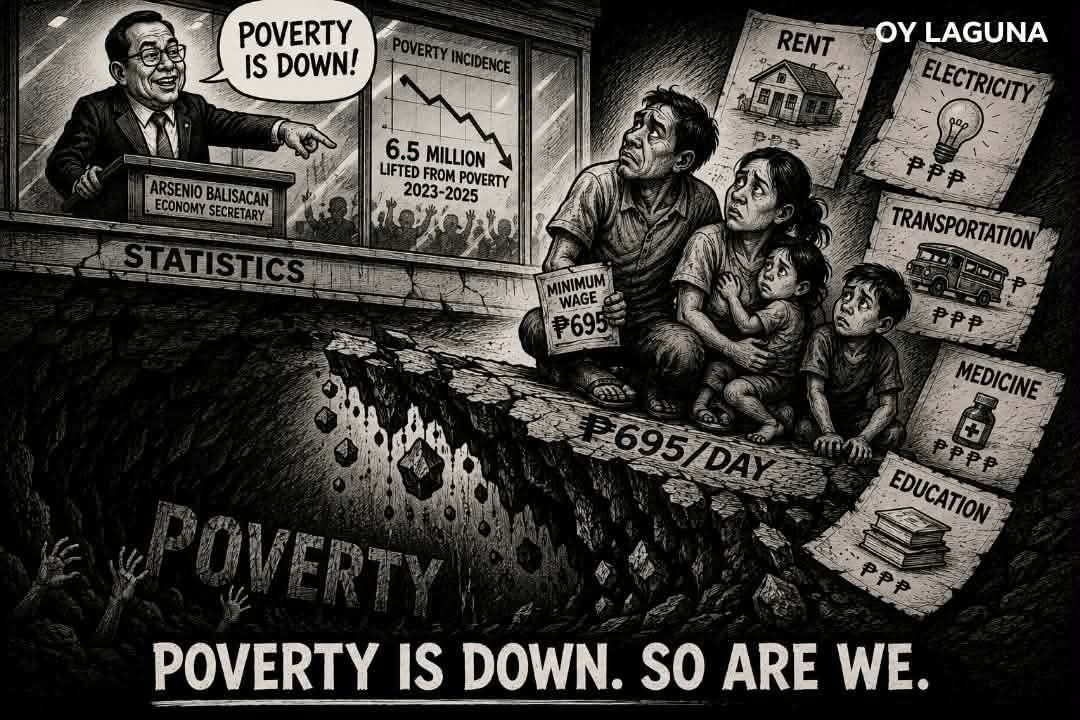

Is Economy, Planning, and Development Secretary Arsenio Balisacan living in an alternate reality?
At least, that's how his recent statements that the Philippines is on its way to eradicating poverty sounded to the average Filipino.
Citing data from the Philippine Statistics Authority that 6.5 million Filipinos were "lifted from poverty" from 2023 to 2025, Balisacan had the gall to declare this: “For the first time, fewer than one in ten Filipinos is living below the poverty line.”
Bold words to say to a country where millions of Filipinos are now on the brink of breaching that line.
Critics have pointed out that the government's analysis on poverty relies on "problematic, outdated, and very unrealistic" standards, to quote think tank IBON Foundation.
The problem, according to IBON, is that its food threshold is based on a bare-minimum, least-cost basket while non-food needs are not directly and adequately costed.
With the current government standards, the 2025 annual per-capita poverty threshold is only P35,121, or P96.22 per person per day. For a family of five, this amounts to just P14,634 a month.
And even that couldn’t be achieved by the current minimum wage of P695 in Metro Manila alone (not counting the P85 wage hike that was slapped with a temporary restraining order a few weeks ago), which meant that the average Filipino worker earns just over P13,900 a month.
As mentioned earlier, non-food needs such as housing, electricity, transportation, education, healthcare and other basic expenses aren’t even considered adequately.
This leads credence to what some have charged: that the average Filipino worker is actually one sickness, accident or day off away from reaching the brink of poverty.
Perhaps, Mr. Balisacan, you should try living on the minimum wage for you to understand what being "poor" actually means today?
#OpinyonLaguna #WeTakeAStand #Editorial