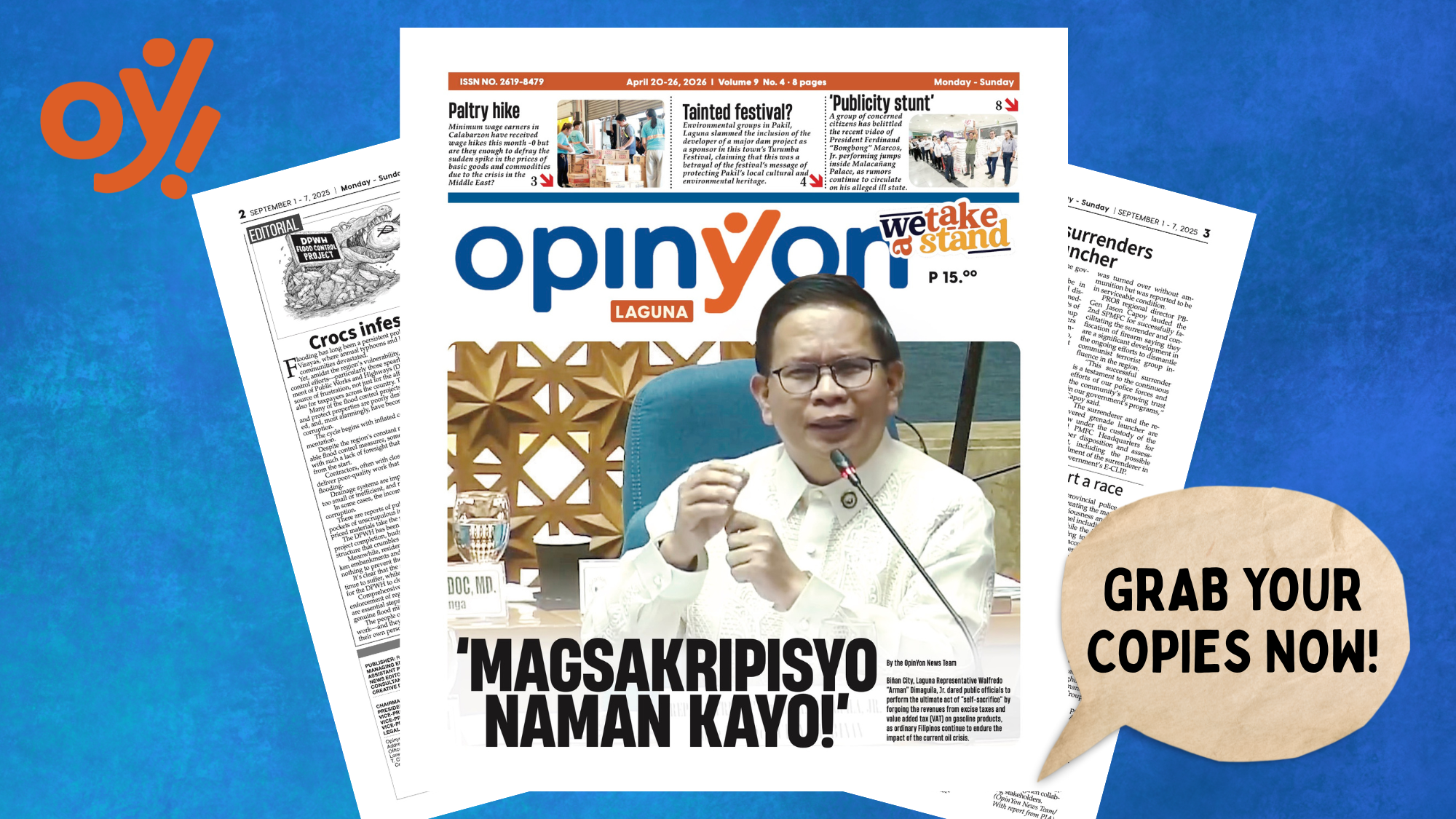

Self-sacrifice. That has been the mantra of the government these past days, as the Philippines faces a full-blown economic meltdown due to the impacts of the war in the Middle East.
But shouldn’t the government itself lead by example in sacrificing the billions in revenues from taxing petroleum products?
The reluctance of the Marcos administration’s economic managers to implement long-term measures to alleviate the long-term impacts of the current oil crisis has had many, including some solons, frustrated and baffled.
The billions government officials claim it stands to lose in suspending taxes on gasoline products is “chicken feed” compared to the trillions in lost economic opportunities, not to mention the cumulative public hardship due to high fuel prices.
Frustrated
No one was more frustrated at the government’s apparent aversion to suspending excise taxes on gasoline products than Biñan City, Laguna Representative Walfredo “Arman” Dimaguila, Jr.
During a recent hearing at the House of Representatives last April 13, Dimaguila took out the combined frustration of the Filipino public on Department of Finance (DOF) officials who insist that suspending excise taxes and value-added tax (VAT) on petroleum products will have a negative impact on the economy.
"Hindi po ba dapat ipakita natin sa mga tao na gobyerno naman ang magsakripisyo?" was how the solon put it before Finance Undersecretary Rolando Ligon.
Double taxation
During Dimaguila’s questioning of Ligon, the solon pointed out that not only were petroleum products charged a P10-per-liter flat excise tax rate, but were also subject to a 12-percent VAT.
“Hindi po ba parang double taxation na rin po ito?” the representative pointed out.
Not only that, Dimaguila noted that, technically, the sudden spike in the prices of petroleum products has coincidentally caused a windfall for the government treasury.
For instance, he pointed out, the government receives roughly P7 in VAT when prices of diesel were still at the P60-per-liter level, before the war in Iran started last March.
Now, with prices of diesel having breached the P150-per-liter level, the government should now receive a P18 VAT per liter.
"Tama po ba na in times of crisis, na hindi naman natin na-project na tataas ang presyo at collection [ng VAT]...hindi po ba hindi naman tama na krisis na nga, eh naging burden pa ang gobyerno?" Dimaguila asked.
Self-sacrifice
And this, the solon argued, is where the government should make a supreme act of “self-sacrifice” and bow down to the growing demands to suspend implementing excise taxes on petroleum products. (Later that day, President Ferdinand “Bongbong” Marcos, Jr. announced a limited suspension on excise taxes covering liquefied petroleum gas and kerosene).
To recall, DOF officials have argued that the government will lose up to P43.6 billion in “just three months” should it totally suspend excise taxes on diesel and gasoline.
Finance Undersecretary Karlo Adriano was quoted as saying that a large portion of diesel and gasoline consumption comes from higher-income groups, raising concerns that the bulk of the benefit would go to wealthier households rather than vulnerable sectors.
But for Dimaguila – as well as others who have called on the government to suspend excise taxes – the government can (and should) adjust to whatever losses it might accrue in the near future.
"Kapag bumaba ang tax collection, during budget deliberations, ito lang po ang isasagot ninyo: hindi po pwede itong mga project na gusto ninyo dahil kailangan pong magtipid ang gobyerno...and I think na maganda pong sabihin iyan sa mga tao," the solon pointed out.
While the government has argued that the billions in revenues in excise taxes have funded various financial assistance programs (ayuda) for those affected by the oil crisis, Dimaguila believed that the public will feel the benefits of the ayuda much more effectively if prices of gasoline products were lowered.
"Nagbibigay tayo ng ayuda sa tricycle drivers, jeepney drivers, e nag-grocery sila, mataas din ang presyo ng mga grocery items, [balewala din iyon]," he argued.
“Kung yung amount na ito ay directly sa petroleum products natin aalisin at mararamdaman ng mga tao...e di hindi na po ninyo kailangan pang mag-ayuda.”
True relief
Dimaguila’s sentiments were later echoed by other solons who had believed that true relief to those who carry the burden of the impacts of the oil crisis should not rest on mere dole-outs.
For instance, Senator Loren Legarda has argued that government should not continue taxing fuel during a time of rising oil prices and then justify it as necessary to fund assistance programs.
“Hindi dapat umasa ang gobyerno sa dagdag na koleksyon mula sa pagtaas ng presyo ng langis para pondohan ang ayuda. Kahit maganda pa ang paglalaanan, naghihirap muna ang mamamayan na sumasalo sa mataas na gastos, at saka pa lamang sila posibleng makatanggap ng bahagyang ginhawa sa ayuda. Hindi naman ito revenue crisis kundi cost-of-living crisis,” Legarda said in a press statement.
Legarda also castigated the Marcos administration's claims that Congress alone has the authority to suspend VAT on oil products.
"Hindi pwedeng sabihin ng Malacañang na walang batas. Nag-file na ako noon at nag-refile pa ako ulit ngayon, para wala nang dahilan. Ang tanong ngayon: susuportahan nyo ba? I-cecertify nyo ba na urgent? Kung hindi, malinaw na hindi ito prayoridad at ang gusto ng gobyerno ay tuloy-tuloy na buwisan ang krisis," she stressed.