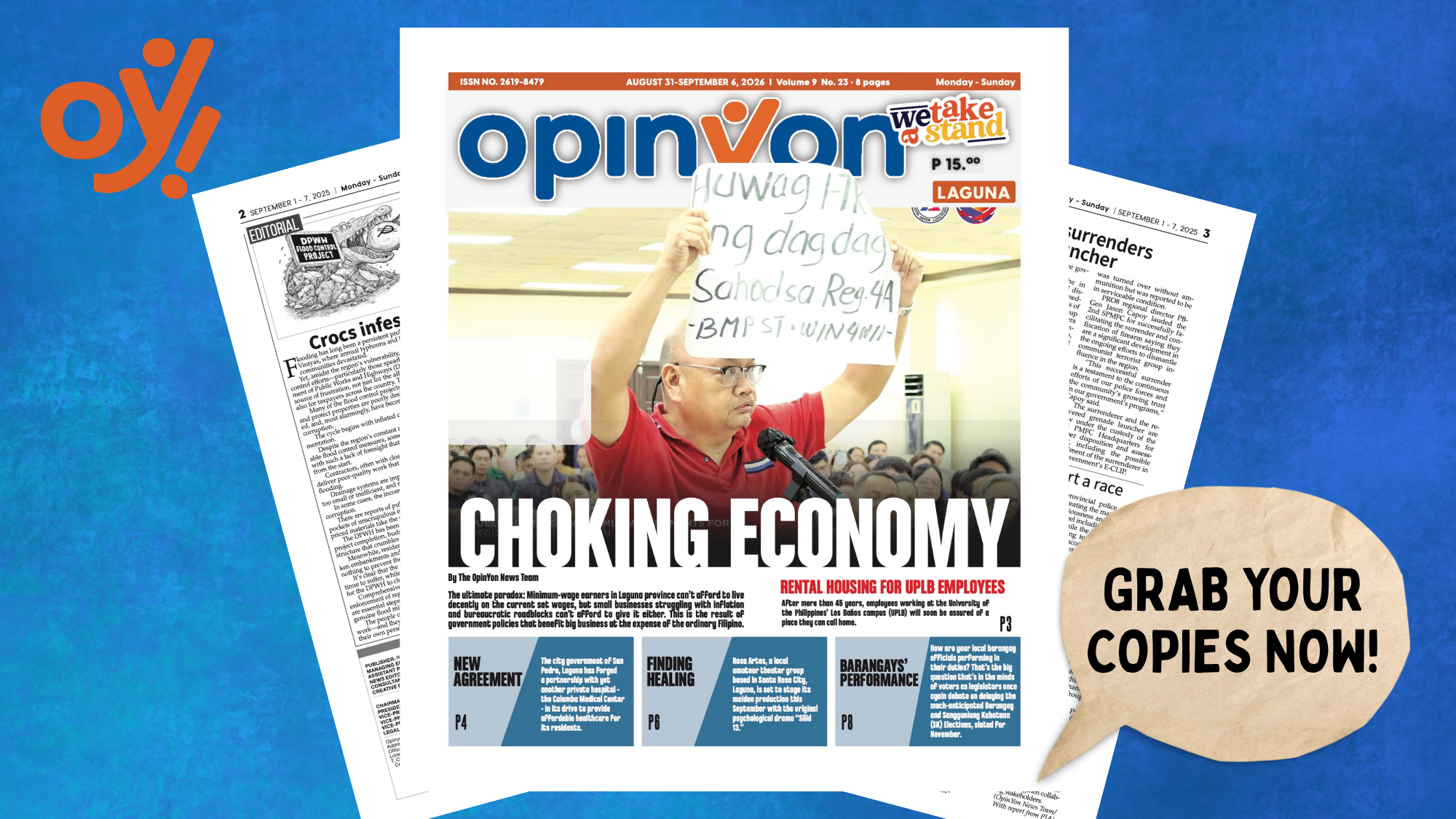

The recent hearings conducted by authorities in Laguna province regarding proposals to raise the minimum wage in the region has exposed a paradox created by government policies that benefit big business at the expense of the ordinary Filipino.
That paradox: minimum-wage earners can’t afford to live on their current salaries due to high inflation rates.
But small businesses can’t afford to give them higher wages, either, due to added costs that make it difficult for them to break even, much less earn a profit.
Consultation
This paradox became the main takeaway of the recent public hearing conducted by the Regional Tripartite Wages and Productivity Board (RTWPB) in Calamba City, Laguna last August 25.
The hearing in Laguna province was one of the series of public consultations conducted by the RTWPB – Region IV-A to discuss the 16 petitions filed by labor groups, seeking to raise the minimum wage for blue-collar workers and domestic helpers in the region.
The last adjustment to the region's minimum wage took place last April 1, when the second tranche of Wage Order No. IVA-22 officially took effect.
This order provided additional salary adjustments following the first tranche implemented on October 5, 2025, meaning that minimum-wage earners in Calabarzon now get a daily average rate of P525 to P600.
Domestic workers, on the other hand, currently earn P6,750 per month since March 2025.
Inflation
Since then, however, the country's record-high inflation rates, exacerbated by the recent conflict between the United States and Iran that had driven up oil prices, have eroded whatever gains ordinary workers had had on their daily salaries.
Data from the Philippine Statistics Authority (PSA), for instance, placed Laguna province’s inflation rate at 7.1 percent last July – significantly lower than the 8 percent reported in June, but still the highest in the region.
This was the main argument of labor representatives who participated in the forum, saying that the current P600 a day falls short of the “living wage” that a typical breadwinner should earn.
The Association of Minimum Wage Earners and Advocates (AMWEA) argued that the ideal “living wage” for the average family in Calabarzon should be at P1,312, which the current minimum wage only covers 45.73 percent of.
While the difference between the “living wage” and the actual wage has slowly narrowed – from 35.54 percent in 2021 to 48.95 percent in 2025 – the difference once again widened the following year due to spiraling inflation rates, the group added.
The significant gap between the real wage and the living wage, labor representatives argued, have forced many workers to work longer hours or take multiple jobs to sustain their families – potentially impacting their productivity in the long run.
"Alam po natin na pahirapan po ito na maibibigay [ng mga employer], pero kung magagawa po natin ito ng paraan para lumapit po yung gap na iyan ay matatanggap ng mga kapwa minimum wage earners," Margarita Grepaldio of AMWEA said.
Lack of support
On the other hand, micro, small and medium enterprises (MSMEs) argue that they, too, are affected not only by the high inflation rates but also the “government-mandated costs” such as business permits and benefits for their workers.
Bryant Ong Kim An, president of the Employers' Confederation of the Philippines (ECOP) Rizal Chapter, noted that the most affected sectors when it comes to implementing wage hikes are MSMEs with 20 or less employees, particularly in the retail and services sector.
While it was never explicitly stated during the forum, it was implied that MSMEs generally lack the same amount of government support that has been lavished on large multinational firms that have made their foothold in Laguna province.
Ong cited a case where the owner of a small printing shop that was affected by fire was denied help from government agencies, including Small Business Corp. (SB Corp.), a government agency whose exact mandate was to assist MSMEs.
“Pino-problema rin niya po yung mga kailangan niyang i-fulfill na requirements sa BIR, sa LGU, tapos kung iko-close po niya yung business na iyon e kailangan pa rin po niyang magbayad sa BIR,” he also pointed out.
Ong added that wage hikes are also accompanied by increases in contributions to employee benefits such as the Social Security System (SSS) and PhilHealth.
As a solution to the dilemma of small businesses bearing the burden of wage hikes, he proposed that the government provide a subsidy to MSMEs to enable them to abide by wage orders and still contribute to the local economy.
More than ‘ayuda’
The recent hearing on the issue of wage hikes in the Calabarzon region have demonstrated how ineffective the current Marcos administration’s economic policies have been to alleviate poverty among the working class.
Too often, the government’s poverty-alleviation programs center too much on “ayuda” or quick dole-outs to the poorest of the poor and too little on easing the burden of doing business and providing relief for the ordinary worker.
After all, cash dole-outs under various guises are easier to distribute and are more popular with the masses, politically-wise, in a country where votes can be bought with impunity.
But the main takeaway of the RTWPB IV-A’s recent hearing is this: it takes more than dole-outs to revive a stagnating economy.
It’s removing the bureaucratic and political chokeholds that have served as a barrier for both business and labor to reap the fruits of their labor and contribute to their mutual benefit.