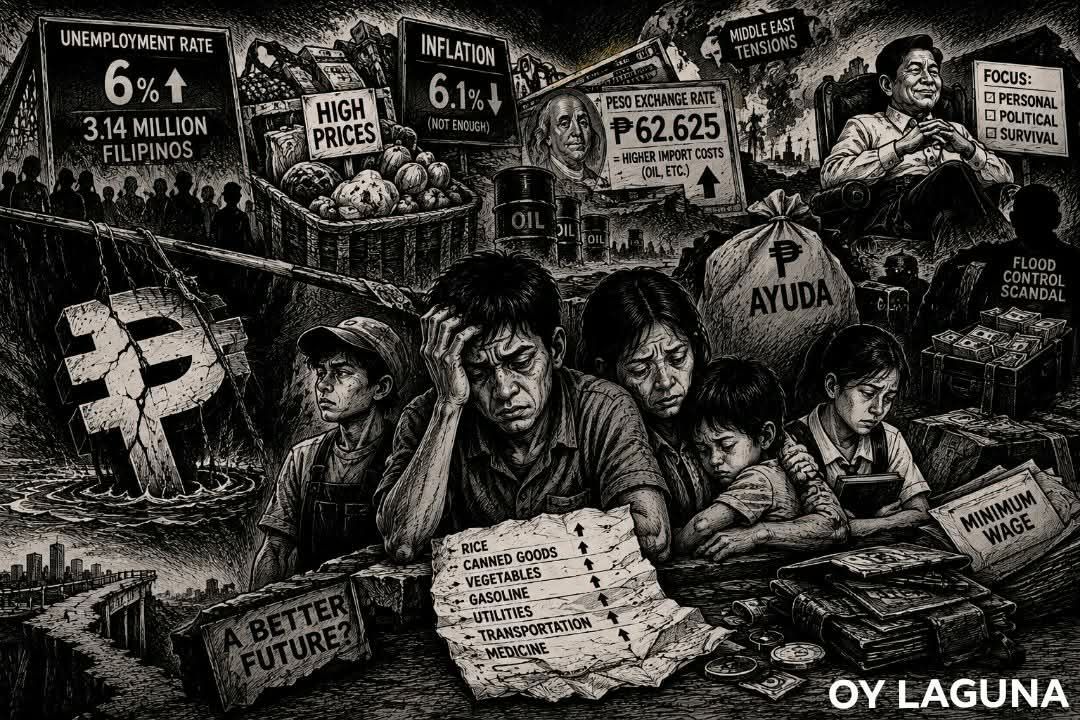

Never before has our economic outlook seemed bleak – except, perhaps, in the final years of the first Marcos administration.
Unemployment rate in the Philippines rose to 6 percent last July, compared to 4.9 percent last June. That translates to 3.14 million Filipinos who are unable to provide for their families.
And even those who are gainfully employed, particularly among those in the minimum-wage sector, making ends meet is a huge struggle.
Even as debate rages on the possibility of yet another wage hike, labor groups are convinced that whatever paltry wage hike the government approves won’t even cover their daily expenses.
Statisticians of the government claim that the country's headline inflation rate has eased further from 6.2 percent last July to 6.1 percent in August.
Yet that miniscule "improvement" hardly reflects the reality at the local market. Consumers still pay the price (literally and figuratively) of high costs of basic goods and commodities.
The peso further slid to another all-time low of P62.625 to the dollar last week. That translates to possibly even higher price hikes for imported commodities, particularly oil, exacerbated by the renewed tensions in the Middle East and an uncertain global and local political climate.
And what is the administration of President Ferdinand “Bongbong” Romualdez Marcos, Jr.’s response to the ongoing crisis?
Nothing except “ayuda,” short-term financial aid that are nothing more than dole-outs.
There has been no word from our so-called “economic experts” on how to arrest the downward spiral of our economy, much less on how to attract investors and livelihood for the millions who are waiting for a better future.
What else can we expect from a leadership that is apparently now too focused on personal and political survival – especially as its designated “scapegoat” is at risk of revealing who is the real mastermind of the robbery of trillions of pesos in flood-control money?
#OpinYonLaguna #Editorial #Economy